At Davos, a Speech on Sovereignty — and a 24-Hour Warning From Washington

Davos, Switzerland — January 2026
When Prime Minister Mark Carney stepped onto the stage at the World Economic Forum on Tuesday morning, few expected his speech to provoke an immediate response from the president of the United States — let alone one delivered by name, on camera, less than 24 hours later.
Yet that is exactly what happened.
Carney’s address, framed as a sober assessment of a global order under strain, quickly became something more consequential: a public declaration that Canada would no longer accept what he described as the “fiction” of partnership when integration had become a source of vulnerability and constraint. By Wednesday morning, President Donald Trump had answered directly, telling a global audience that Canada “lives because of the United States” and warning Carney to remember that fact “the next time you make your statements.”
The speed and tone of the exchange transformed a routine Davos speech into a defining moment in North American relations — and a vivid illustration of the pressures Canada says it is now refusing to accept.
“A Rupture, Not a Transition”
Carney’s speech was notable less for any single policy proposal than for its framing. “We are in the midst of a rupture, not a transition,” he said, arguing that the postwar rules-based international order was no longer eroding gradually but breaking outright. The assumption that smaller and middle powers could ensure stability by accommodating stronger states, he suggested, had become dangerously outdated.
In one of the most widely circulated passages — clipped and reposted thousands of times on X and LinkedIn by executives and diplomats — Carney invoked the Czech dissident Václav Havel’s idea of “living within a lie.” Havel used the metaphor of a shopkeeper displaying a political slogan he does not believe in order to avoid trouble. Carney applied the concept to international relations: a system sustained not by shared belief, but by ritualized compliance.
“Friends,” Carney said, pausing as cameras flashed, “it is time for companies and countries to take their signs down.”
The message was unmistakable. Canada, he argued, would no longer perform gratitude or acquiescence to preserve the appearance of mutual benefit when economic integration, security arrangements and supply chains were increasingly being used as tools of leverage.
Carney called for what he described as “middle power autonomy”: diversifying trade, building domestic resilience, and acting collectively with countries that lacked great-power dominance but bore the greatest risks from its abuses. He urged “variable geometry” — flexible coalitions across climate, technology, finance and security — and warned that in a world of “fortresses,” those not at the table would end up “on the menu.”
A Personal Rebuke
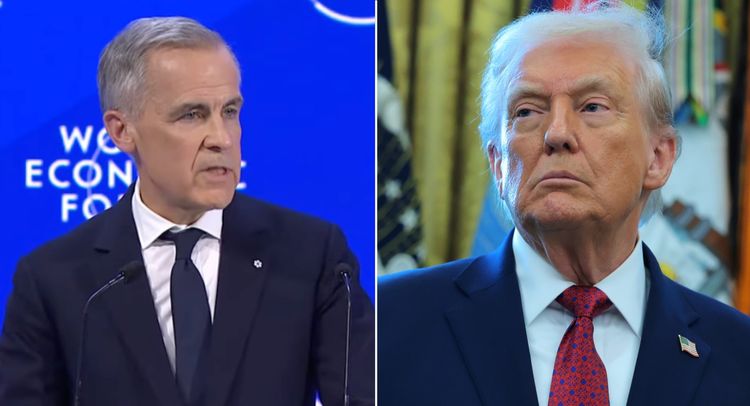
Trump’s response came swiftly.
Taking the stage at Davos on Wednesday, the president did not cloak his remarks in diplomatic language or indirect references. “I watched your prime minister yesterday,” he said. “He wasn’t so grateful. They should be grateful to the U.S., Canada. Canada lives because of the United States. Remember that, Mark, the next time you make your statements.”
The comments rippled instantly across American media and social platforms. On Truth Social, Trump allies framed the remarks as a necessary reminder of American generosity. On X, critics — including several former U.S. diplomats — noted that public admonitions of allied leaders by name were highly unusual, particularly at a forum designed to project stability to global markets.
What Trump objected to was not obscure. He cited Canada’s reliance on U.S. military protection, cooperation on continental defense, and proposed participation in the so-called “Golden Dome” missile defense system. These, he argued, were benefits for which Canada owed gratitude.
The subtext was sharper: security cooperation was not a shared arrangement among equals, but a favor — one that could be revoked or leveraged if Canada’s rhetoric strayed too far.
The Pressure Beneath the Partnership
For analysts, the exchange crystallized a tension that has been building for years.
Trump also pointed to tariffs as evidence of American strength, claiming that factories and auto plants were relocating from Canada and Mexico to the United States as a result of his trade policies. While some Canadian plants in Ontario have been idled, U.S. labor data shows no corresponding surge in American auto employment, complicating the president’s narrative. Still, the message was clear: economic pain inflicted on allies could be reframed as proof of American success.
This is precisely the dynamic Carney warned about. In his speech, he argued that integration had become a vector for coercion — through tariffs, supply chains, financial systems and standards — and that treating these arrangements as “gifts” requiring perpetual gratitude was the mechanism by which dependence is enforced.
Trump’s response made that mechanism explicit. Be grateful. Adjust your tone. Remember your place.
Why the Reaction Was So Fast
The timing may be the most revealing detail.
Great powers routinely ignore speeches by smaller states, especially those delivered at Davos, where lofty rhetoric is often discounted as performative. That Trump responded within a single business day — and at the same venue — suggests something deeper than irritation.
Carney did not merely announce a Canadian policy shift. He issued an invitation.
“The task of the middle powers,” he said, “is to stop pretending, to name reality, to build strength at home, and to act together.” The line was widely shared by leaders and commentators from Europe, Latin America and Southeast Asia, many of whom face similar pressures from larger powers.
For Washington, the risk is not Canada alone, but contagion: the possibility that other middle powers might follow suit, coordinating to reduce their exposure to unilateral pressure.
A Line Now Drawn
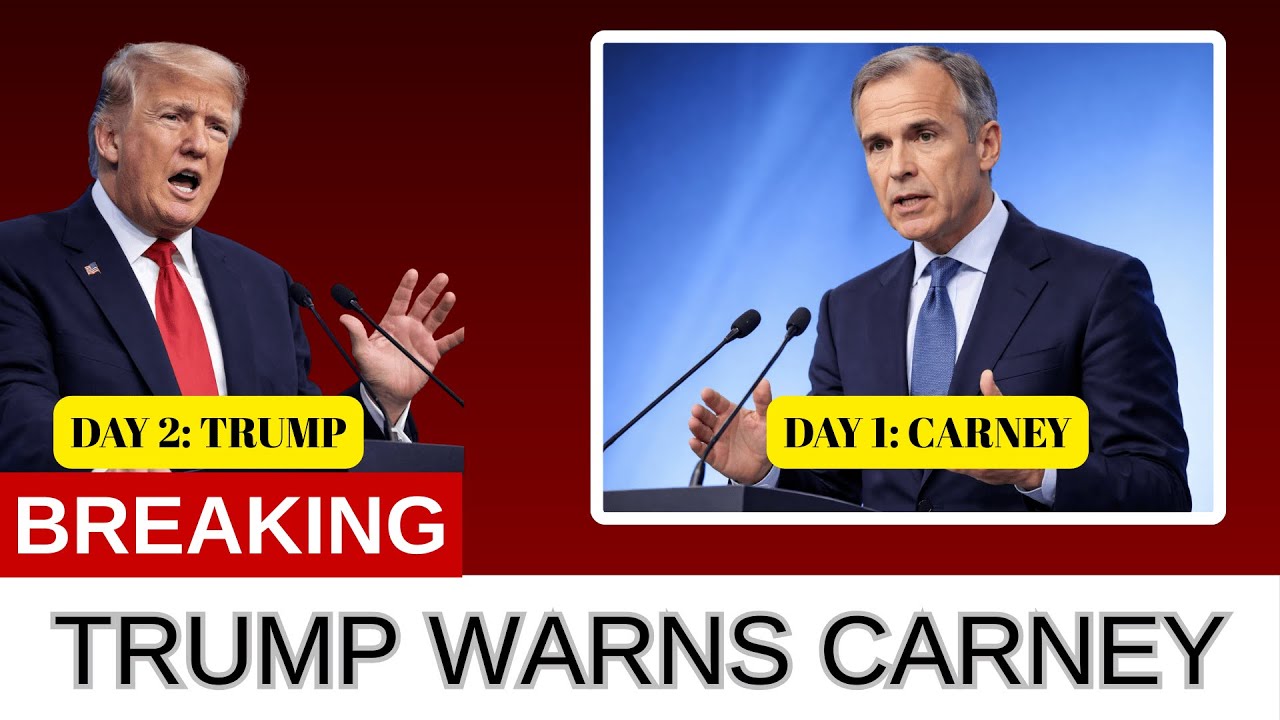
In that sense, Trump’s reaction did not undermine Carney’s argument. It validated it.
Carney articulated sovereignty. Trump demanded gratitude. Carney rejected subordination dressed as partnership. Trump asserted dominance openly. Both did so on camera, by name, before the world’s political and financial elite.
The old North American bargain relied on a shared pretense: that asymmetry could be ignored as long as cooperation appeared voluntary and beneficial. What unfolded in Davos suggests that pretense is no longer sustainable.
“This isn’t a diplomatic spat,” said one senior European official attending the forum, speaking on condition of anonymity. “It’s a clarification.”
Whether Canada can successfully build the alternatives Carney described — diversified trade, stronger domestic capacity, and effective middle-power coalitions — remains an open question. But one thing is now unmistakable.
The era of quiet accommodation is over. The pressures are explicit. And the choice Carney outlined — sovereignty through collective action, or dependence enforced through gratitude — is no longer theoretical.
It was played out, in real time, over 24 hours in Davos.






