How a European Coalition Outflanked Boeing and Shook America’s Grip on Airborne Surveillance
In the mid-2000s, executives inside Boeing’s airborne early warning and control (AWACS) division believed they were celebrating another inevitability. A Middle Eastern ally, long reliant on American military technology, was preparing to finalize a multibillion-dollar purchase of Boeing’s E-3 AWACS aircraft — a system that for decades had symbolized U.S. airpower dominance. Champagne waited on ice.
Then the phone rang.
According to former defense officials familiar with the episode, the message from Washington was blunt: the United Arab Emirates had canceled its order. Not delayed. Not renegotiated. Canceled. The contract, worth roughly $2 billion, had been awarded instead to a European-led consortium Boeing executives barely knew existed.
What followed would become one of the most consequential disruptions in modern defense procurement — and a case study in how American military monopolies can collapse when innovation stalls and competitors cooperate.
A Monopoly That Lasted Half a Century
For nearly 50 years, Boeing’s AWACS platform had no real competition. Built around a modified Boeing 707 airframe and crowned with a rotating radar dome, the E-3 Sentry served as the airborne command-and-control nerve center of modern warfare. It could track hundreds of targets, manage air campaigns across vast regions, and coordinate complex joint operations in real time.
Every military that could afford the capability bought American. NATO relied on it. Japan, Saudi Arabia, Britain, and France all followed suit. The alternatives simply did not exist.
That monopoly bred comfort — and eventually complacency. While the E-3’s radar and electronics were incrementally upgraded, the underlying platform remained rooted in 1970s design logic. Costs climbed relentlessly. By the early 2000s, a single AWACS aircraft could exceed $500 million, with operating expenses inflated by the aging 707 supply chain.
As defense analysts on platforms like War on the Rocks and Breaking Defense would later note, Boeing had little incentive to change. Foreign military sales were effectively guaranteed. Allies needed the capability. And Washington liked keeping critical surveillance systems firmly under American control.
The Swedish Disruption

The first crack in that dominance emerged quietly in Scandinavia.
Saab, Sweden’s aerospace and defense champion, had long specialized in advanced radar systems. Its Erieye radar — an active electronically scanned array (AESA) — offered key advantages over Boeing’s mechanically rotating dome: faster electronic scanning, fewer moving parts, greater reliability, and lower drag.
But Saab lacked a suitable aircraft. Its earlier airborne warning platforms, based on turboprops like the Saab 340, were effective for national defense but insufficient for global missions.
Instead of building a new aircraft, Saab looked abroad.
Canada’s Opening — and Britain’s Engine
The solution came from Montreal. Bombardier, the Canadian aerospace manufacturer, was struggling. Its business jet division faced fierce competition from Gulfstream and Dassault, while its CSeries commercial aircraft program was draining cash.
When Saab proposed militarizing Bombardier’s Global 6000 business jet, executives saw a lifeline. The aircraft offered intercontinental range, long endurance, ample cabin space for mission crews, and — critically — an existing production line.
Rolls-Royce soon completed the triangle. The British firm’s BR710 engines already powered Bombardier’s Global series, offering fuel efficiency ideal for long surveillance missions. For Rolls-Royce, sidelined for decades by American engine giants like GE and Pratt & Whitney, the program offered a rare chance to anchor a strategic military platform.
Three countries. Three companies. No American primes.
A System That Shouldn’t Have Worked — But Did
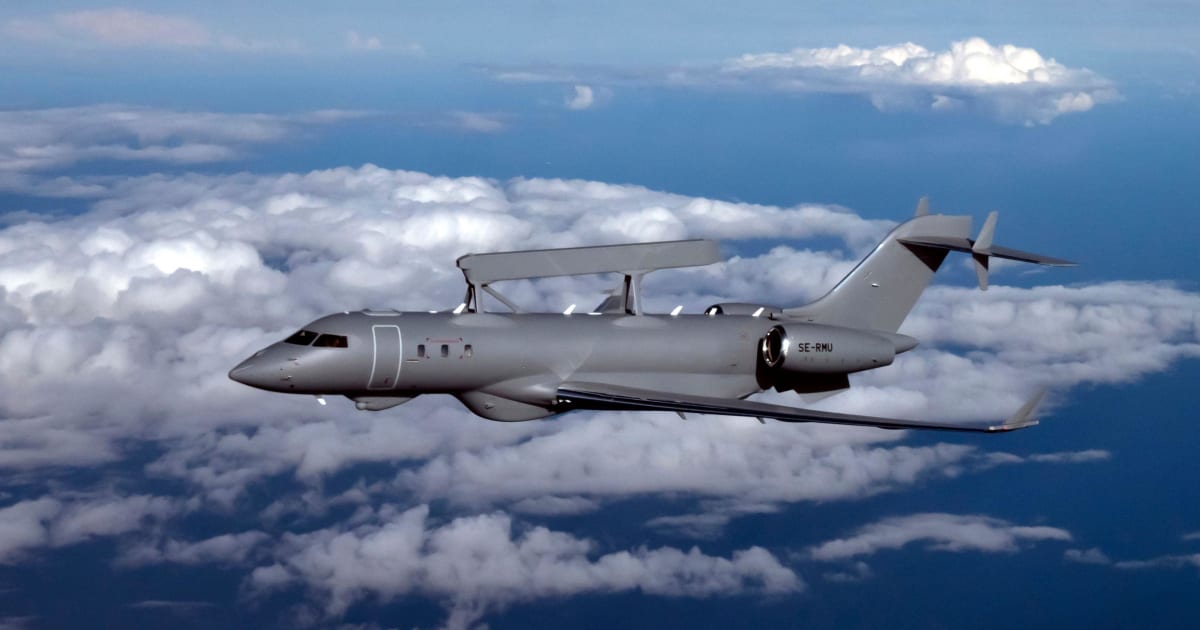
By 2018, the aircraft — now branded GlobalEye — was ready. Saab invited prospective buyers to demonstrations. What they saw, according to defense coverage on outlets like Defense News and The Drive, upended long-held assumptions.
GlobalEye could track more than 300 targets at ranges exceeding 200 nautical miles. Its AESA radar updated faster than legacy AWACS systems. Endurance exceeded 11 hours without refueling. And the price — between $200 million and $250 million per aircraft — was less than half of Boeing’s offering.
The math was brutal. For the cost of two AWACS aircraft, a country could buy four or five GlobalEyes, dramatically increasing coverage, redundancy, and training capacity.
The UAE’s Shock Decision
The United Arab Emirates moved first.
Despite its deep military ties with Washington — including fleets of F-16s, Patriot missile systems, and Apache helicopters — the UAE opted for the European system. Its initial order of two GlobalEye aircraft quickly expanded to five.
The decision stunned Boeing and alarmed Pentagon planners. As former U.S. defense officials later acknowledged in interviews cited by Politico and Foreign Policy, this was not just about losing a sale. It was about losing influence.
Airborne early warning platforms are the backbone of network-centric warfare. When allies operate American systems, interoperability is seamless — and U.S. commanders retain deep visibility into coalition operations. European alternatives complicate that picture.
A Strategic Wake-Up Call
The losses mounted. Sweden ordered GlobalEye. South Korea evaluated it seriously. Poland and Brazil expressed interest. Conservative estimates put Boeing’s lost contracts at more than $4 billion over a decade.
The Pentagon responded on multiple fronts. Boeing rushed modernization efforts. Northrop Grumman pushed its E-2D Hawkeye harder. Washington leaned on financing incentives, training packages, and diplomatic pressure emphasizing alliance interoperability.
But the underlying reality had changed.
As defense commentators across U.S. social media — from retired officers on X to analysts on Substack — increasingly observed, American defense dominance was no longer guaranteed by habit or politics alone. Allies were willing to shop. Technology had diffused. And cost mattered.
The Broader Lesson
GlobalEye’s success revealed a deeper shift in global defense markets. Monopolies, even American ones, can be broken. Coalition development models work. Mid-tier companies, when aligned, can outmaneuver giants grown comfortable.
For decades, the United States assumed control of critical military technologies was permanent. The GlobalEye story suggests otherwise.
It wasn’t sabotage. It wasn’t betrayal. It was competition — and a reminder that in a multipolar world, even the most entrenched dominance can evaporate when innovation stops.






