While Donald Trump was busy threatening fresh tariffs on Canada and joking—again—about turning America’s closest ally into the “51st state,” Canada was doing something far more consequential in Brussels: it was building an escape hatch.
On June 23, 2025, Prime Minister Mark Carney signed a sweeping defense-and-security pact with the European Union, positioning Canada for deeper cooperation on procurement, cyber and maritime security, and joint industrial planning. The agreement was notable not only for its scope but for its symbolism: it was the first such EU defense pact with a country in the Americas, negotiated at a moment when European capitals were openly questioning whether Washington could still be counted on as the backbone of NATO’s security guarantee.
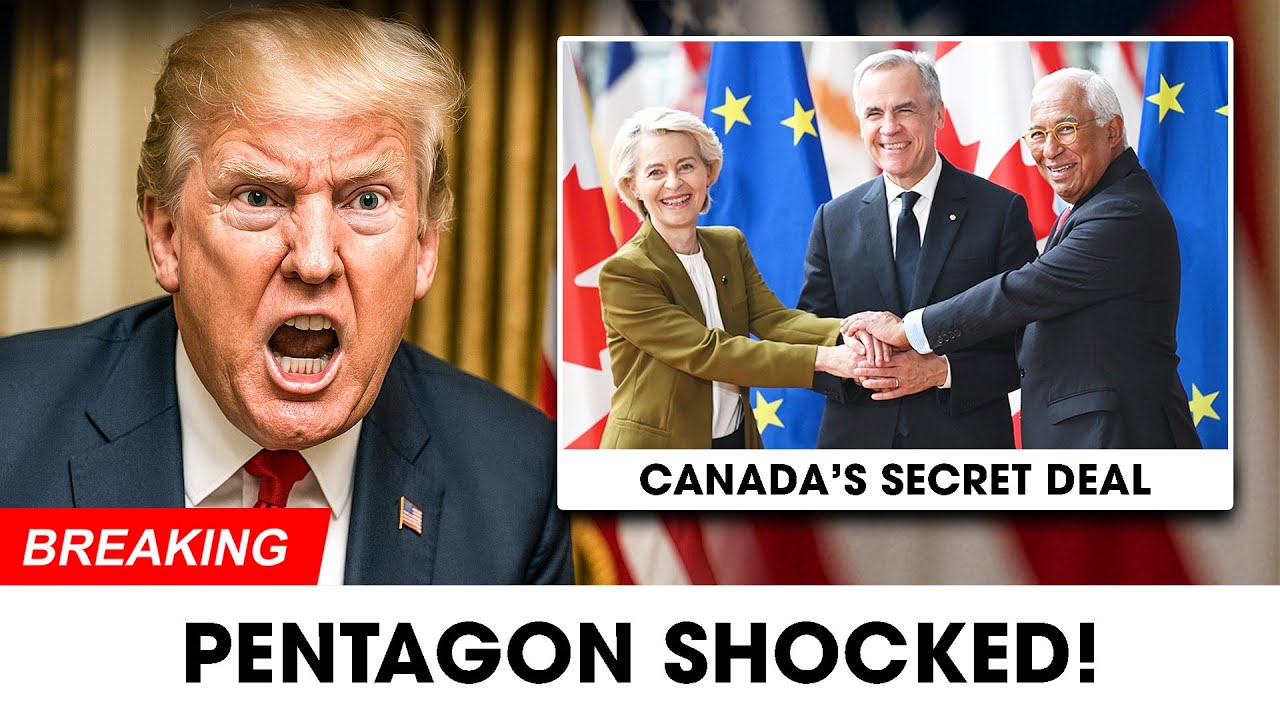
That June pact proved to be more than symbolism. In late 2025, Canada formally joined the European Union’s Security Action for Europe initiative—SAFE—becoming the first non-EU country to gain access to the bloc’s €150 billion defense financing framework. AP News+1 SAFE is designed as a major rearmament lever: EU-backed, low-interest loans to accelerate procurement and production of the kinds of systems Europe believes it needs on a faster timeline—missiles, ammunition, drones, air defense, and other modern capabilities—after Russia’s war in Ukraine and amid uncertainty about the durability of U.S. political commitments.
For Canada, entry into SAFE is a strategic pivot dressed as a procurement policy. Canadian defense spending has long been tethered to the United States—by geography, interoperability, and habit. Canadian leaders have acknowledged that more than 70% of Canadian military capital spending has flowed to American suppliers, leaving Ottawa exposed when political relations sour or when the U.S. uses trade measures as leverage. AP News Joining SAFE doesn’t sever the relationship; it gives Canada options. And options, in geopolitics, are power.
For Europe, Canada’s inclusion is a calculated signal as well: a quiet vote of confidence in a partner seen as stable, rules-oriented, and unlikely to weaponize tariffs as a routine negotiating tactic. The contrast with London is instructive. The United Kingdom—home to one of Europe’s largest defense industries—sought access to SAFE and failed, with talks collapsing over money and terms. Le Monde.fr If the EU can turn away Britain, it is plainly not treating SAFE as charity. It is treating it as industrial strategy.
The industrial implications are where this story stops being about diplomatic theater and becomes a matter of contracts, supply chains, and jobs. SAFE is built to prioritize “Made in Europe” production, even as it leaves limited room for non-EU components. Le Monde.fr Canada’s participation, in practical terms, means Canadian firms can bid into European procurement ecosystems that are poised to grow rapidly through the second half of this decade—often with financing that makes long-term production planning easier. AP News In an era when defense manufacturing capacity has become as important as defense budgets, that financing channel is not a footnote; it is the point.
For the United States, the discomfort is not that Canada is “switching sides.” It is that Canada is reducing Washington’s leverage at precisely the moment Trump is trying to increase it. A tariff threat works best when the targeted country lacks alternatives. SAFE, by design, creates alternatives. It is an insurance policy against the volatility of American domestic politics—and a hedge against the possibility that a future U.S. administration might again flirt with downgrading NATO commitments or treating allies as adversaries.
Canada’s move also lands in the middle of a broader reassessment in Ottawa about dependence on U.S. platforms. Carney’s government has signaled it is reconsidering plans to buy American F-35 fighter jets, with alternatives—including Sweden’s Saab Gripen—back on the table, partly due to promises of more local industrial participation. AP News That, too, is the logic of diversification: not anti-American, but less captive to a single supplier and a single political mood.
None of this guarantees smooth sailing. Europe’s defense bureaucracy is famously complex, and SAFE is a political project as much as a financial one. Canada will have to navigate EU priorities, national procurement politics, and the inevitable tug-of-war between “European champions” and new entrants. And there is the obvious risk: retaliation. Trump has shown he is willing to escalate trade fights quickly, even with close partners.
But Canada’s calculus appears to be that the bigger danger is dependence without recourse. SAFE gives Ottawa a second door out of the room—one it can open wider as needed. For a country that shares the world’s longest undefended border with a superpower increasingly comfortable with economic coercion, that may be the most important purchase Canada makes this decade: not a specific weapons system, but strategic autonomy in a shifting alliance landscape.






