💥 TRUMP RUSHES to FED COURT After JACK SMITH TESTIMONY — Emergency Filing Triggers Legal Scramble and a High-Stakes Showdown ⚡
WASHINGTON — The hours after Special Counsel Jack Smith concluded his long-anticipated testimony on Capitol Hill set off a familiar chain reaction: urgent filings, sealed arguments and a renewed clash over who controls the narrative of a dormant but unresolved federal investigation involving President Donald Trump.
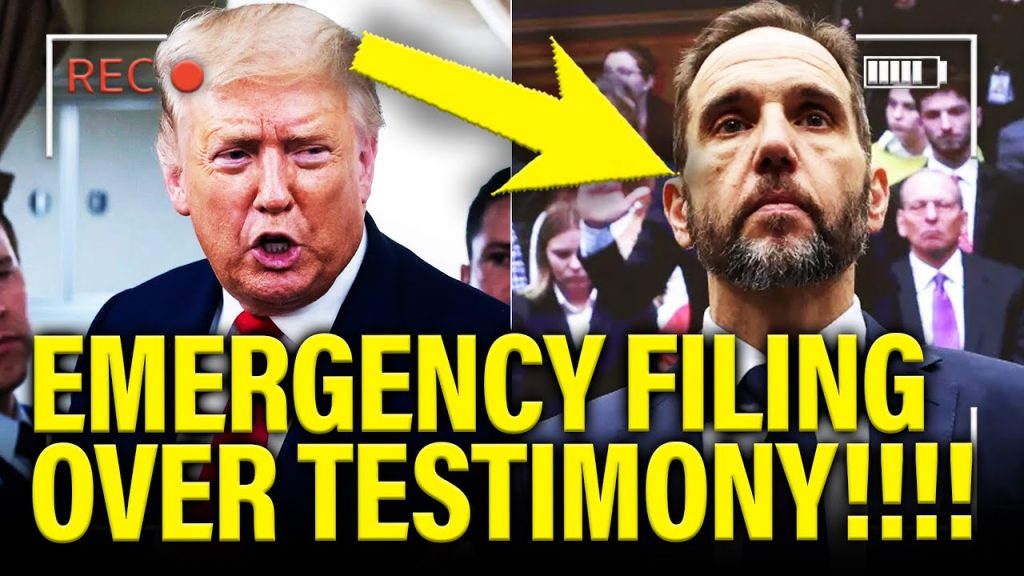
Mr. Smith appeared before lawmakers this week to discuss his work investigating the events surrounding Jan. 6. But the hearing’s most consequential moments came in what he did not say. Bound by court orders and Justice Department guidance, Mr. Smith declined to address the second volume of his final report, which concerns the handling of sensitive government records after Mr. Trump left office. Within hours, lawyers aligned with the former defendants moved swiftly in federal court, seeking to reinforce restrictions that would keep that material under seal.
At the center of the dispute is a question that has lingered since the underlying case was dismissed: whether the public is entitled to see the factual record assembled by a special counsel when criminal charges are no longer proceeding, or whether internal Justice Department deliberations may remain permanently hidden.
The fight now sits before Eileen Cannon, the federal judge who once presided over the records case and who has retained jurisdiction over related filings despite having dismissed the prosecution more than a year ago. Judge Cannon’s decisions — and delays — have drawn scrutiny from legal scholars and lawmakers alike, particularly after the United States Court of Appeals for the Eleventh Circuit recently pressed her to clarify the status of the sealed materials.
The Justice Department, led by Attorney General Pam Bondi, has taken an unusual position. In filings submitted after Mr. Smith’s testimony, department lawyers argued that Volume Two of the report constitutes internal, deliberative communications and should not be released outside the department. In effect, prosecutors have aligned themselves with the former defendants’ request to keep the report from public view — a stance that has fueled accusations from critics that the department is acting less like a neutral arbiter than a gatekeeper shielding sensitive findings.
Justice Department officials say the position reflects long-standing protections for grand jury material and internal prosecutorial deliberations. They argue that releasing such material could chill future investigations and undermine institutional norms, particularly when charges are no longer pending. The department also told the court it could not vouch for the adequacy of redactions proposed by Mr. Smith’s team, noting that current leadership was not involved in the investigation’s day-to-day work.
On Capitol Hill, the explanation has not satisfied Democrats. Jamie Raskin, the ranking member on the House Judiciary Committee, said after the hearing that lawmakers had been prevented from asking “the vast majority of questions” about the documents investigation. He and other Democrats signaled they would seek to recall Mr. Smith once the court resolves the sealing dispute.
“This is not an academic matter,” Mr. Raskin said during the hearing. “It goes to whether Congress — and the public — can understand what the government found.”
Legal analysts describe the moment as a procedural tangle with significant implications. Ordinarily, prosecutors advocate for disclosure of final reports once cases conclude, subject to narrow redactions. Here, the opposite is happening: the department is urging continued secrecy, and the defendants are no longer active parties in a live prosecution. That alignment raises thorny questions about standing — who, if anyone, can appeal an order keeping the report sealed if both sides before the trial court agree.
“It’s an unusual posture,” said a former federal prosecutor who requested anonymity to discuss internal dynamics. “If the government and the defendants are on the same side, the traditional adversarial process breaks down.”
The practical effect has been to freeze the report in place. Judge Cannon set a briefing schedule that extends into early 2026, after which she is expected to rule on whether the report may be released in whole or in part. Until then, Mr. Smith is barred from discussing any nonpublic details related to the documents inquiry — a restriction the department underscored by warning that unauthorized disclosures could expose him to prosecution.
Supporters of the department’s approach say critics are overlooking real constraints. Grand jury secrecy rules are strict, they note, and courts have long recognized a deliberative process privilege for prosecutors. From that perspective, the controversy is less about shielding facts than about preserving legal guardrails that apply regardless of the subject.
But opponents argue that the stakes are higher when the subject is a former president and current officeholder. They point to prior special counsel reports — including those by independent counsels in both Republican and Democratic administrations — that were released with extensive factual detail once cases concluded.
“What’s different here is not the law,” said a constitutional law professor at a major university. “It’s the willingness of the executive branch to keep the public from seeing the record, even when no trial will test it.”
Mr. Trump, for his part, has continued to denounce Mr. Smith and the investigation, calling it illegitimate and politically motivated. His allies have echoed those claims in court filings, arguing that the special counsel’s appointment was unlawful and that the investigation itself should never have occurred. The Justice Department’s brief adopted elements of that argument, asserting that the probe was flawed from its inception — language that critics say reads more like a defense memorandum than a neutral filing.
Whether the appeals court will eventually intervene remains unclear. The Eleventh Circuit could review Judge Cannon’s decision if an appeal is properly lodged, but identifying a party with standing to bring that appeal may prove difficult. Some legal scholars speculate that Congress could attempt to intervene or that a future administration could revisit the issue, though both paths would be untested.
For now, the result is a legal stalemate. Mr. Smith has testified, but not fully. Congress has asked questions, but not the ones it considers most urgent. And the public remains in the dark about a set of findings that, by all accounts, detail a significant chapter in the post-presidential handling of government records.
As the filings accumulate and deadlines slip, the broader question persists: in a system built on transparency and adversarial testing, what happens when secrecy becomes the default — and when the institutions designed to reveal the truth find themselves aligned against disclosure?
The answer may not come quickly. But the scramble that followed Mr. Smith’s testimony suggests that, even without a courtroom trial, the battle over what Americans are allowed to know is far from over.






