A Viral “Birth Certificate” Claim Tests the Boundaries of Politics, Platforms and Proof
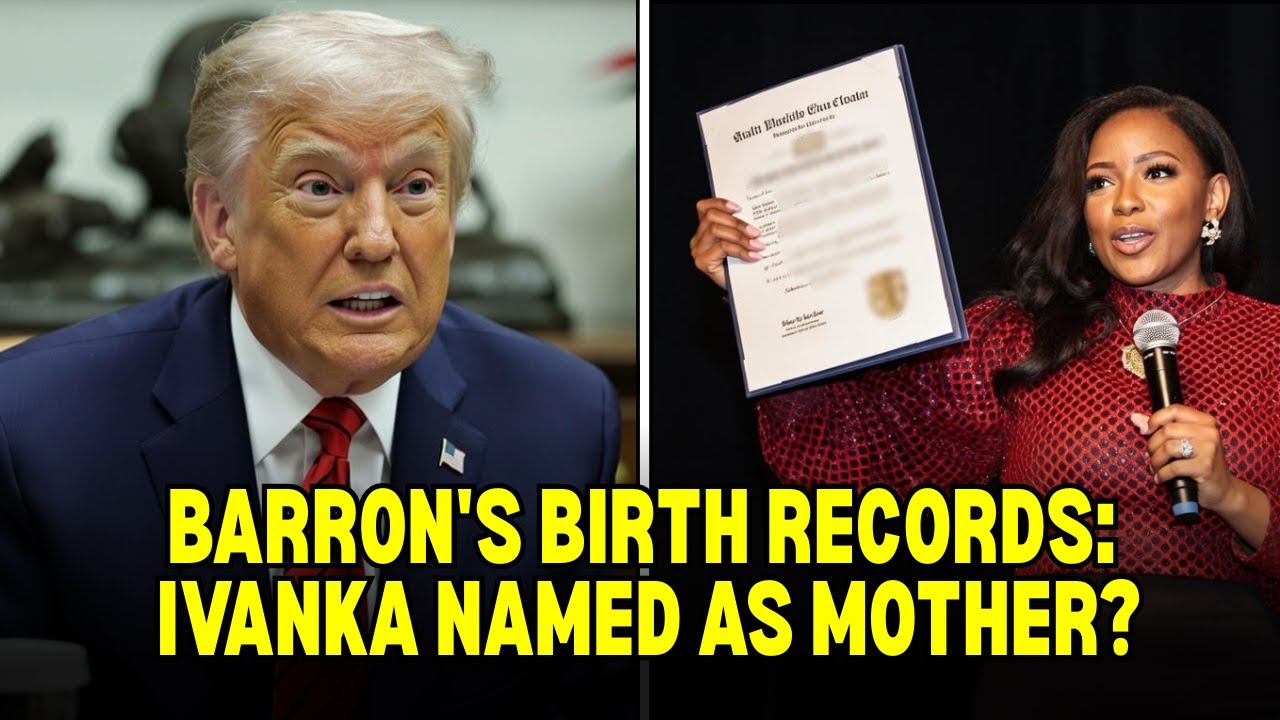
A familiar script has been playing out across American social media: a dramatic confrontation, a seemingly definitive document, and a demand that a powerful figure answer for a deeply personal allegation. The latest iteration centers on a claim that a birth certificate for Barron Trump lists Ivanka Trump as the child’s mother—a story framed online as a moment of accountability that “documents” and “experts” have supposedly validated.
There is no credible public evidence that this is true.
The claim has not been substantiated by any major news organization, and the documents circulating online—where they appear at all—are typically presented as screenshots, cropped images, or “leaked” PDFs without verifiable provenance. As with many viral political rumors, the narrative is engineered to feel conclusive while remaining difficult to fact-check in the ordinary course of reporting.
“This is the anatomy of modern misinformation,” said one media researcher who studies political rumor ecosystems: a story that is emotionally charged, easily shareable, and constructed to mimic the visual language of proof.
A Pattern With a Paper Trail — Just Not the One Claimed
This is not the first time Barron Trump and Rep. Jasmine Crockett have appeared in viral storylines that collapsed under scrutiny.
In May 2025, Snopes investigated a widely shared rumor that Barron Trump had “debated” Rep. Crockett on live television. Snopes found that AI-generated videos helped fuel the claim and that no legitimate broadcast supported it. Snopes later published a broader compilation of recurring Barron Trump rumors, describing how false narratives reappear in new forms—often with recycled imagery, fabricated quotes, or staged “broadcast” framing.
Reuters has also repeatedly fact-checked claims attributed to Barron Trump that originated from unaffiliated social media accounts—an indication of how frequently his name is used as a vessel for viral content. In one 2024 fact check, Reuters reported that a purported Barron Trump statement circulating on X was not from an official account, and a spokesperson said he made no such comment. Reuters published a similar 2025 fact check on a fake post attributed to Barron Trump.
The “birth certificate” narrative fits this established pattern: a high-stakes allegation packaged with the aesthetics of documentation—scans, seals, “expert analysis”—but without the underlying chain of verification that credible newsrooms require.
Why These Claims Spread So Fast
The rumors thrive because they sit at the intersection of three powerful forces: politics, family, and spectacle.
Family narratives are emotionally sticky. They create the illusion of intimacy—inviting the public to feel they are peering behind the curtain of power. When those narratives involve taboo or betrayal, they spread even faster, precisely because audiences sense that “you’re not supposed to talk about it.”
Add to that the architecture of social media. Platforms reward engagement, and engagement is driven by content that triggers anger, shock, or moral judgment. A claim involving a birth record is especially viral because it suggests bureaucratic finality. It implies that the truth is already written down, already “official,” already discoverable—if only someone brave enough will reveal it.
That is why these posts often include cinematic language: “the room went silent,” “documents surfaced,” “experts confirmed.” It’s storytelling designed to short-circuit skepticism.

The Documentation Trap
In journalism, a document is not proof simply because it exists. Reporters ask: Who obtained it? From where? Can the issuing agency confirm it? Is there an unbroken chain of custody? Are there independent corroborations?
Viral content rarely provides any of this. Instead, it offers the appearance of authority—cropped forms, stamps, signatures—while discouraging the basic questions that would verify authenticity.
Even when “experts” are invoked, they are often unnamed or unverifiable. Viewers are told “handwriting analysts” or “document authenticators” examined something, without a methodology, without credentials, and without contact information. It is an argument from authority, with the authority missing.
A Risk of Real Harm — Especially With a Minor
There is another reason mainstream outlets typically avoid repeating this class of allegation: it targets a young person who is not a public official. Even in highly politicized environments, American journalistic norms generally apply heightened caution to minors.
Sensational claims about parentage are not just gossip; they can function as harassment, inviting strangers to litigate a child’s identity for clicks. They also create a permanent digital record, one that follows the subject regardless of the claim’s veracity.
That risk is not theoretical. Fact-checkers have documented years of rumor cycles around Barron Trump. The recurrence suggests not a one-off misunderstanding but a sustained genre of content in which “proof” is routinely fabricated or misrepresented.

The “Accountability” Aesthetic
Many posts frame the story as a moral tale: an elected official “holding power to account.” The rhetoric borrows from legitimate democratic impulses—transparency, integrity, truth—while attaching those values to unverified claims.
This strategy is effective because it recruits audiences who care about accountability. The viewer is encouraged to see themselves as a responsible citizen simply by watching, sharing, or commenting. In the language of social media, engagement becomes a substitute for verification.
What a Responsible Newsroom Would Do
A New York Times–style article about this would not declare the claim true or false based on a screenshot. It would attempt to confirm the underlying factual premise through on-the-record sources and official documentation. If such confirmation cannot be obtained, it would report that the claim is unsubstantiated and describe the broader context: how such rumors spread, who amplifies them, and what prior fact checks show about related narratives.
In this case, the relevant context is clear: credible fact-checkers have already found that AI-generated videos and fabricated posts have fueled false Barron Trump narratives in the past, including content linked to Jasmine Crockett. Reuters has also documented repeated use of fake posts attributed to Barron Trump.
The Real Story
The most important question is not whether a viral “birth certificate” graphic can rack up millions of views. It can. The question is what happens when audiences start treating viral documentation aesthetics as a replacement for proof.
In an era when AI tools can generate convincing “official” documents and realistic broadcast-style videos, skepticism is no longer cynicism—it is a civic necessity. The burden of proof cannot be outsourced to a screenshot.
And that may be the deeper lesson behind the rumor’s popularity: in a fractured media environment, people are hungry for certainty. Rumors promise it instantly. Journalism earns it slowly.






