Trump’s New York Fraud Judgment Leaves His Empire Exposed — and the Clock Is Ticking
NEW YORK — For years, Donald J. Trump built his public identity on a single, immovable claim: that his wealth was vast, liquid and untouchable. This winter, that image collided head-on with a very old and very ordinary feature of the American legal system — judgment enforcement.
After a New York judge found that Mr. Trump and the Trump Organization had engaged in persistent financial fraud, state authorities now hold the legal power to seize his properties if he cannot pay a civil penalty that has swelled to roughly $454 million with interest. For the moment, that outcome has been delayed by an appeal and a court-approved bond. But the underlying threat has not disappeared. It has merely been paused.
At the center of the case is a ruling by Arthur Engoron, who concluded that Mr. Trump had for years exaggerated the value of his real estate to obtain favorable loans and insurance terms. The conduct, the judge wrote, was not accidental or isolated but systematic, producing financial advantages to which Mr. Trump was not entitled.
The penalty was severe: approximately $355 million in disgorgement, plus statutory interest accruing at nine percent annually. That interest has pushed the total liability close to half a billion dollars — a sum large enough to imperil even a sprawling real estate portfolio.
New York’s attorney general, Letitia James, has been unusually direct about what would happen if Mr. Trump cannot pay. In public remarks, she said her office would seek “judgment enforcement mechanisms,” including asking a court to seize assets. She even named potential targets, noting that she looks every day at 40 Wall Street, a 72-story skyscraper owned by Mr. Trump in Lower Manhattan.
Those statements were not rhetorical flourishes. They were paired with concrete legal steps. In March 2024, Ms. James’s office formally registered the fraud judgment in Westchester County, where Mr. Trump owns the Seven Springs estate and a golf club. Under New York law, registering a judgment in a county allows the creditor — in this case, the state — to pursue liens and enforcement actions against property located there.
The move was widely interpreted by legal analysts as preparatory. If payment did not materialize, the path forward would be straightforward: liens, writs of execution and, ultimately, law enforcement officers authorized to levy and sell property to satisfy the debt.
That scenario, however dramatic it may sound, is routine in civil litigation. What makes this case extraordinary is the identity of the debtor — a sitting president and former real estate magnate who has long claimed near-limitless resources.
Mr. Trump temporarily avoided that fate by securing a reprieve from a New York appeals court, which agreed to pause enforcement if he posted a $175 million bond. He did so within the required window, using a specialty insurer to back the guarantee. With the bond in place, the state is barred from seizing assets while the appeal proceeds.
But the bond is not payment. It is insurance.

If Mr. Trump loses on appeal, he will still owe the full judgment, plus additional interest accumulated during the delay. If he cannot pay at that point, the enforcement machinery will restart, and the state will not need to invent new authority. It already has it.
The ruling also imposed nonfinancial penalties that cut at the core of Mr. Trump’s business operations. He was barred for several years from serving as an officer or director of any New York company, and similar restrictions were imposed on his sons. The Trump Organization faces limitations on its ability to secure loans and conduct business in the state — constraints that could complicate efforts to raise cash quickly.
The pressure does not exist in isolation. Mr. Trump also faces substantial liabilities from other civil judgments, including damages owed to E. Jean Carroll, as well as mounting legal fees from multiple ongoing cases. Each obligation draws from the same finite pool of liquid assets.
Taken together, the financial picture is markedly different from the one Mr. Trump has long presented. While his wealth is largely tied up in real estate, civil judgments demand cash — or assets that can be converted into it, often at distressed prices.
That tension has transformed what was once a theoretical question — could a former president really lose his buildings? — into a live one. The answer, legally speaking, is yes. The law does not carve out exceptions for political stature or branding prowess.
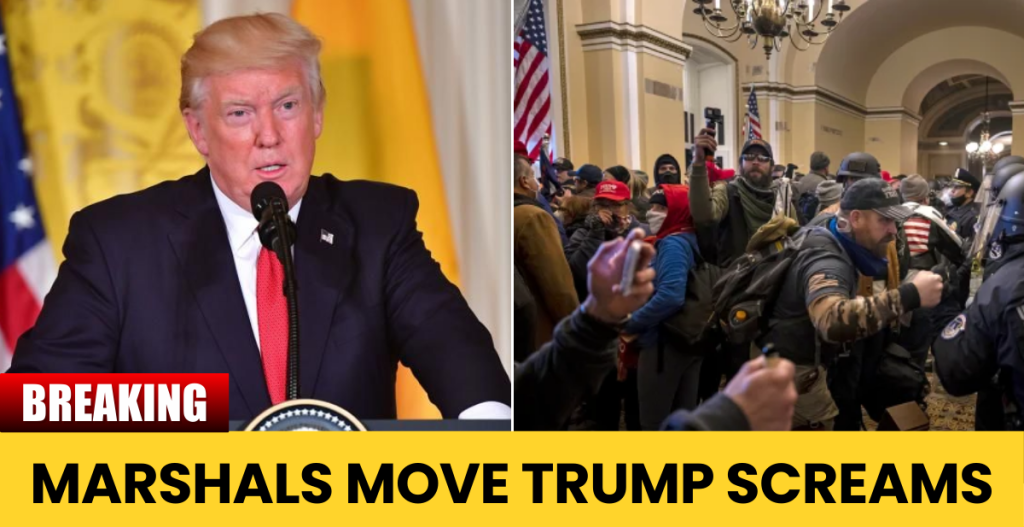
What has not happened is equally important. No federal marshals have padlocked Trump Tower. No state officials have arrived with eviction notices. The sensational images circulating online remain hypothetical. But the legal infrastructure required for such action has been assembled, tested and publicly acknowledged.
For Mr. Trump, the appeal represents more than a legal maneuver. It is time bought at great cost, with no guarantee of success. Every month that passes adds interest to the judgment and uncertainty to his finances.
For New York, the case has become a demonstration of principle: that civil fraud laws apply even at the highest levels of wealth and power, and that enforcement does not end with a courtroom verdict.

The confrontation between those two realities — a man who built his persona on invincibility, and a legal system designed to be relentlessly procedural — is still unfolding. But one fact is already clear. The question is no longer whether Donald Trump could face the seizure of his properties. It is how close that possibility now sits, and how much room remains for him to maneuver before the clock runs out.






