For years, Donald Trump has treated intelligence as both shield and weapon. He boasts about his IQ, describes his brain as “a machine,” and repeats the phrase “stable genius” with such insistence that it has become inseparable from his public persona. That bravado has long been fertile ground for late-night comedy, particularly on The Late Show with Stephen Colbert, where exaggeration and irony are tools of critique.
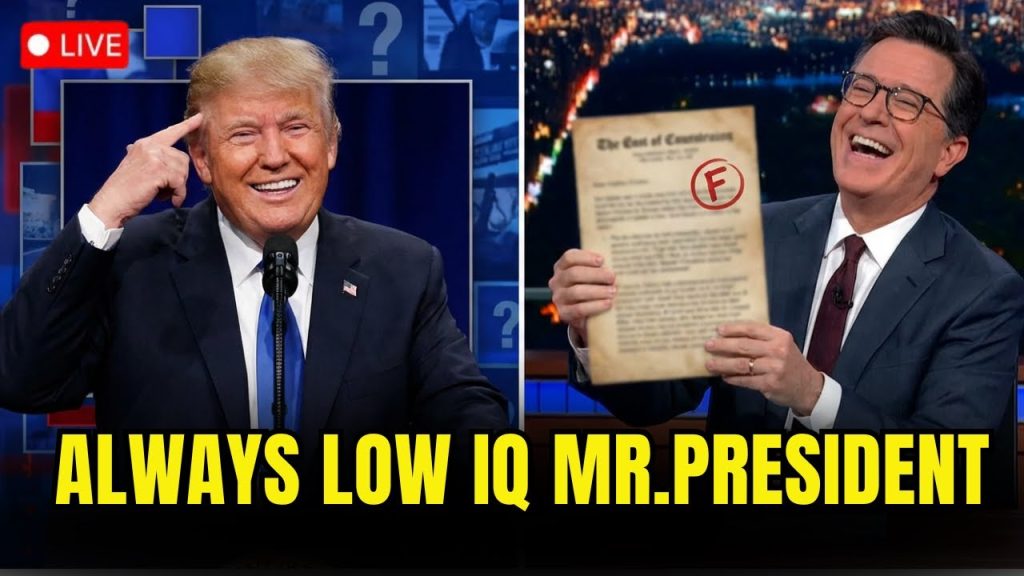
That context helps explain why a recent viral video—headlined as Stephen Colbert pulling out Trump’s “real report card” and laughing—spread so quickly. The clip promises a decisive moment: bragging meets evidence, confidence meets collapse. It looks like accountability rendered in paper and ink.
It is also entirely fictional.
No such report card was produced on Mr. Colbert’s show. There was no late-night segment in which authenticated cognitive assessments or academic grades were revealed. The “worksheet,” the misspelled answers, the red “FAILED” stamp—these are narrative devices, not documents. They belong to satire written in the language of exposé.
The video’s power lies in how carefully it mimics the grammar of credibility. Mr. Colbert’s real monologues often pivot from humor to seriousness; props are common; pauses are deliberate. The viral narration borrows those habits and layers them onto invented material. The audience laughter, the solemn turn, the montage of alleged physical decline—all are edited to imply verification where none exists.
This technique has become increasingly familiar. Fabricated late-night moments are framed as calm, devastating reveals rather than jokes, because calmness reads as truth. A fictional prop reads as a receipt. And a host known for satire lends borrowed authority to claims that would otherwise demand sourcing.
The subject matter—cognitive decline and intelligence—adds to the clip’s traction. These are sensitive questions that hover around modern politics but are rarely resolved by evidence available to the public. That ambiguity creates a vacuum. Fiction rushes in to fill it.

To be clear, Mr. Trump’s habit of boasting about intelligence is real. So is his refusal to release academic records or detailed medical documentation. Mr. Colbert has mocked those habits repeatedly, often by highlighting contradictions in Mr. Trump’s own words. Those segments work because they rely on what is verifiable: speeches, interviews, public statements. The viral video replaces that method with invention.
The distinction matters. Satire traditionally signals its exaggeration; journalism grounds itself in fact. The clip erases the boundary. Viewers are invited to feel as though they have watched a revelation rather than a parody, and the emotional satisfaction of that feeling encourages sharing before skepticism has time to intervene.
There is also an unintended irony. Mr. Trump’s critics frequently warn that spectacle overwhelms substance, that performance substitutes for proof. A fictional “report card” delivered as evidence risks replicating the same dynamic—valuing the image of exposure over the discipline of verification.
Nothing in the public record shows a late-night host unveiling Trump’s cognitive test results. What does exist is a long-running cultural exchange: a former president who equates confidence with intelligence, and a comedian who uses satire to puncture that equation. The real critique is linguistic and behavioral, not documentary.
The viral clip offers something neater than reality: a single sheet of paper that ends the argument. Reality is messier. It relies on patterns, contradictions, and accountability that accumulates over time. That kind of reckoning rarely fits in a folder, however thin.

The laughter in the video feels decisive. It is also a reminder of how easily authority can be staged. When satire is dressed as evidence, it may travel faster—but it leaves audiences less certain of where comedy ends and fact begins.






