When Claims of Intelligence Become a Brand—and Comedy Asks for Proof
For decades, Donald Trump has treated intelligence not simply as a personal trait, but as a central pillar of his public identity. He has repeatedly described himself as a “very stable genius,” dismissed critics as “low IQ,” and portrayed elite academic institutions—particularly Ivy League universities—as overrated factories of incompetence. Intelligence, in this framing, becomes less a measurable quality than a rhetorical weapon.
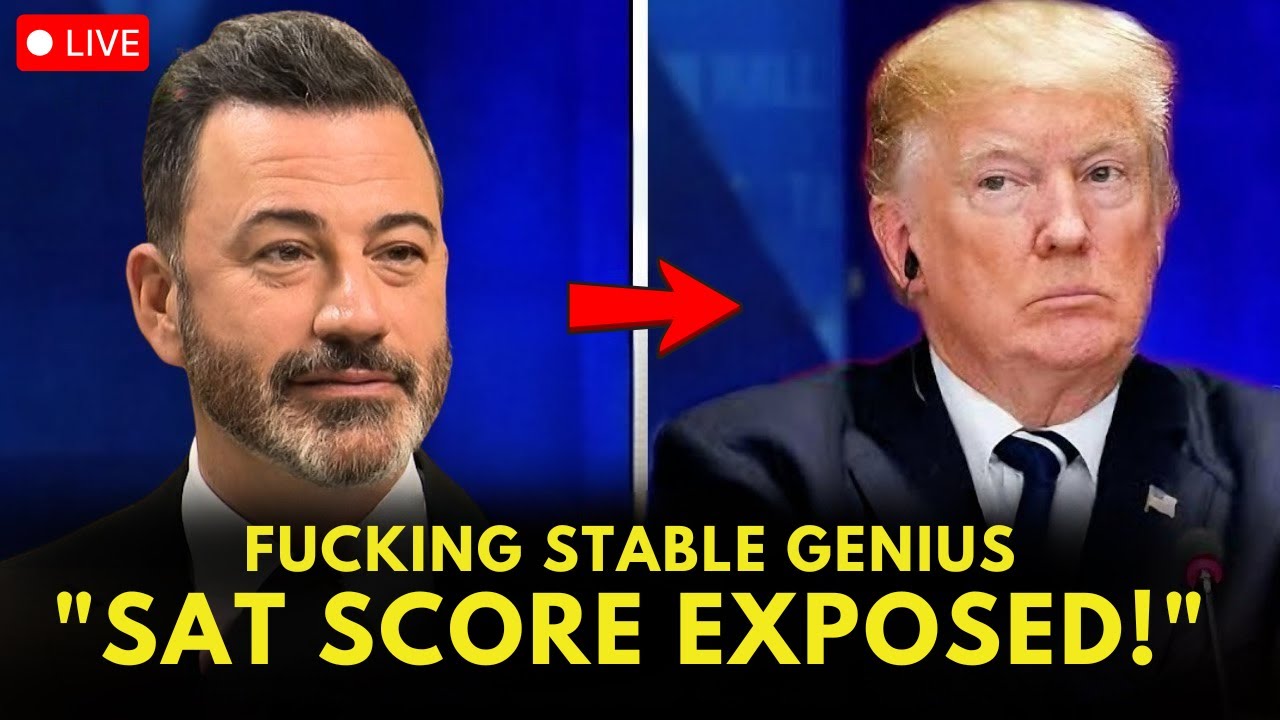
That weapon was on display again recently, when Mr. Trump mocked highly educated critics and derided Ivy League graduates as foolish. On Jimmy Kimmel Live!, Jimmy Kimmel responded not with counterinsults, but with a carefully structured piece of satire that examined how fragile such claims can become when treated as evidence rather than branding.
Mr. Kimmel opened his monologue by revisiting a familiar pattern: Mr. Trump’s tendency to question the intelligence of others while shielding his own academic record from scrutiny. Rather than asserting new facts, Mr. Kimmel framed the segment as a thought experiment. What happens, he asked, when someone who weaponizes intelligence is subjected to the same transparency he demands from others?
The answer unfolded through props, pacing, and restraint. Holding up a mock archival folder, Mr. Kimmel made explicit that the documents were satirical—not real disclosures—carefully underlining the point that this was commentary, not accusation. The numbers he read aloud were deliberately ordinary, the kind that fall squarely in the middle of standardized distributions. The audience reaction shifted accordingly: laughter gave way to quiet recognition.
The effectiveness of the segment lay in what it refused to do. Mr. Kimmel did not argue that Mr. Trump lacked intelligence, nor did he suggest that academic scores define human worth. Instead, he focused on consistency. A person can be successful, capable, and influential without being the hyperbolic genius they claim to be. The problem, he implied, arises when exaggerated self-mythology is used to demean others.
The satire extended beyond scores to privilege itself. A mock admissions memo—again clearly labeled as parody—highlighted the role of connections, legacy, and influence in elite education. The point was familiar to many Americans: access and opportunity often matter as much as aptitude. By emphasizing systems rather than individuals, the segment widened its lens from one man to a broader cultural fixation on credentials and status.
When a parody “live call” erupted into shouted denials and legal threats, Mr. Kimmel’s response was notably subdued. “If the record is wrong, correct it,” he said. “If it’s right, explain it. Either way, screaming isn’t evidence.” The line drew applause precisely because it avoided escalation.
In the days that followed, reactions fell along predictable lines. Supporters accused Mr. Kimmel of disrespect. Critics praised the segment as fair commentary. Clips circulated widely, replayed not for shock value but for tone—the pause before the numbers, the refusal to gloat, the calm insistence on accountability.
What the moment ultimately exposed was not an academic record, real or imagined, but a behavioral contrast. Confidence rarely needs repetition, and intelligence seldom announces itself. In a media environment driven by volume and outrage, the segment’s quiet challenge carried unusual force: if intelligence is used as a public cudgel, it becomes subject to public questions. And sometimes, asking for evidence is enough to make a myth wobble.






