🔥 BREAKING: COLBERT TURNS ONE TRUMP MOMENT INTO A FULL TAKEDOWN — LATE-NIGHT MELTDOWN SENDS STUDIO INTO TOTAL CHAOS ⚡
Most political comedy depends on speed. A joke lands, the news cycle moves on, and the punchline is quickly replaced by the next outrage. Stephen Colbert, however, built a different model during the Trump years — one that relied less on novelty than on repetition, memory and strategic persistence. Rather than chasing every headline, Colbert learned how to extract extraordinary mileage from a single presidential moment, transforming it into a lasting cultural reference point.
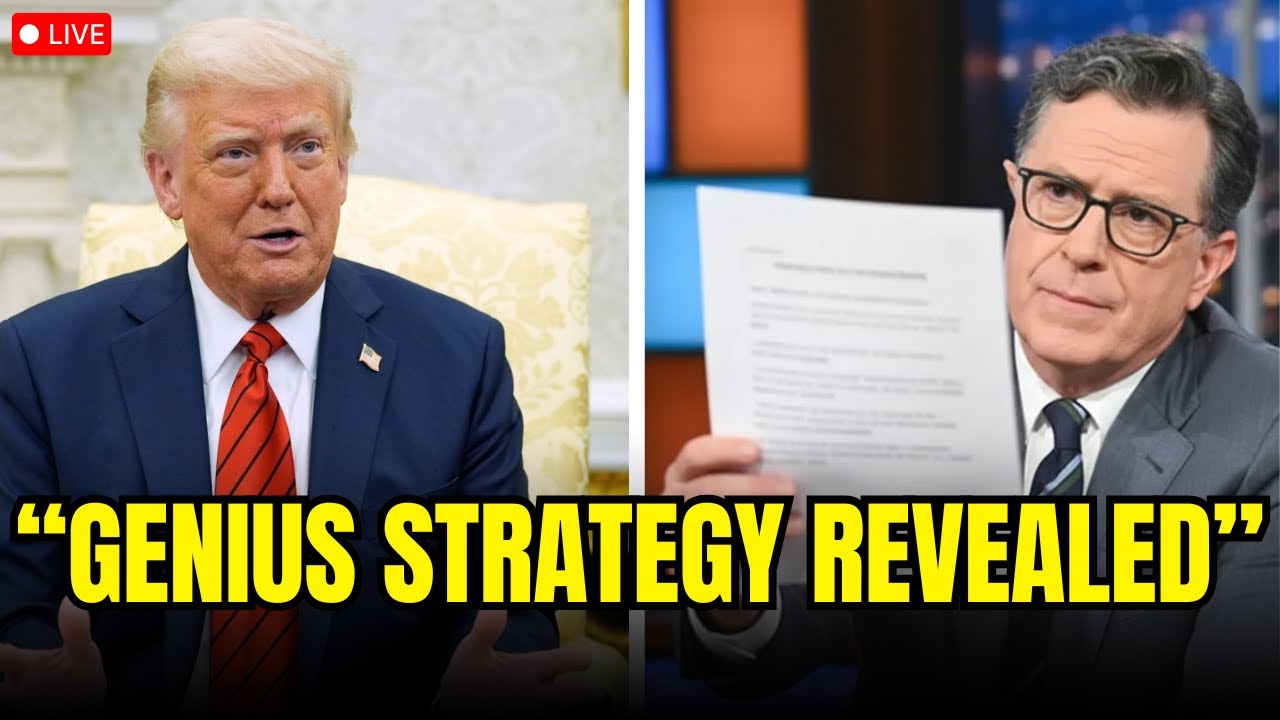
The method was deceptively simple. Donald J. Trump would say or post something unusual — a tweet, a boast, a self-description — and most late-night hosts would respond once, perhaps twice, before moving on. Colbert did the opposite. He stayed. He returned to the same phrase night after night, rotating angles, deepening the analysis, and gradually redefining the moment until it no longer belonged to Trump at all.
The clearest early example came on May 31, 2017, when Trump posted his now-infamous midnight tweet: “Despite the constant negative press covfefe.” The message was deleted hours later, but screenshots ensured it could never fully disappear. Other comedians made their jokes and pivoted. Colbert devoted an entire segment to it, probing its pronunciation, inventing theories, and dissecting its absurdity.
Then he came back the next night. And the next.
When the White House press secretary suggested the word was intentional, Colbert seized on the explanation as fresh fuel. What might have been a one-day punchline became a week-long exercise in ridicule, capped by the transformation of “covfefe” from a typo into a symbol of confusion and denial. By the time the segment cycle ended, the word no longer required explanation. It had been permanently reframed through Colbert’s lens.
That pattern repeated itself throughout Trump’s presidency. In January 2018, Trump declared himself a “very stable genius.” Colbert immediately recognized the phrase as a gift that would keep giving. The first night brought straightforward mockery. Subsequent nights unpacked the psychology of self-declared genius, compared Trump’s claim to historical figures who had announced their own brilliance, and embedded the phrase into a running narrative.
“Stable genius” stopped being a quote and became a shorthand. Whenever Trump later acted impulsively or contradicted himself, Colbert needed only to invoke the phrase to trigger recognition and laughter. The setup had already been done weeks earlier. The joke was preloaded.
The approach reached its most refined form in July 2020, when Trump publicly bragged about acing a cognitive assessment, proudly reciting the words: “Person. Woman. Man. Camera. TV.” Once again, Colbert resisted the temptation to burn the joke in a single night. Instead, he structured an extended arc. One night featured disbelief. Another involved administering the test to his own staff. Another broke down what the test actually measured and why Trump’s performance was not remarkable.
:max_bytes(150000):strip_icc()/stephen-colbert-donald-trump-071825-1-4d6ec25df5ec4d33a18dbe8c518951cc.jpg)
Graphics appeared. Props followed. The phrase became merchandise-adjacent shorthand. For weeks afterward, any Trump claim to intellectual superiority was met with those five words, now permanently divorced from their original intent. Trump had offered them as proof of competence. Colbert repurposed them as evidence of insecurity.
What made this technique effective was not just repetition, but exhaustion. Colbert explored every angle until nothing remained unexplored. By the time he was finished, the original moment had been fully defined by comedy. Trump’s own framing was no longer accessible. His words had been repossessed.
The strategy also exploited a deeper asymmetry. Trump thrived on immediacy, outrage and control of the narrative. Colbert thrived on memory. Trump wanted moments to pass. Colbert made them immortal. Each attempt by Trump to lash out — calling the show boring, untalented or unwatchable — only confirmed that the approach was working. Anger became another renewable resource.
While other comedians scrambled nightly for new material, Colbert built what amounted to a comedy infrastructure. One tweet could support a week of programming. One boast could sustain callbacks for years. The audience, rather than tiring of the repetition, learned to anticipate it. Recognition itself became part of the joke.
This was not merely mockery for mockery’s sake. It was a form of narrative discipline. Colbert imposed continuity on a political figure who often relied on contradiction and volume. By refusing to let moments fade, he created accountability through humor, ensuring that past statements followed Trump into the present.
In the end, Colbert did not need Trump to speak often. He needed him to speak once. Trump supplied the raw material. Colbert did the construction. And in that process, fleeting remarks were turned into lasting cultural artifacts — a reminder that in the age of short attention spans, repetition, wielded carefully, can be a powerful form of resistance.






