The Epstein Question Trump Doesn’t Want to Answer

For years, President Donald J. Trump has dismissed questions about his relationship with Jeffrey Epstein as a distraction—tabloid fodder unworthy of serious attention. “I wasn’t a fan,” Trump has said. “I barely knew him.” The implication was clear: whatever Epstein became, Trump was never truly part of that world.
But the public record tells a more complicated story—one preserved not by rumor or anonymous sources, but by photographs, archived interviews, and Trump’s own words.
Jeffrey Epstein, the disgraced financier who died in federal custody in August 2019 while awaiting trial on sex-trafficking charges, moved for decades within elite social circles. His connections spanned Wall Street, academia, politics, and royalty. The mystery surrounding his death—ruled a suicide but shadowed by failures in jail oversight—has only intensified scrutiny of those once close to him.
Among them is Donald Trump.
A Relationship Rewritten
After Epstein’s 2019 arrest, Trump quickly sought distance. Speaking to reporters, he portrayed Epstein as a peripheral figure in Palm Beach society. “I knew him like everybody in Palm Beach knew him,” Trump said. “I had a falling out with him a long time ago.”
That framing—brief acquaintance, early break—became a recurring refrain. It was politically convenient and rhetorically simple. And for a time, it largely held.
Until it didn’t.
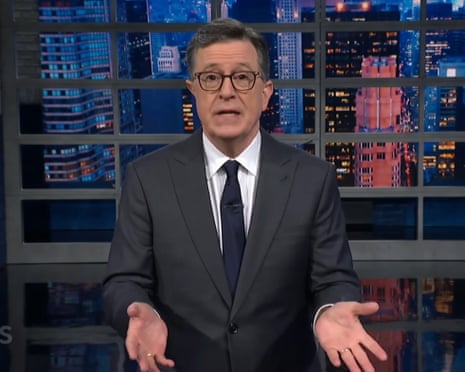
In September 2020, during a segment on The Late Show, Stephen Colbert revisited Trump’s denials using material that had long been publicly available but rarely assembled so plainly. One by one, Colbert displayed photographs of Trump and Epstein together—smiling, relaxed, often surrounded by women—at events over multiple years, including at Trump’s Mar-a-Lago estate.
The images were not obscure. Many had circulated online for years, resurfacing periodically on platforms like Twitter (now X), Reddit, and Instagram whenever Epstein’s name returned to the headlines. What Colbert did was not uncover new evidence, but contextualize old evidence against Trump’s contemporary claims.
“That’s a lot of photos with someone you barely know,” Colbert remarked dryly.
The Quote That Won’t Go Away
Photographs alone can be dismissed as coincidence—shared social scenes, overlapping guest lists. Words are harder to explain away.
In a 2002 profile in New York Magazine, Trump spoke warmly of Epstein.
“I’ve known Jeff for fifteen years. Terrific guy. He’s a lot of fun to be with.
It is even said that he likes beautiful women as much as I do, and many of them are on the younger side.”
The quote, widely authenticated and archived, resurfaced repeatedly after Epstein’s arrest. It has been cited by major outlets including The New York Times, The Washington Post, CNN, and Reuters. Trump has never denied saying it. Instead, he has argued that it was taken out of context or that his opinion of Epstein later changed.
But the quote remains striking—not only for its familiarity, but for its tone. It suggests not distance, but familiarity; not suspicion, but admiration.
The Pattern of Denial

The Epstein episode fits a broader pattern that media critics and historians have noted in Trump’s public life: categorical denial followed by confrontation with documentary evidence.
From the Access Hollywood tape to campaign finance records tied to Stormy Daniels, Trump has often relied on repetition and counter-accusation, betting that time, distraction, or partisan loyalty will dull the impact of contradicting facts.
In the Epstein case, however, the evidence required no leaks, subpoenas, or investigative breakthroughs. It was already there—stored in magazine archives, photo agencies, and social media feeds.
As media scholars have noted, the internet has fundamentally altered political memory. Denials that might once have survived now collide with searchable archives. Screenshots, videos, and digitized print records rarely disappear.
“Archives are unforgiving,” said one former network news editor in a 2020 interview with Columbia Journalism Review. “They don’t care how many times something is denied.”
Why the Epstein Story Persists
To Trump’s supporters, the Epstein controversy is often framed as a partisan obsession—or worse, a conspiracy theory distraction from policy debates. To critics, it represents something more troubling: unanswered questions about power, accountability, and selective transparency.
Epstein’s death eliminated the possibility of courtroom testimony that might have clarified who knew what, and when. That vacuum has fueled speculation across the political spectrum, from cable news to TikTok explainers and long Reddit threads parsing flight logs and guest lists.
Trump, notably, has resisted releasing additional documents related to Epstein while encouraging investigations into others. That asymmetry has drawn criticism even from some conservative commentators, who argue that full disclosure would dispel suspicion rather than inflame it.
Evidence Versus Amnesia
What Colbert’s segment illustrated—and what continues to resonate online—is not merely a contradiction, but a test of public memory.
Trump’s defense requires voters to forget: to forget photographs, to forget quotes, to forget years of documented social proximity. Colbert’s approach was simple—almost old-fashioned. He checked.
No anonymous sourcing. No speculation. Just receipts.
In an era of misinformation and deepfakes, the irony is sharp: the most damaging evidence is often the least sensational. A magazine quote. A wire-service photograph. A timestamped archive.
The Question That Remains
None of this proves criminal conduct by Trump. No court has alleged it. No charges have been filed. That distinction matters.
But the question is not one of guilt—it is one of credibility.
Can a public figure plausibly claim to have “barely known” someone he praised in print and photographed with repeatedly over more than a decade? Or does that claim rely on what critics call “strategic forgetting”?
As Epstein’s case continues to cast a long shadow over American elites, the unresolved tension between denial and documentation remains. For Trump, it is a reminder that in the digital age, history is not so easily rewritten.
Photographs remain. Quotes endure. And evidence, once assembled, has a way of speaking for itself.