For years, late-night television has served as a kind of informal opposition press in American politics, using humor to process what traditional journalism often approaches with caution. But in recent days, that long-standing arrangement appeared to fracture into something more confrontational — and more consequential — as Donald Trump reacted with visible anger to an unusually coordinated response from two of his most persistent critics on television.
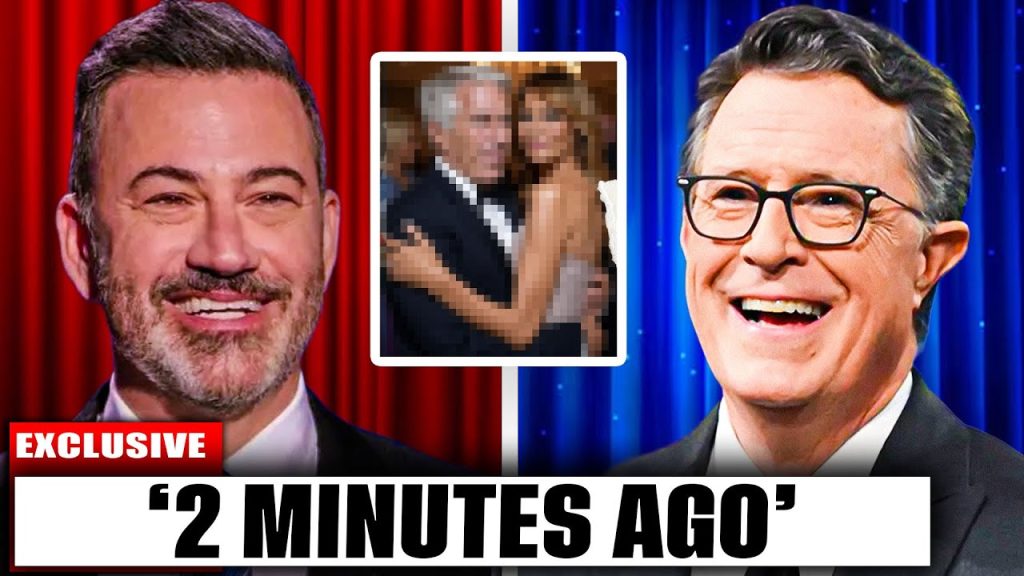
The flashpoint came during an unprecedented crossover between Jimmy Kimmel and Stephen Colbert, who appeared on each other’s programs on the same night. The moment was played for comedy, but the underlying message was pointed: neither host intended to retreat, even as their shows faced mounting corporate and political pressure.
The exchange occurred against a backdrop of escalating tension between the former president and major media institutions, including lawsuits, regulatory threats and public attacks on journalists. What made the episode unusual was not the satire itself — Trump has long been a staple of late-night ridicule — but the timing and the stakes.
A Rare Crossover, and a Shared Target
The coordinated appearance was not subtle. Colbert was introduced on Kimmel’s stage as a fellow “no-talent late-night loser,” echoing language Trump had repeatedly used on his social media platform. The audience understood the reference immediately, and laughter followed. But beneath the joke was a deliberate act of defiance.
In recent weeks, Trump had publicly celebrated what he described as the silencing of his critics. He praised the cancellation of Colbert’s show and the temporary suspension of Kimmel’s, portraying both developments as personal victories. On Truth Social, he mocked their ratings, their relevance and their livelihoods.
The hosts responded not by denying the attacks, but by incorporating them directly into their performances. In doing so, they reframed Trump’s insults as evidence of overreach rather than dominance.
Kimmel later explained that the crossover was designed, at least in part, “to drive the president nuts.” By that measure, it appeared to succeed.
Corporate Decisions Under Scrutiny
The episode also brought renewed attention to the role of media corporations caught between political pressure and editorial independence. Kimmel recounted how executives at ABC abruptly pulled his show off the air hours before a scheduled taping, citing concerns about “lowering the temperature.” The decision forced audience members and staff to be sent home and left guests stranded.
Colbert, meanwhile, described being informed by CBS that his program would end after a decade on the air — a move announced days after he publicly criticized Paramount Global, CBS’s parent company, for settling a lawsuit filed by Trump. Paramount paid $16 million to resolve the suit, even as internal assessments reportedly concluded the case lacked merit.
The timing raised uncomfortable questions. Paramount is currently seeking federal regulatory approval for a merger, a process overseen by agencies influenced by the executive branch. Colbert did not explicitly accuse his employer of political capitulation, but the implication lingered.
“This is not how a free press behaves,” he said, arguing that appeasement only invites further demands.
Trump’s Reaction Escalates
As the crossover clips circulated online, Trump responded with a flurry of posts, attacking both hosts and celebrating their professional setbacks. At the same time, he continued to repeat false claims about the 2020 election while an emergency session of the United Nations Security Council convened to address international crises.
Administration officials attempted to keep the focus on foreign policy, but Trump’s attention appeared elsewhere. His ambassador to the United Nations insisted that recent U.S. military actions abroad were merely “law enforcement operations,” language that drew criticism from diplomats and legal scholars alike.
For critics, the juxtaposition was telling: while global institutions debated sovereignty and international law, the former president was publicly fixated on television hosts and comedians.

Comedy as Pressure Point
Late-night satire has long occupied an ambiguous space in American politics — dismissed by some as trivial, embraced by others as cultural commentary. But the reaction to the Kimmel-Colbert crossover suggested that Trump views it as something more threatening.
Psychologists and media analysts note that repetition, ridicule and amplification can be uniquely destabilizing for public figures who rely heavily on narrative control. In this case, Trump did not deny the substance of the jokes. Instead, he attacked the messengers, a pattern familiar from his dealings with journalists, judges and political opponents.
“The moment stops being about comedy,” said one former network executive, “and becomes about power — who gets to speak, and who gets punished for it.”
The Chilling Effect Question
The controversy has reignited debate about whether media companies are retreating in the face of political pressure. Advocates for press freedom warn that even temporary suspensions or cautious programming decisions can have a chilling effect, encouraging self-censorship before it is formally demanded.
Kimmel argued that yielding “even an inch” to authoritarian instincts invites further encroachment. Colbert echoed the sentiment, invoking historical examples of gradual erosion rather than abrupt crackdowns.
Their public solidarity was reinforced by surprise appearances from other late-night figures, including Seth Meyers, who framed the moment as larger than any single show.
A Paradoxical Outcome
Ironically, the backlash may have achieved the opposite of its apparent intent. Kimmel’s return episode drew record viewership, surpassing 15 million views online. Colbert’s final season has become appointment television. Far from fading, both hosts have gained renewed prominence.
“Every time he attacks them, he makes them stronger,” one media analyst observed.
The photograph of Kimmel, Colbert and Meyers together — captioned simply “Hi, Donald” — quickly went viral, recasting the episode not as a retreat, but as a rally.
More Than a Television Feud
What began as late-night satire has evolved into a broader confrontation over speech, power and institutional independence. It is no longer just about jokes at a president’s expense, but about whether media organizations will defend those who make them.
In that sense, the episode revealed something deeper than Trump’s temper. It exposed the fragile line between entertainment and accountability — and the discomfort that arises when laughter refuses to be silenced.
As one host put it on air, looking directly into the camera: “This isn’t about us. It’s about whether anyone still gets to say no.”







