When Volume Meets Evidence: Jimmy Kimmel and a Televised Test of Credibility
Late-night television has long trafficked in satire, but every so often it produces a moment that lands closer to civic examination than comedy. That was the case this week when Jimmy Kimmel devoted a segment of his show to a single claim that Donald Trump has repeated for years: that he knows more than anyone else.
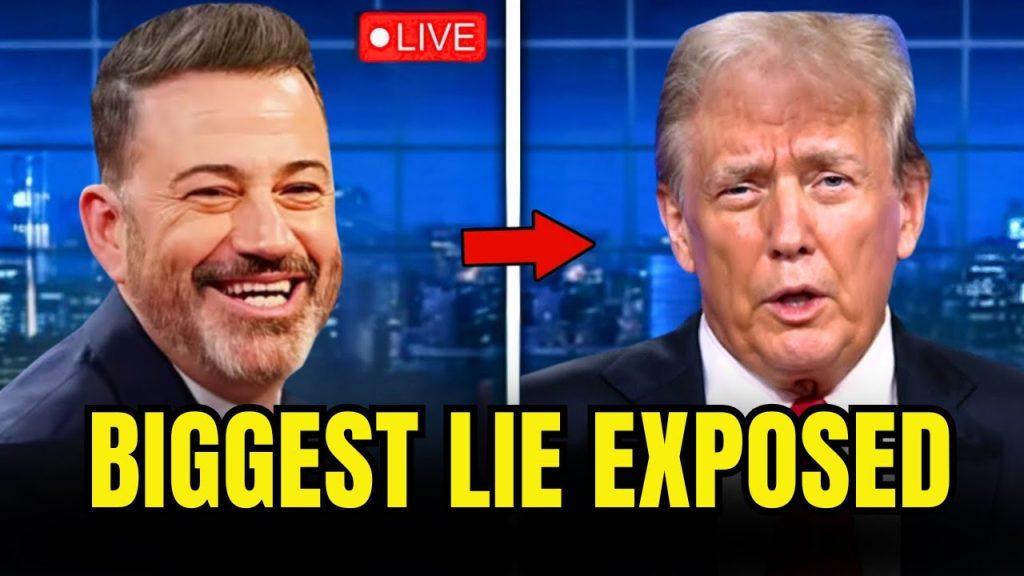
The segment did not rely on insult or escalation. Instead, it adopted a method that has become increasingly rare in political media — restraint. Mr. Kimmel played Mr. Trump’s own statements, one after another, and placed them alongside documented reporting about his governing habits. The effect was cumulative rather than explosive, and its resonance owed much to what Mr. Kimmel chose not to do.
A Familiar Claim, Replayed
The segment opened with footage from a Trump rally. On screen, the former president paced the stage and delivered a line that has become a refrain of his public persona: that he knows more about the economy, the military and science than anyone else. The crowd applauded. The clip ended.
Back in the studio, Mr. Kimmel did not immediately respond. He paused, allowing the bravado to linger, before offering a simple transition: “Okay,” he said. “Let’s test that.”
What followed was a sequence of brief clips — Mr. Trump asserting that he knew more about ISIS than American generals; suggesting that wind turbines cause cancer; likening physical exercise to a battery that drains finite energy. Each clip played cleanly, without commentary, before yielding to the next.
The audience laughed at first. Then the laughter thinned. A pattern emerged.
From Joke to Method
Rather than escalating the tone, Mr. Kimmel narrowed it. “Here’s the lie,” he said calmly. “Not that he’s wrong sometimes. Everyone’s wrong sometimes. The lie is that he knows what he’s talking about when he clearly doesn’t.”
It was a subtle but important distinction. Mr. Kimmel did not argue policy. He did not mock intelligence. He challenged the consistency between claim and conduct.
A graphic appeared summarizing publicly reported accounts of Mr. Trump’s presidency — that he often skipped intelligence briefings, requested abbreviated summaries and expressed impatience with detailed written material. These accounts have been documented by multiple news organizations over the years and were presented without embellishment.
“You can’t be the smartest guy in the room,” Mr. Kimmel said, “if you won’t stay in the room long enough to listen.”
Applause followed, then receded.
The Power of Contrast
The segment’s force came not from any single revelation but from juxtaposition. Mr. Trump’s repeated insistence on unmatched knowledge was placed beside a record suggesting disinterest in the very processes that produce expertise.
In media terms, it was an exercise in contrast rather than confrontation. The audience was not instructed what to think. It was shown a sequence and invited to draw its own conclusions.
Mr. Kimmel underscored the point with one final claim from Mr. Trump — “I alone can fix it” — before offering his own conclusion, quietly: “That might be the biggest lie of all.”
“No one fixes anything alone,” he said. “Not presidents. Not leaders. People who actually know things ask questions. They listen. They change their minds when the facts change.”
The segment ended without a joke. There was no band cue, no punchline. The absence felt deliberate.

Reaction and Reframing
Within hours, the clip spread widely online. Its virality was notable not for outrage but for repetition. Viewers replayed it to point out the structure of the argument rather than the personality of its target.
Commentary focused less on Mr. Kimmel’s motives than on the material itself — the clips, the documented habits, the side-by-side presentation. In that sense, the segment functioned less like satire and more like an editorial, using evidence and sequencing rather than assertion.
Mr. Trump did not respond directly to the substance of the segment. Instead, he criticized Mr. Kimmel personally, reviving a pattern familiar to observers of his media strategy. The response, many noted, reinforced the segment’s premise: deflection rather than clarification.
Why It Landed
The exchange arrives at a moment when public trust in institutions — political, media and scientific — remains fragile. In such an environment, claims of personal omniscience can resonate, particularly when repeated with confidence and volume.
What Mr. Kimmel demonstrated was that repetition alone does not confer credibility. By stripping away tone and focusing on record, he shifted the frame from personality to practice.
“This wasn’t humiliation because someone made fun of him,” Mr. Kimmel said near the end of the segment. “It’s humiliation because the story collapsed under its own weight.”
The line captured why the moment traveled. The segment did not demand belief. It invited comparison.
Late Night as Accountability
Late-night television occupies an ambiguous space in American civic life — dismissed by some as frivolous, embraced by others as a site of informal accountability. Segments like this blur that boundary, showing how entertainment formats can accommodate evidentiary arguments without abandoning their audience.
For Mr. Kimmel, the approach marked a departure from overt satire toward something closer to media literacy: showing how claims function, how evidence accumulates and how volume can obscure gaps.
For Mr. Trump, it represented a familiar vulnerability. His political success has often depended on dominating the narrative through repetition and confidence. When those tools are neutralized — when claims are replayed quietly and set beside record — the strategy falters.
After the Applause
By morning, coverage of the segment focused less on comedy than on credibility. Headlines described a late-night host “exposing” a lie, but the exposure lay not in revelation so much as in arrangement.
Nothing in the segment was new. The clips were public. The reporting had been done. What changed was the order and the silence around them.
In the end, the moment suggested a broader lesson about political communication. When claims are stripped of volume and faced with evidence, they do not always provoke rebuttal. Sometimes they simply stop.
And in that stillness, audiences are left to confront the difference between confidence and competence — a distinction that, once seen, is difficult to unsee.






