When Confrontation Becomes Content: Jon Stewart, Donald Trump, and the Viral Economy of “Truth”
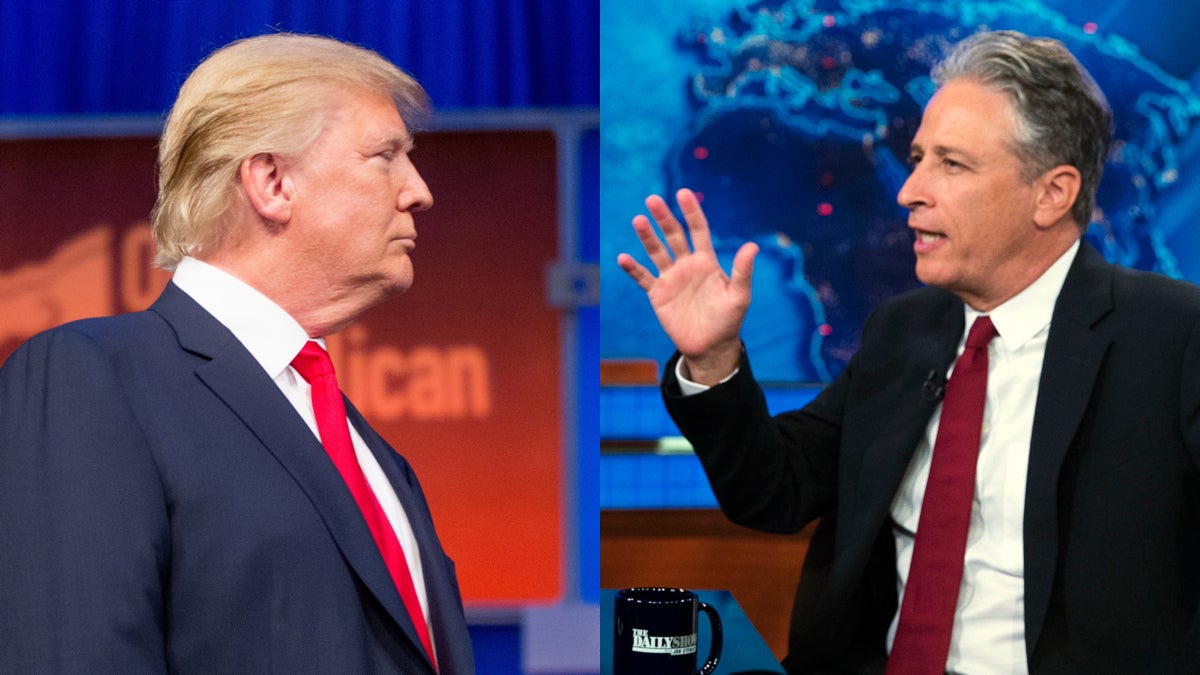
On a recent night of national television, a familiar dynamic played out with unfamiliar intensity. Jon Stewart, long regarded as one of the most disciplined interrogators of political rhetoric in entertainment, confronted Donald Trump in a segment that quickly escaped the studio and took on a second life online.

Within hours, the clips were circulating with breathless captions promising a “truth bomb,” a phrase that has become shorthand in the digital age for moments that feel revelatory—whether or not they are verifiable. The speed and scale of the reaction said as much about the media ecosystem as it did about the exchange itself.
The Set-Up: Calm Versus Command
Mr. Trump entered the segment in familiar form, projecting confidence and control, a posture honed over decades in business and politics. Mr. Stewart, by contrast, adopted a quieter register. He did not interrupt. He did not rush. The contrast was deliberate.
This is a technique Mr. Stewart has refined over years: let the subject fill the space, then narrow the frame. The audience senses the shift before it can name it. Attention tightens. The room leans forward.
What followed was not a barrage of jokes but a method—sequencing statements, pausing between them, allowing silence to do work that punch lines usually perform.
From Exchange to Event
The moment metastasized online because it satisfied a modern appetite for spectacle that resembles accountability. Viewers are primed to interpret confrontation as exposure and intensity as proof. In this environment, tone can be mistaken for evidence, and volume for verification.
Crucially, the viral framing often traveled farther than the segment itself. Edited clips, stripped of context, circulated with captions that promised revelation rather than analysis. The result was a familiar pattern: a televised exchange becomes raw material for a parallel narrative economy, one that rewards escalation and certainty.
Late Night’s Double Role
Late-night television occupies an ambiguous position in American public life—part entertainment, part informal watchdog. Its most effective moments often rely on a simple mechanism: juxtaposition. Statements are placed beside records; claims beside consequences.
But there is a line between scrutiny and amplification. When clips are recut and recirculated without context, the format that once clarified can begin to distort. The host’s intent—interrogating rhetoric—can be overtaken by an audience’s desire for decisive conclusions.
Mr. Stewart’s on-air approach remained controlled. The online afterlife did not.
The Audience as Participant
What distinguished this moment was not merely what was said, but how viewers participated. Social platforms rewarded the most dramatic interpretations, not the most careful ones. Hashtags promised humiliation; thumbnails promised shock.
In this sense, the audience became co-authors of the story. The exchange was no longer about what happened in the studio but about what could be inferred, implied, or exaggerated. The distance between critique and claim collapsed.
This is the central tension of contemporary media: the tools designed to democratize access also accelerate distortion.

Trump’s Familiar Countermove
Mr. Trump responded in character—by attacking the messenger rather than engaging the substance. It is a tactic that has served him before, shifting attention from content to conflict. In the short term, it can be effective. In the long term, it often reinforces the original critique: deflection instead of clarification.
Yet the reaction also fed the viral cycle, providing fresh material for the same platforms that had amplified the moment in the first place.
Why It Felt Bigger Than It Was
To many viewers, the exchange felt historic because it resembled a reckoning—calm versus force, method versus bravado. But the sense of rupture owed less to new information than to presentation.
Nothing fundamentally unknown was established on air. What changed was the staging: silence, pacing, and contrast created the impression of exposure. In an era saturated with claims, restraint can feel radical.
The Cost of Collapsing Standards
The danger arises when the aesthetics of truth—documents on a desk, deliberate pauses, solemn tone—are mistaken for truth itself. When audiences accept presentation as proof, misinformation finds fertile ground.
This does not diminish the value of sharp questioning. It underscores the responsibility that accompanies it. Skepticism must apply not only to power but to virality.
A Teachable Moment
What viewers witnessed was not a courtroom verdict or an investigative report. It was a media moment—one that revealed how easily critique can be repackaged into certainty once it leaves the studio.
The real lesson may be less about the individuals involved than about the system that carried the story forward. Accountability requires more than confrontation; it requires verification, context, and restraint—qualities that travel poorly online.
After the Applause
By the next morning, headlines focused on reaction rather than substance. The question was no longer what had been asked, but how loudly it had echoed.
Late-night television can still illuminate. But in a viral economy, illumination competes with distortion. The challenge—for hosts, audiences, and platforms alike—is to tell the difference.
Because when confrontation becomes content, the loudest version is not always the truest one.






