When a President Tests the Limits, the System Is Forced to Answer
WASHINGTON — It began, as so many consequential moments in American politics do, with a remark framed as a joke.
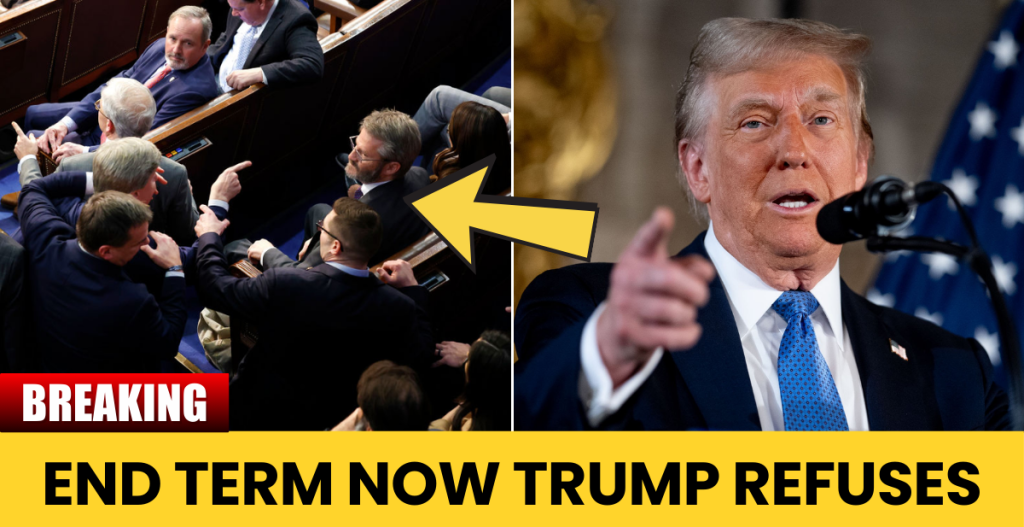
Standing before a closed-door gathering of House Republicans earlier this month, Donald Trump mused aloud that Democratic policies were so disastrous that elections might as well be canceled. In the same remarks, he revisited a theme that has increasingly surfaced during his second term: the idea that he might somehow serve beyond the Constitution’s two-term limit.
The comments were delivered casually, almost playfully. They were also extraordinary.
In a political system built on precedent, restraint and assumption of good faith, presidents rarely speak publicly about suspending elections or extending their time in office. When they do, the words reverberate beyond the room in which they were spoken, forcing institutions — and the public — to confront questions that normally remain theoretical.
This time, the reaction was immediate. Petitions calling for Trump’s removal began circulating within hours. Advocacy groups renewed demands that Congress intervene. Even some Republicans, privately and in a handful of public statements, expressed unease.
The episode has crystallized a broader anxiety that has hovered over Trump’s presidency since his return to office: whether democratic norms are being tested rhetorically, procedurally, or deliberately — and whether the American system is prepared to respond.
A Familiar Pattern, Sharper Edges
Trump’s defenders have been quick to dismiss the remarks as unserious — another provocation aimed at energizing his base and antagonizing critics. But historians and constitutional scholars note that the danger of such statements lies less in their immediate feasibility than in their cumulative effect.
Authoritarian erosion, they argue, rarely begins with formal declarations. It advances through normalization: ideas once considered unthinkable are floated, then repeated, then defended as misunderstood or mischaracterized. Over time, the boundaries of acceptable discourse shift.
Trump has returned repeatedly to the same themes — questioning election legitimacy, suggesting he deserves additional time in office, portraying constitutional constraints as unfair obstacles rather than binding rules. Each instance, taken alone, can be dismissed. Together, they form a pattern.
That pattern is unfolding as Trump faces mounting resistance from Congress, courts, and public opinion. His approval ratings remain underwater, his signature policies on tariffs and spending cuts are broadly unpopular, and the 2026 midterm elections loom as a potential turning point.
In that context, critics argue, rhetoric about canceling elections is not merely rhetorical. It is expressive — revealing how the president understands power, accountability, and constraint.
The Constitutional Reality
Legally, the path Trump alludes to does not exist.
The 22nd Amendment to the Constitution is unambiguous: no person may be elected president more than twice. Altering that provision would require a two-thirds vote in both chambers of Congress and ratification by three-quarters of the states — a threshold so high that it has never been met for the purpose of extending presidential tenure.
Nor does the Constitution provide any mechanism for canceling or indefinitely postponing federal elections at the discretion of the executive. Elections are scheduled by statute. Power flows from them. The premise of democratic accountability depends on their regular occurrence.
Trump knows this. His lawyers know this. Which raises a question that has become increasingly central to his presidency: if the ideas are unworkable, why raise them at all?
Congress at a Crossroads
The answer may lie in the evolving relationship between Trump and Congress.
Since returning to office, Trump has pressed the outer boundaries of executive authority — withholding funds appropriated by lawmakers, initiating military actions without explicit authorization, and resisting court orders with unusual frequency. Each confrontation has tested whether Congress will assert its institutional prerogatives or defer, as it often has in recent years.
For much of Trump’s tenure, Republicans have opted for caution, wary of provoking his base. Democrats, lacking control of both chambers, have struggled to impose meaningful constraints. The result has been a presidency that has encountered friction but few durable consequences.
That equilibrium may be shifting. A small number of Republicans have begun exploring procedural tools to bypass party leadership and push legislation rebuking the White House. Others have voiced concern about Trump’s effect on their electoral prospects.
Still, hesitation remains the dominant posture. The fear of political reprisal continues to outweigh institutional alarm.
Public Pressure and Democratic Memory
Outside Washington, the reaction has been less restrained.
Grassroots campaigns demanding Trump’s removal have gained traction, framing his remarks as disqualifying rather than provocative. Their organizers argue that even speculative talk of canceling elections crosses a line that cannot be normalized.
Such efforts may not succeed immediately. But they serve another purpose: creating a record.
In democracies that have experienced backsliding, historians often note not only what leaders attempted, but how institutions and citizens responded — who objected, who acquiesced, and who chose silence. Public memory is shaped as much by resistance as by outcome.
The International Context
Comparisons to other countries are imperfect but instructive.
In Hungary, Turkey, Venezuela and elsewhere, leaders did not abolish democratic systems overnight. They undermined them incrementally — politicizing courts, attacking the press, rewarding loyalists, and reframing elections as obstacles to stability rather than expressions of popular will.
In each case, early warnings were dismissed as exaggeration. The turning points, in retrospect, were moments when institutions failed to draw clear lines.
Trump’s remarks do not place the United States on an identical trajectory. But they raise a familiar question: how resilient are norms when leaders openly challenge them?
What Comes Next

The immediate future will be shaped by response, not rhetoric.
If Congress treats Trump’s comments as inconsequential, they will likely recur, perhaps with greater boldness. If they provoke tangible institutional pushback — legislative, legal, or political — the boundaries may reassert themselves.
The 2026 midterm elections now loom larger than a routine referendum on policy. They have become, implicitly and explicitly, a test of democratic confidence. Trump himself has framed them as existential, warning allies that defeat would invite accountability.
That framing may be revealing. Leaders secure in legitimacy rarely fear elections. Leaders who do often seek ways around them.
A Moment of Definition
American democracy has endured crises before — wars, depressions, scandals, and presidential abuses of power. Its survival has depended less on the virtue of individual leaders than on the willingness of institutions and citizens to defend constraints.
Trump’s remarks did not alter the Constitution. They did not cancel an election. They did, however, force a reckoning.
They asked whether norms still matter when openly challenged, whether Congress is prepared to act as a coequal branch, and whether voters recognize normalization when they see it.
The answers will not come from a single speech or petition. They will emerge, slowly and unmistakably, from what happens next — and from what does not.
History tends to remember those moments not for what was said, but for how seriously it was taken.






