When Late Night Went Quiet: How Kimmel and Colbert Turned Stillness Into a Test of Power
Late-night television is engineered for momentum. Jokes accelerate, laughter fills the gaps, and the next segment arrives before reflection has time to form. On a recent night, that machinery stalled. Not because of outrage or insult, but because two hosts—hours apart on different networks—made the same counterintuitive choice: they slowed everything down.
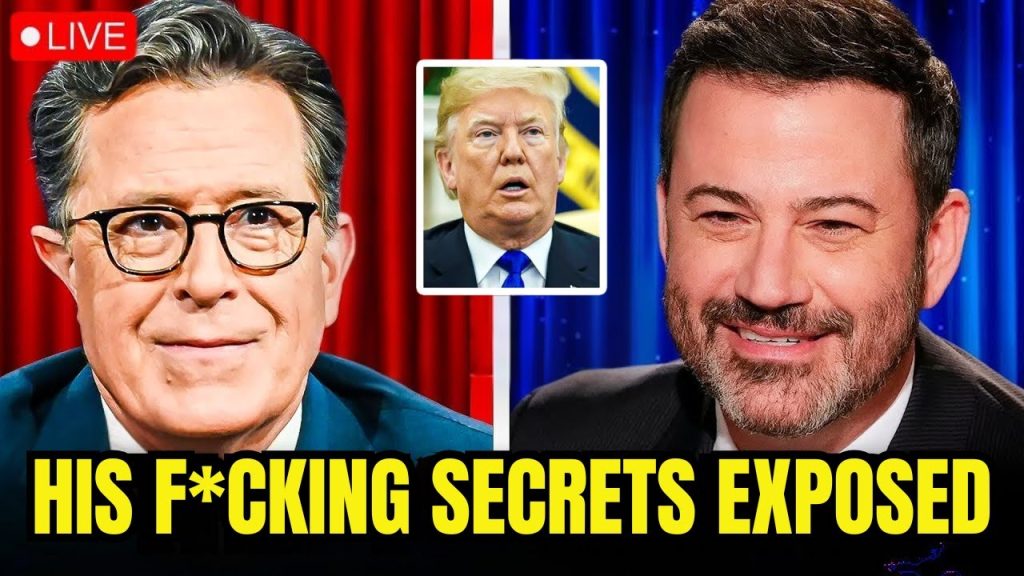
The hosts were Jimmy Kimmel and Stephen Colbert. The subject, as so often in the past decade, was Donald Trump. The method, however, was not mockery. It was patience.
What unfolded across two programs became less a comedy event than a media experiment—one that suggested how fragile political performance can become when deprived of its usual accelerants.
A Pause on Kimmel’s Stage
Mr. Kimmel opened with a familiar device: a rally clip of Mr. Trump, confident and expansive, asserting unrivaled intelligence and instinct. Ordinarily, the beat would cue a punchline. Instead, Mr. Kimmel waited.
“Let’s check something,” he said quietly, before playing a sequence of clips in which Mr. Trump contradicted himself—professing total knowledge in one moment, disavowing responsibility in the next. There was no narration, no editorial flourish. The statements were simply placed side by side.
The audience laughed at first. Then the laughter thinned. Patterns emerged. Mr. Kimmel leaned forward to name the problem, briefly and clinically: a person cannot be right all the time if they never admit error; claims of mastery collapse when words cancel each other out. He closed the segment without celebration. The silence did the work.
Colbert’s Evidence, Not a Punchline
Hours later, Mr. Colbert took a different path to the same destination. He opened with another rally clip—this time, Mr. Trump declaring himself a “genius,” citing doctors who had “never seen a brain like his.” The audience chuckled, expecting satire.
Mr. Colbert did not respond. He stared into the camera. Seconds passed. Laughter faded. Then he produced a large photo board and placed it on his desk: an image of Mr. Trump staring directly at a solar eclipse from the White House balcony as aides pointed skyward. Mr. Colbert let the image linger.
“That’s not a punchline,” he said evenly. “That’s a contradiction.” Genius, he added, is not announced; it is demonstrated, especially when applause is absent.
By morning, the clips were everywhere. Viewers connected the methods—comparison on one show, evidence on the other—and the conclusion was difficult to avoid.
Why the Quiet Worked
The power of the night lay not in ridicule but in restraint. Late-night comedy often wins by volume, by stacking jokes until laughter overwhelms rebuttal. This time, the hosts removed the noise. Without the rhythm of punchlines, Mr. Trump’s assertions were forced to stand on their own.
Silence is risky on television. It threatens pace and ratings. But it also denies guests and subjects the opportunity to deflect. When statements are frozen and juxtaposed, inconsistencies become visible without accusation. Viewers perform the analysis themselves.
The segments echoed a broader weariness in public discourse. Audiences are accustomed to confidence and repetition; they are less accustomed to memory being applied. Comparison, rather than condemnation, proved decisive.
The Reaction That Followed

Mr. Trump noticed. He responded online with a familiar barrage—attacking the hosts, the networks, the audience. The posts were loud and immediate. What they did not contain was an explanation of the contradictions highlighted on air.
That omission mattered. Analysts replayed the silence more than the jokes. Commentators debated why there was anger without answer. Supporters defended tone; critics pointed back to the clips. The more the attacks escalated, the more the original question lingered.
In a media ecosystem built on outrage, unanswered questions can be more corrosive than hostile ones.
Late Night’s Changing Function
The episode underscored how late-night television has evolved. Hosts are no longer competing only with one another; they are competing with an attention economy that rewards either extremes or clarity. Increasingly, the most viral moments are not the loudest but the most legible—the segments that resemble a case file more than a roast.
This does not turn comedy into journalism. But it does show how arrangement can rival argument. When claims are curated and slowed, audiences can judge coherence without being told what to think.
Power, Noise, and Stillness
Mr. Trump’s political persona has long relied on motion—on dominating the room, changing subjects, generating conflict faster than opponents can respond. Kimmel and Colbert disrupted that strategy by refusing to move with him. They asked viewers to remember and to look.
The result suggested a paradox of modern media power: performance thrives on noise, but credibility depends on consistency. When the noise stops, consistency is all that remains.
What Viewers Actually Saw
Despite the viral framing, no one was “destroyed” on air. There was no triumphant sign-off, no declaration of victory. Mr. Kimmel and Mr. Colbert did not claim the moral high ground. They simply paused long enough for reality to catch up.
Viewers did not leave feeling entertained so much as unsettled. The illusion did not shatter through cruelty but through contrast. Assertions, once stripped of applause and acceleration, proved brittle.
The Lesson That Lingered
By the next day, coverage had shifted away from comedy toward credibility. The question was not whether the hosts had been fair, but why the contradictions remained unanswered. In politics built on repetition, comparison is disruptive.
In the end, Mr. Trump’s reaction mattered less than its cause. He was not undone by insult. He was challenged by stillness.
Late night did not defeat him. Patience did. Two hosts paused. The audience noticed. And once the shouting stopped, the image and the question remained—unrebutted, unmoved, and difficult to forget.







