Trump’s Tariff Threat to Canada Exposes a Hard Truth: Interdependence Cuts Both Ways
President Donald Trump has never been shy about wielding tariffs as a weapon. But his latest threat—imposing a sweeping 100 percent tariff on all Canadian goods entering the United States if Ottawa deepens trade engagement involving China—has drawn a different kind of reaction from economists, diplomats, and even parts of his own political base.
Instead of projecting strength, the warning has illuminated something more uncomfortable: the extent to which the United States depends on Canada, and the limits of pressure politics in a deeply integrated continental economy.
A threat born of frustration, not trade law
Mr. Trump’s warning was delivered not through a formal trade action or a legal complaint filed under international rules, but via social media—blunt, unconditional, and sweeping. It framed a narrow, preliminary tariff-relief arrangement between Canada and China as if it were a full-fledged strategic realignment against Washington.
Trade specialists were quick to note the discrepancy. Canada has not signed a comprehensive free-trade agreement with China. What exists, according to officials in Ottawa, is a limited effort to restore pre–trade-war conditions on specific goods, such as canola, while maintaining controls in sensitive sectors like electric vehicles.
“This isn’t a rules-based challenge,” said one North American trade analyst. “It’s not about violations. It’s about leverage—and emotion.”
That assessment has been echoed widely across U.S. and Canadian media, where commentators described the threat as a political bluff rather than a viable policy plan.
Davos and the real trigger
The timing of the threat is telling. Only days earlier, Mr. Trump had publicly said it was “a good thing” for Canada to pursue trade deals. Nothing in the substance of Canada’s China engagement changed. What did change was the stage.
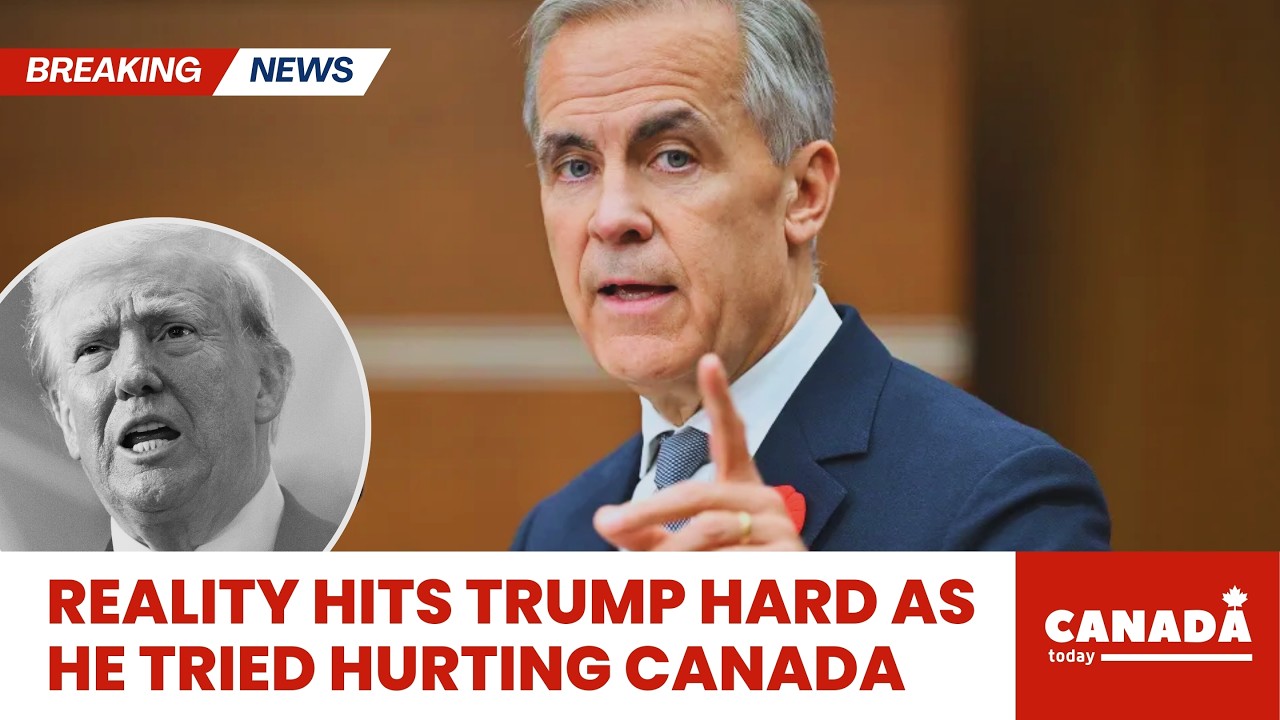
At the World Economic Forum in Davos, Canada’s prime minister, Mark Carney, delivered a speech that challenged the logic of coercion in global trade. Without naming the United States or Mr. Trump, he argued that an international order built on intimidation and dependency was fraying, and that middle powers needed to diversify partnerships to protect economic sovereignty.
The speech was widely praised in European and Asian press. In Washington, it appears to have struck a nerve.
“Trump does not respond well to public challenge,” said a former U.S. diplomat. “Especially from countries he assumes should fall in line quietly.”
Why a 100 percent tariff would boomerang
A blanket tariff on Canada is not just aggressive; it would be economically self-destructive for the United States.
Canada supplies roughly 40 percent of the oil consumed in the United States, much of it flowing directly into Midwest refineries engineered specifically for Canadian crude. There is no quick substitute. A punitive tariff would almost certainly drive up gasoline and heating prices within days, feeding inflation at home.
Manufacturing tells a similar story. Automobiles, machinery, defense equipment, and construction materials are produced through integrated supply chains that cross the border multiple times before completion. Canadian steel, aluminum, auto parts, lumber, fertilizers, and critical minerals are not optional inputs; they are structural components of American industry.
“Tariffing Canada isn’t like tariffing a distant supplier,” said an executive at a U.S. manufacturing trade group. “It’s like tariffing your own factory.”
Agriculture would also feel the shock. Canada is a major source of wheat, canola, beef, and farm inputs. Higher costs would pass quickly to American consumers in the form of higher grocery prices—an outcome politically toxic in an election cycle.

A bluff with a narrow margin for error
For these reasons, many analysts view the threat as a pressure tactic rather than a policy blueprint. The backlash to actual implementation would not come first from Ottawa, but from U.S. oil producers, automakers, farmers, governors, and consumers.
That reality gives Canada leverage Mr. Trump rarely acknowledges. Pressure works best when the other side has nowhere else to turn. Canada, increasingly, does.
The hypocrisy problem
The tariff threat has also revived accusations of inconsistency. Only months ago, Mr. Trump struck his own understanding with Beijing that lowered tariffs on both sides, a move he later described as “winning” the trade war. He has signaled openness to further engagement with China and has spoken positively about future talks.
Against that backdrop, threatening Canada for restoring limited, pre–trade-war conditions with China has struck even sympathetic observers as contradictory.
“Easing tariffs with Beijing and then scolding Ottawa for doing far less is a hard circle to square,” said one former trade negotiator.
Control versus diversification
At its core, the dispute is not about China. It is about control.
Mr. Trump’s trade worldview favors alignment within an American tariff wall, with penalties for deviation. Canada’s recent signals—quietly expanding options, emphasizing domestic investment, and diversifying partnerships—run counter to that model.
Mr. Carney’s response to the threat underscored the contrast. Rather than escalating rhetorically, he emphasized a “Buy Canadian” strategy: investing at home, building infrastructure, strengthening domestic industry, and reducing exposure to external pressure.
The message was simple: Canada cannot control what others do, but it can control its own resilience.

A lesson in limits
Mr. Trump’s tariff threat was meant to demonstrate power. Instead, it has highlighted dependence.
If Canada were truly expendable, intimidation would be unnecessary. The fact that Washington must threaten reveals how constrained its options are. North American interdependence is not a weakness to be exploited at will; it is a reality that disciplines all sides.
The threat may fade, as many expect. But the episode leaves a mark. It shows that pressure politics lose force when partners diversify, and that in an integrated economy, dominance is harder to assert than rhetoric suggests.
In trying to bend Canada back into line, Mr. Trump may have underscored the very point his critics have been making: power in the modern trading system belongs not to those who shout the loudest, but to those with credible alternatives.
And on that front, Canada appears to be better positioned than the White House would like to admit.