Canada’s Quiet Uranium Power—and America’s Growing Nuclear Dependence

For decades, the United States has treated nuclear power as a pillar of energy security — a domestic, reliable source of electricity insulated from the turbulence of global oil and gas markets. But beneath that assumption lies a quieter, more complicated reality: a significant share of America’s nuclear energy now depends on a single foreign supplier. And that supplier is Canada.
Nearly 40 percent of the uranium used to fuel U.S. nuclear reactors comes from Canada, primarily from Saskatchewan’s Athabasca Basin, a remote region that contains some of the richest uranium deposits on Earth. The material extracted there is not merely abundant; it is unusually high-grade, precisely calibrated for modern reactors that operate under strict engineering tolerances.
This dependence has long existed, largely unnoticed outside energy circles. Now, amid shifting geopolitics, climate targets, and supply-chain disruptions, it is drawing increasing attention in Washington, on Wall Street, and across global energy markets.
A Critical Backbone of the Grid
The United States operates 94 nuclear reactors across 28 states. Together, they generate roughly 20 percent of the nation’s electricity — more than all renewable sources combined. Nuclear power supplies steady, carbon-free electricity to major cities, hospitals, data centers, military installations, and industrial hubs. Unlike solar or wind, it operates around the clock.
“These reactors are baseload assets,” said a former senior official at the Department of Energy, speaking on background. “You can’t turn them off and on because of politics or trade disputes. They have to run.”
Yet while the reactors themselves are domestic, the fuel that powers them is not. U.S. uranium mining accounts for only about 4 percent of national demand, according to industry data cited frequently by analysts at Bloomberg and the Financial Times. Restarting idled mines or developing new ones would take at least five to ten years, requiring permits, environmental reviews, financing, and infrastructure.
In other words, there is no short-term substitute.
The Collapse of a Global Supply Web
For years, American utilities relied on a diversified uranium supply chain. Canada provided high-quality ore. Kazakhstan supplied large volumes at competitive prices. Russia filled crucial gaps, especially in enrichment services, which convert uranium into reactor-ready fuel.
That system is now fraying.
Russia’s role in global nuclear fuel markets has become politically radioactive following its invasion of Ukraine. While nuclear fuel has been exempt from many sanctions, pressure is mounting in Congress to reduce or eliminate Russian involvement. Several utilities have already moved quietly to unwind Russian contracts, according to reporting by Reuters and Politico.
Kazakhstan, the world’s largest uranium producer, faces its own uncertainties. Landlocked and dependent on transit routes through Russia or the Caspian Sea, its exports are vulnerable to geopolitical disruptions. Analysts have warned that logistical bottlenecks and regional instability could constrain future supply.
That leaves Canada.
“Canada is increasingly seen as the safest, most reliable uranium supplier in the world,” said an energy strategist quoted recently on CNBC. “It has the geology, the infrastructure, and the political stability.”
Saskatchewan’s Strategic Asset
The Athabasca Basin produces uranium with concentrations up to 100 times the global average. Mines operated by companies like Cameco have become indispensable to Western nuclear programs.
Utilities are responding accordingly. Long-term uranium contracts — once considered old-fashioned — are back in vogue. According to industry trackers followed closely by investors on platforms like X (formerly Twitter) and LinkedIn, U.S. utilities are locking in Canadian supply for decades, not years.
This shift is already affecting markets. Uranium prices have surged over the past two years, drawing renewed interest from hedge funds, pension funds, and retail investors. Analysts on networks like Bloomberg Television and Fox Business have increasingly framed uranium as a strategic commodity, not just a raw material.
Trade, Leverage, and USMCA
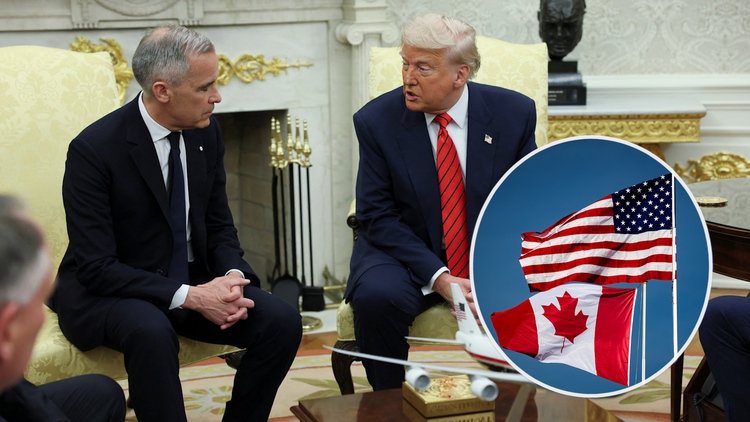
The timing is sensitive. In 2026, the United States, Canada, and Mexico will conduct a formal review of the U.S.-Mexico-Canada Agreement (USMCA). While uranium has rarely been a headline issue in past trade negotiations, its importance is now difficult to ignore.
Canada does not need to threaten export controls or impose restrictions to exert influence. Its leverage is structural.
“If Canada were to redirect even a portion of its uranium exports toward Europe or Asia, the U.S. would feel it almost immediately,” said a former trade negotiator familiar with North American energy policy.
Europe is scrambling to replace Russian nuclear fuel. India is expanding its reactor fleet at breakneck speed. Asian economies are signing long-term supply agreements to lock in future capacity. Every ton of uranium Canada commits abroad is a ton unavailable elsewhere.
National Security Meets Climate Policy
The implications extend beyond trade.
The Biden administration — and likely future administrations — view nuclear energy as essential to meeting climate goals. Shuttering reactors because of fuel shortages would undermine emissions targets, destabilize electricity markets, and increase reliance on fossil fuels.
At the same time, nuclear power is deeply intertwined with national security. Many military facilities and defense contractors depend on nuclear-generated electricity. Grid instability is not merely an economic issue; it is a strategic risk.
“This is a blind spot in the U.S. energy narrative,” said an analyst at a Washington-based think tank. “We talk about independence, but the reality is interdependence.”
A Quiet Shift, With Loud Consequences
Canada has not made dramatic announcements or issued ultimatums. There have been no sanctions, no threats, no press conferences. The influence comes from position, not posture.
That subtlety is part of what makes the moment significant. As one widely shared post on X put it recently: “Canada doesn’t need to say a word. The uranium speaks for itself.”
For policymakers, utilities, and investors, the message is clear. Energy security in the 21st century is not just about what a country produces, but about who it depends on — and how quickly those dependencies can change.
The United States is only beginning to reckon with the fact that one of its most critical power sources rests on a quiet partnership north of the border. How it responds — through domestic investment, diplomatic strategy, or trade negotiations — will shape not only the future of nuclear energy, but the broader balance of power in a decarbonizing world.
This is not merely an energy story. It is a story about planning, realism, and the hidden architecture of modern power. And as global competition for uranium intensifies, Canada’s role at the center of that architecture is becoming impossible to ignore.