Canada’s Arctic Rail Revival Signals a Quiet Reordering of North American Trade

WINNIPEG — The announcement itself was understated, delivered without spectacle in a city more accustomed to being passed over than placed at the center of global strategy. But when Prime Minister Mark Carney stood beside Manitoba Premier Wab Kinew in November and described a northern railway as a project of “national importance,” the implications extended far beyond the Prairies.
Canada, long defined by trade routes that run south before they go anywhere else, is beginning to redraw its economic map.
At the center of that shift is the Hudson Bay Railway, a 1,300-kilometer line stretching from the agricultural heartland of Manitoba to the Arctic port of Churchill. Once dismissed as a failed 20th-century ambition, the line is now being rebuilt to Class I freight standards with $262 million in combined federal and provincial funding. The goal is explicit: create a direct, sovereign export corridor to global markets — one that does not pass through the United States.
For decades, Canada’s export economy has relied on American infrastructure even when selling to Europe or beyond. Grain, fertilizer, minerals, and energy products routinely moved south by rail, entered U.S. ports, and only then crossed the Atlantic. The arrangement was efficient, but it came at a cost: higher fees, reduced control, and strategic dependence.
That dependence has begun to feel riskier.
During Donald Trump’s presidency — and again amid renewed tariff threats and sovereignty rhetoric — Canadian policymakers increasingly questioned whether relying on U.S. logistics was compatible with long-term economic security. Analysts at Bloomberg Opinion and the Council on Foreign Relations noted at the time that supply chains once optimized for efficiency were now being reassessed through the lens of political leverage.
Mr. Carney, elected on a mandate to diversify Canada’s trade relationships, appears to have drawn a clear conclusion. Rather than retaliating with tariffs or diplomatic theater, his government is investing in physical alternatives.
The Hudson Bay Railway is the most dramatic example.
Built in the 1930s to give Prairie farmers a shorter route to Europe, the line was defeated by geography and neglect. Permafrost shifted. Muskeg swallowed track beds. Floods washed out bridges. Maintenance costs soared, and the port of Churchill — ice-bound for much of the year — could not guarantee reliable shipping windows. Farmers and exporters chose predictability over nationalism, sending their goods south instead.
By the late 1990s, Ottawa gave up. The railway and port were sold to an American firm for one dollar, a symbolic admission that the project no longer fit Canada’s economic logic. When flooding severed the line entirely in 2017, stranding the town of Churchill for more than a year, many assumed the experiment was over for good.
It was not.
In 2018, a coalition of 41 First Nations and northern municipalities formed the Arctic Gateway Group and bought the railway and port. The move was widely interpreted as an act of regional resilience rather than commercial ambition. Indigenous ownership, social advocates argued, mattered even if profitability did not follow.
What changed was technology — and politics.
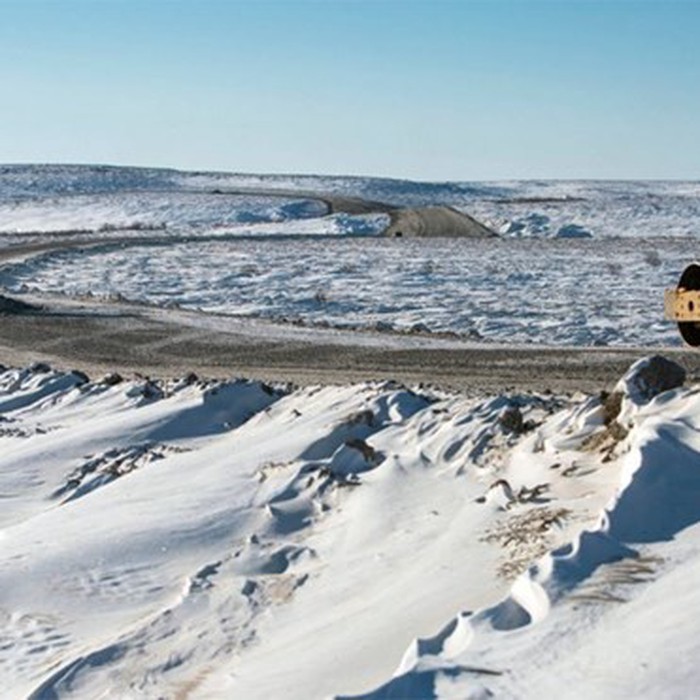
The current rebuild is not a patchwork repair but a comprehensive reconstruction. The railway is being engineered to Class I standards, capable of handling heavy unit trains at commercial scale. New roadbeds stabilize track over permafrost. Modern rails, reinforced bridges, and upgraded culverts are designed to withstand extreme weather. Advanced monitoring systems — including ground-penetrating radar, lidar mapping, drones, and sensor-based analytics — allow operators to predict failures before they occur.
This shift from reactive repair to predictive maintenance has transformed reliability, the single most important factor for bulk commodity shippers.
“Class I is a signal to markets,” said one logistics analyst quoted recently in FreightWaves, a U.S. industry publication. “It tells you this corridor is not experimental. It’s permanent.”
That permanence is already attracting traffic.
Grain is the most immediate beneficiary. Saskatchewan and Manitoba produce vast quantities of wheat, canola, and specialty crops, much of which is bound for Europe. The route from Churchill across Hudson Bay is significantly shorter than shipping west to Vancouver or south through American ports. With expanded storage and icebreaker support extending the shipping season, volumes are expected to grow into the millions of tons annually.
Fertilizer is close behind. Saskatchewan’s potash industry, which exports roughly 95 percent of its output, has long depended on U.S. logistics networks. With Class I capacity, heavy loads can now move north efficiently. Genesis Fertilizers has already signed agreements to use the corridor, according to industry filings cited by Canadian and U.S. trade commentators on X.
Critical minerals may be the most strategically significant cargo of all. Northern Canada holds substantial deposits of nickel, lithium, cobalt, and rare earth elements — materials essential to electric vehicles, defense systems, and renewable energy infrastructure. Direct rail access to an Arctic port allows these resources to reach European buyers without passing through American processing or export terminals.
The Arctic Gateway Group has confirmed multiple successful shipments of critical minerals to Europe over the past two seasons, a fact that has drawn attention from U.S. supply-chain analysts who see the move as part of a broader Western effort to reduce chokepoints.
Energy proposals push the vision even further. Under the “Port of Churchill Plus” concept, planners are studying corridors for liquefied natural gas, hydrogen transported as ammonia, and expanded electricity transmission. Alberta officials have openly discussed an energy route to Churchill, framing it as a way to reach global markets while bypassing U.S. export bottlenecks.
For American logistics firms that once dismissed the Hudson Bay Railway as a curiosity, the revival poses an uncomfortable question. Every ton that moves north is a ton that no longer generates revenue for U.S. railways, ports, and storage facilities. While the United States remains Canada’s largest trading partner by far, the balance of leverage may be shifting at the margins.
“This isn’t about abandoning the U.S.,” a former Canadian trade official wrote recently in a widely shared LinkedIn post. “It’s about no longer having only one door to the world.”
Whether the corridor ultimately redirects “hundreds of billions” in trade, as some proponents suggest, remains uncertain. Climate conditions, global commodity cycles, and shipping insurance costs will all play a role. But what is already clear is that Canada is no longer content to treat geography as destiny.
A railway once written off as a failure is being repurposed as a strategic asset. In doing so, Canada is quietly asserting a principle that has gained traction across Western capitals: in an era of politicized supply chains, infrastructure is sovereignty.
And sometimes, the most consequential shifts begin not with a summit or a sanction, but with steel laid carefully across frozen ground.