Canada’s Quiet Counterstrike: How “Buy Canadian” Is Rewriting the Economics of Trump’s Tariff Threats

When former President Donald Trump threatened on Saturday to impose a 100 percent tariff on all Canadian goods entering the United States, the remark landed with the familiar shock of a blunt instrument. It was sweeping, punitive and unmistakably political. But in Ottawa, the response was notably subdued.
Hours later, Prime Minister Mark Carney released a short, pre-recorded video. There was no mention of Trump. No condemnation. No appeal for negotiations. Instead, Carney offered a simple framing: Canada could not control what other countries did, but it could control what it bought, built and invested in at home.
“We can be our own best customer,” he said. “We’ll buy Canadian. We’ll build Canadian.”
To many observers in Washington, the contrast was striking. While Trump escalated rhetorically on social media, Canada unveiled what amounts to a structural answer to tariff pressure — one that does not rely on retaliation, but on insulation. Behind Carney’s calm delivery lay a sweeping industrial and procurement strategy that had been months in the making, and that now threatens to erode the very leverage Trump’s tariff threats are designed to exploit.
A Policy Hidden in Plain Sight
The “Buy Canadian” strategy did not emerge in reaction to Trump’s weekend remarks. It was embedded in Canada’s 2025 federal budget, passed quietly in November, and formally implemented on December 16. At the time, it attracted limited attention outside policy circles, dismissed by many commentators as routine economic nationalism — the kind every advanced economy practices to some degree.
Only after Trump’s tariff threat did the scale become clear.
Under the revised federal procurement rules, Canadian suppliers are given priority on major government contracts, with mandatory domestic content requirements for steel, aluminum and wood. For strategic procurements valued at $25 million or more — a threshold scheduled to drop to $5 million by spring 2026 — materials must not only be sold by Canadian companies, but manufactured or processed in Canada.
The federal government estimates that the changes will redirect at least $70 billion in spending toward domestic suppliers over the next several years. In total, nearly $300 billion in federal expenditures over five years will fall under some form of Canadian-content requirement.
“It’s not protectionism in the old sense,” said one former Canadian trade official, now at a Washington think tank. “It’s a demand-side industrial policy designed to make external pressure less effective.”
Turning Procurement Into Strategy
The first visible result arrived on January 15, days before Trump’s threat. Ottawa and the Ontario government jointly increased funding for 55 new Toronto subway trains, bringing the project’s value to $1.9 billion. The trains will be built by Alstom at facilities in Thunder Bay, Ontario, and in Quebec, supporting hundreds of domestic manufacturing jobs.
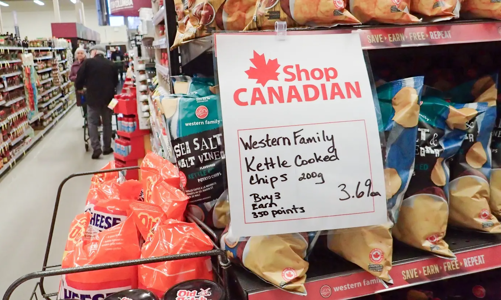
Carney highlighted the project as the first of many. Over the next five years, Buy Canadian provisions will apply to defense procurement, housing, transit, municipal infrastructure and energy projects.
Defense spending alone totals $81 billion, meeting NATO’s two-percent target this year. New investments include domestic ammunition production, vehicle manufacturing, shipbuilding and cyber defense — areas long dominated by U.S. contractors. A newly created defense investment agency is tasked with accelerating procurement and building a Canadian defense industrial base less reliant on American supply chains.
Housing represents another pillar. Through the Build Canada Homes initiative and related programs, Ottawa plans to double annual housing construction to as many as 480,000 units by the end of the decade, using industrialized building methods and Canadian lumber and steel. Infrastructure spending, totaling more than $115 billion, carries similar requirements.
The cumulative effect is deliberate. Where Canada once relied on exports to the United States to sustain key industries, Ottawa is now locking in domestic demand through government purchasing power.
Why Tariffs Lose Their Bite
Trump’s tariff threats rest on a long-standing assumption: that Canada needs access to U.S. markets more than the United States needs Canadian supply. About three-quarters of Canadian exports still go south of the border, and cross-border supply chains — particularly in autos, energy and construction materials — are deeply integrated.
But procurement-driven demand changes the equation.
If Canadian steel mills have guaranteed domestic buyers for federally funded projects, tariffs on exports hurt less. If Canadian aluminum smelters know government construction will prioritize their output, reliance on volatile foreign markets diminishes. If lumber is absorbed by domestic housing programs, U.S. lumber duties lose much of their sting.
The same logic applies to defense. Ammunition factories built to meet Canadian procurement needs will operate for decades. Once established, they are unlikely to be dismantled in favor of imports, regardless of political shifts in Washington.
“This is not a temporary countermeasure,” said an economist who advises multinational manufacturers. “It’s permanent capacity creation. That’s what makes it strategically significant.”
A Familiar Debate, Reframed
In U.S. media, reactions have been mixed. Conservative commentators on platforms like Fox News and X have framed Buy Canadian as an affront to free trade, while others note the irony: the United States has long enforced Buy American provisions, including under Trump himself.
Trade lawyers point out that government procurement preferences are broadly permitted under World Trade Organization rules and are common among allies. Challenging Canada’s approach would likely invite scrutiny of U.S. procurement policies in return.
On financial networks like CNBC and Bloomberg, analysts have focused less on legality and more on trajectory. Canada’s strategy, they note, accelerates a gradual economic decoupling already underway as geopolitical risk reshapes supply chains.
Trump, for his part, has few obvious counters. He can raise tariffs further, but doing so may only strengthen domestic support in Canada for reducing dependence on U.S. markets. He can accuse Canada of protectionism, but that argument rings hollow in a political environment where industrial policy has bipartisan backing in Washington.
A Different Kind of Message
Perhaps the most striking aspect of Canada’s response is its tone. Carney did not frame Buy Canadian as defiance. He framed it as pragmatism.
Provincial leaders quickly echoed the message. British Columbia’s premier praised the strategy as forward-looking. Manitoba’s premier declared that Canada would not be economically coerced — by any country.
The discipline contrasts sharply with past trade disputes, where Canadian leaders often rushed to reassure Washington of their goodwill. This time, Ottawa made clear it was not negotiating under threat.
For decades, Canadian governments spoke about diversifying trade and reducing reliance on the United States. Few committed the resources to do it. Trump’s repeated use of tariffs as leverage — coupled with rhetoric questioning Canadian sovereignty — appears to have changed that calculus.
Building Immunity

In Washington, the episode offers a broader lesson. Tariffs work best against economies that lack alternatives. When a government uses its own purchasing power to create those alternatives, coercion becomes harder to sustain.
Canada is not trying to match American economic power. It is doing something more subtle: making American power less relevant to its own prosperity.
As Buy Canadian rolls out through 2026, each contract awarded to a domestic supplier, each factory built to meet federal demand, further reduces the effectiveness of threats made from across the border.
Trump can escalate. He can post. He can threaten. But Canada, for now, is building.
And in the long run, infrastructure tends to outlast rhetoric.