In the House of Commons, Mark Carney Draws a Line: “Canada Is Not America”
In the clipped, adversarial cadence of Question Period, moments of clarity are rare. But on a recent afternoon inside Canada’s House of Commons, Prime Minister Mark Carney distilled his government’s posture into three declarative words: Canada is not America.
It was more than a rejoinder. It was a frame.
Across the aisle, Conservative leader Pierre Poilievre had sought to fuse two anxieties — strained health care access and immigration levels — into a single indictment. Six million Canadians lack a family doctor, he said. Waiting lists have grown. Refugee claims have surged. The system, he argued, has been overwhelmed by what he described as out-of-control immigration.
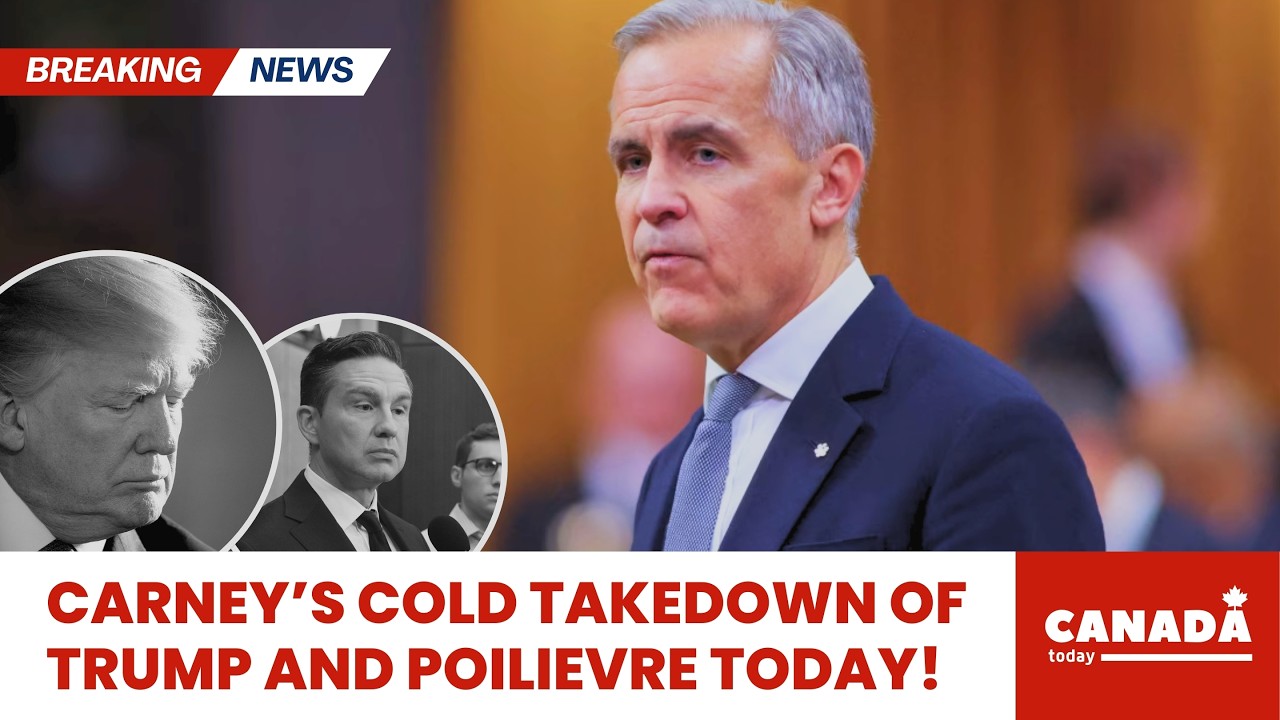
Carney did not contest that the health system faces pressure. Instead, he rejected the premise that the solution lies in narrowing eligibility or adopting a more exclusionary model. “Canada is not America,” he said, affirming that essential health care in Canada remains universal — a pointed contrast with the more fragmented system south of the border.
The exchange that followed was not remarkable for theatrics. It was notable for containment.
Poilievre escalated with large, arresting figures — increases measured in the thousands of percent, deaths on waiting lists, a system allegedly spiraling. The strategy was clear: overwhelm the chamber with scale and urgency, bind the government to a narrative of chaos, and demand a reversal.
Carney answered in the language of incremental control. Asylum claims, he said, are down by one-third during his tenure. Temporary foreign workers are down by half. International student numbers have fallen by 60 percent. If the opposition’s charge was that the system is spinning outward, Carney’s reply was that the valves are already being tightened.
There was also a quieter maneuver embedded in his response. “I just got here,” he said, noting that he is approaching his first anniversary as prime minister. It was a subtle but deliberate act of insulation. After more than a decade of Liberal governance, Carney positioned himself less as an inheritor of accumulated strain and more as a corrective steward tasked with recalibration.
Poilievre resisted that reframing. The prime minister, he argued, sits atop the same cabinet architecture — the same finance, justice and immigration portfolios — that shaped the policies now under scrutiny. Institutional continuity, in the Conservative telling, nullifies personal newness.
Yet Carney’s counter was not to relitigate the past but to relocate responsibility. Parliament, he implied, is a shared enterprise. The opposition leader has spent his entire career in the chamber. Structural pressures — demographic change, pandemic backlogs, global displacement — cannot be affixed to a single officeholder without oversimplifying a system that spans provinces, professional colleges and federal transfer arrangements.
When the debate turned to crime and sentencing, the temperature rose again. Poilievre accused the government of tolerating a two-tiered approach in which foreign nationals receive leniency. Carney did not trade in rhetoric. He pointed to legislation — Bills C-2 and C-12 — and invited opposition support. It was a familiar parliamentary gambit: when accused of inaction, cite the bill number; when challenged on resolve, call for votes.
The tactic shifts the burden. If the opposition supports the legislation, it concedes partial alignment. If it opposes, it must explain why its critique does not translate into statutory change.
What unfolded, then, was less a clash of personalities than a study in competing narratives. Poilievre’s frame is crisis: a health system buckling under demographic and migratory weight, a government inattentive to first principles. Carney’s frame is calibration: pressures acknowledged, numbers adjusted, universality preserved.
The invocation of the United States was not incidental. In recent years, comparisons with Donald Trump and the more combative currents of American politics have served as a shorthand in Canadian debate — a way to signal what Canada is, and what it is not. By drawing a bright line, Carney tethered his defense of universal care to national identity itself.

Whether that identity can withstand persistent strain is another question. Provincial health systems continue to report staffing shortages. Immigration, even at reduced levels, remains historically high by Canadian standards. Public patience is not infinite.
But in the chamber that day, Carney achieved what prime ministers often seek in moments of concentrated attack: he narrowed the aperture. He refused to litigate every statistic in the abstract and instead redirected attention to directionality — down one-third, down 50 percent, down 60 percent. Control, not collapse.
Politics rarely turns on a single sentence. Yet occasionally a sentence clarifies the stakes. “Canada is not America” was both a rebuttal and a reminder — that policy disputes here are often proxies for a deeper argument about the country’s social contract.
In the end, Question Period offered no resolution to the underlying tensions in health care or immigration. It did, however, reveal the contours of the contest to come: crisis versus course correction, rupture versus restraint. And in three words, the prime minister signaled which side of that divide he intends to occupy.