Canada’s Prime Minister Says the Old Order Is Over — and Middle Powers Must Adapt
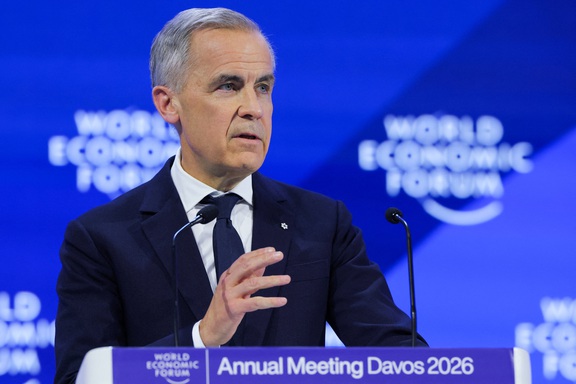
Davos, Switzerland
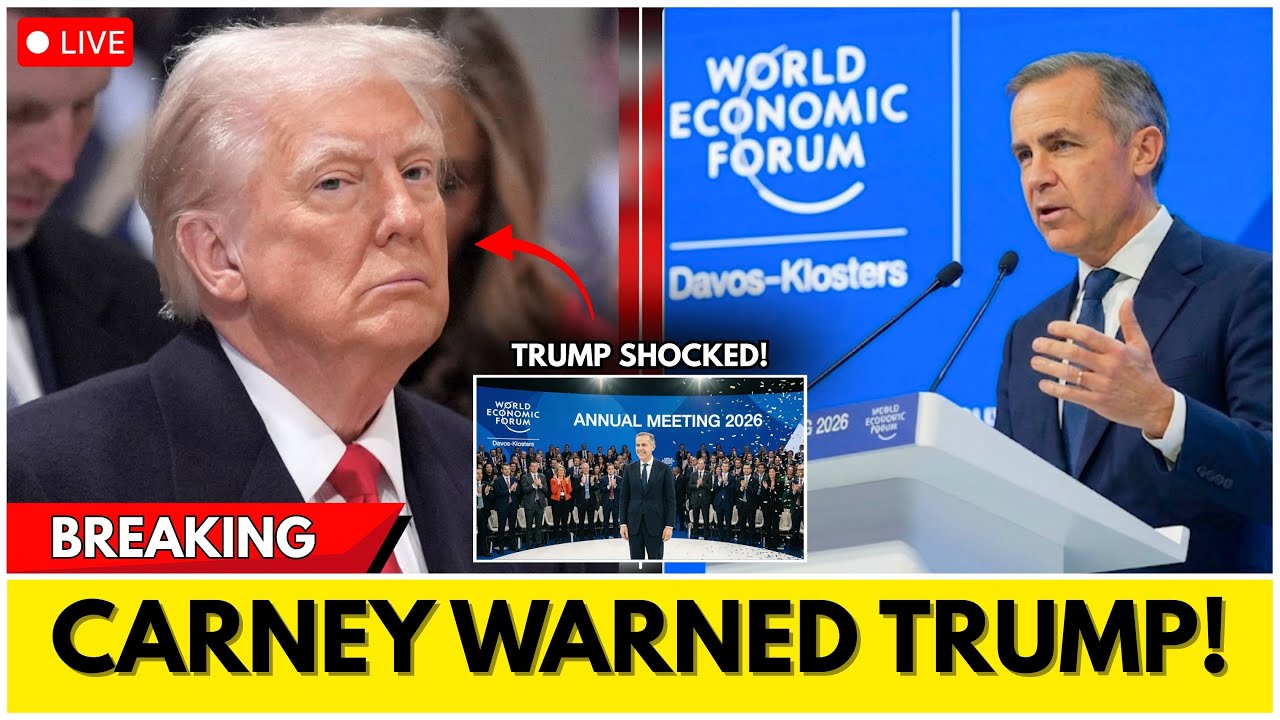
At the World Economic Forum in Davos, Prime Minister Mark Carney of Canada delivered a speech that sounded, at first glance, like a meditation on global cooperation. In reality, it was something far more consequential: a declaration that the postwar, U.S.-led international order is finished — and that countries like Canada are no longer waiting for it to return.
“Middle powers must act together,” Mr. Carney said, “because if you are not at the table, you are on the menu.”
The line quickly ricocheted across social media. It was clipped, reposted, and debated on X. Cable news panels parsed it as a rebuke of American unilateralism. Foreign policy analysts described it as one of the most explicit acknowledgments yet from a close U.S. ally that the rules-based order Washington once championed can no longer be assumed to function.
What made the speech striking was not just its rhetoric, but the fact that Canada’s actions already match its tone.
While President Trump has threatened tariffs, trade retaliation and even annexation rhetoric against allies, Mr. Carney has spent the past six months quietly executing a foreign policy pivot of unusual speed and scope. According to Canadian government disclosures, Ottawa has concluded or finalized 12 trade and security agreements across four continents, doubled defense spending, locked in a comprehensive partnership with the European Union that includes defense procurement, concluded strategic agreements with China and Qatar, and launched free trade negotiations with India and the Association of Southeast Asian Nations.
This is not aspirational diplomacy. It is operational.
A Speech That Never Named the United States — but Addressed It Throughout
Mr. Carney never mentioned President Trump by name. He did not need to.
Instead, he spoke of “great powers using economic integration as a weapon,” of tariffs deployed as coercion, of supply chains turned into tools of pressure, and of partners asked to perform sovereignty while accepting subordination. The audience in Davos — executives, ministers and central bankers — understood the reference immediately.
In one of the speech’s most pointed passages, Mr. Carney invoked the Czech dissident Václav Havel’s famous 1978 essay The Power of the Powerless, which described how authoritarian systems persist not through belief, but through ritualized compliance. Havel’s metaphor of the “green grocer” — who displays a slogan he does not believe simply to avoid trouble — was not obscure to this audience.
“It is time for companies and countries to take their signs down,” Mr. Carney said.
The line landed heavily. Analysts on Bloomberg and commentators across policy-focused social media read it as a call for allies to stop pretending that old norms still constrain powerful states when they plainly do not.
For Canada, the implication was unmistakable: the era of automatic alignment with Washington, justified by shared rules and mutual restraint, has ended.
“Nostalgia Is Not Strategy”

Perhaps the most consequential part of the speech was also the least emotional.
“The old order is not coming back,” Mr. Carney said. “And we should not mourn it. Nostalgia is not strategy.”
That sentence, widely quoted in U.S. and European media, signaled a rejection of the quiet hope — still common among American allies — that the system might revert to its pre-Trump equilibrium. Mr. Carney argued instead that the rupture is structural and permanent, not a pause or deviation.
In his telling, President Trump did not create the breakdown of the global order but accelerated it, stripping away the remaining illusions that rules alone protect smaller states. The choice, Mr. Carney said, is no longer whether to defend the old system, but how to operate in its absence.
Against a World of Fortresses
Importantly, Mr. Carney did not argue for isolation. On the contrary, he warned against what he called a “world of fortresses” — a future in which every country seeks self-sufficiency in energy, food, finance and technology.
Such a world, he argued, would be poorer, more fragile and more dangerous. Replicating infrastructure is expensive. Hoarding resources creates brittleness. Autarky may buy short-term security, but at enormous long-term cost.
The alternative, Mr. Carney proposed, is what he called collective autonomy: middle powers sharing the costs of resilience through cooperation, diversifying dependencies rather than eliminating them, and ensuring that no single hegemon can dominate critical systems.
It is a framework that rejects both American coercion and Chinese overdependence — without requiring countries to choose one camp wholesale.
Coalitions Without Washington
Canada’s strategy is already taking shape through what officials describe as “variable geometry” coalitions — different groupings for different problems.
On defense, Canada has deepened integration with European partners, including procurement arrangements that no longer depend on U.S. approval. On Arctic security, Ottawa has aligned closely with Denmark and Nordic and Baltic states in response to renewed territorial pressures. On trade, Canada is working to bridge the Comprehensive and Progressive Agreement for Trans-Pacific Partnership with the European Union — a move that would create a 1.5-billion-person free trade zone without the United States.
On technology, Canada is cooperating with like-minded democracies on artificial intelligence governance that avoids both Chinese state control and American corporate dominance. On critical minerals, Ottawa is backing buyer clubs that reduce reliance on single suppliers and dilute great-power leverage.
The United States is not excluded everywhere — but it is no longer indispensable anywhere.
A Different Kind of Realism
Mr. Carney described Canada’s approach as “value-based realism” — a phrase that circulated widely on American policy blogs and think tank feeds after the speech.
The concept is simple but consequential: principles still matter, but relationships are calibrated, not absolutist. Canada will work with China on climate while criticizing human rights abuses. It will partner with Gulf states on energy while maintaining democratic commitments. Cooperation does not require total alignment, and disagreement does not require rupture.
It is a sharp contrast with Mr. Trump’s transactionalism, which prizes immediate advantage over durable relationships and treats compromise as weakness.
Moving On, Not Rebelling
What made the Davos speech unsettling for many in Washington was not hostility toward the United States, but indifference to its approval.
Canada is not staging a dramatic break. It is moving on.
For global investors and governments seeking stability for 30-year infrastructure and energy contracts, that matters. Mr. Trump’s unpredictability has weakened American credibility as a reliable partner. Mr. Carney was effectively marketing Canada as an alternative: stable, pluralistic, resource-rich and strategically clear-eyed.
As one widely shared post from a former U.S. diplomat put it, “This wasn’t anti-American. It was post-American.”
The Table Has Moved
Mr. Carney ended where he began, returning to the green grocer and the danger of pretending.
Removing the sign, he suggested, is not an act of rebellion but of honesty. The rules-based order no longer restrains the powerful. Waiting for it to return is not prudence but denial.
For middle powers, the choice is stark: compete for favor and be consumed, or combine and create leverage. Perform compliance, or build sovereignty together.
In Davos, Mr. Carney made clear that Canada has chosen.
And in doing so, he left an implicit warning for Washington: the table is still there — but it has moved.