At the World Economic Forum in Davos this week, President Trump revived a familiar posture — part brinkmanship, part performance — and aimed it north.
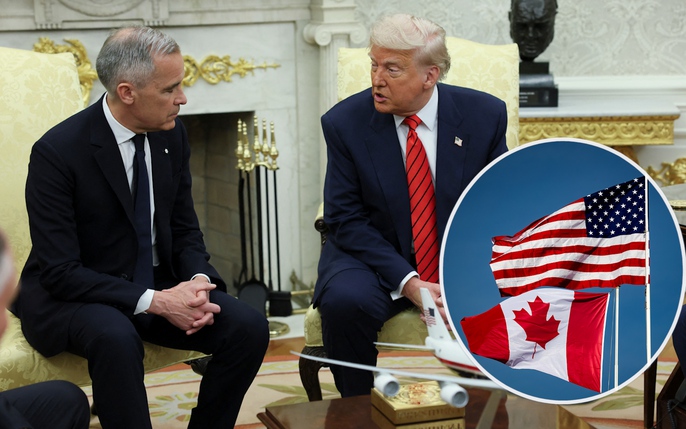
“We’re building a golden dome… going to be defending Canada,” he said, before adding a line that ricocheted across Canadian politics: “Canada lives because of the United States. Remember that, Mark.”
Within 48 hours, Canada’s new prime minister, Mark Carney, answered in a tone designed to puncture the premise rather than escalate the drama. “Canada doesn’t live because of the United States,” he said, according to accounts from the Canadian government’s retreat in Quebec City. “Canada thrives because we are Canadian.”
The exchange — and what followed — has become a case study in how modern economic threats are made, met, and sometimes withdrawn. Trump’s rhetoric on Greenland, paired with warnings about tariffs and sovereignty, appeared to test whether allies would respond with the usual choreography: cautious statements, private calls, and a slow drift back toward accommodation. Instead, the pushback came quickly, publicly, and in alignment: Denmark and Greenland drew explicit red lines about sovereignty, while European leaders and NATO officials signaled discomfort with Trump’s framing.
Then, as abruptly as the threats had surged, Trump stepped back from at least one key lever — the tariff pressure around Greenland — and described a vague “framework” after speaking with NATO leadership. Reuters reported that Trump backed down on Greenland tariffs and pointed to a “deal framework,” without the kind of concrete terms he typically uses to sell a win.

A rebuttal built for a global audience
Carney’s Davos speech was not simply a rebuttal to Trump. It was drafted as a statement of doctrine — one that treated coercive trade tactics as a structural problem, not a bilateral quarrel. In the official transcript published by the World Economic Forum, Carney warned about “economic integration as coercion,” and urged middle powers to act with consistency toward both rivals and allies.
That framing matters, because Trump’s leverage historically depends on uncertainty and fragmentation: if partners fear being isolated, they often soften their response. But when multiple capitals signal — in public — that sovereignty is not negotiable, the threat calculus changes. What looked like pressure on Greenland starts to look like pressure on NATO’s norms.
The political impact inside Canada was immediate. Reuters described Carney’s Davos moment as rallying domestic support, including rare praise from across party lines, in part because it offered Canadians a vocabulary — pride and independence — rather than a defensive crouch.
The retaliation that didn’t land
Trump’s counterpunch arrived not as policy but as symbolism: he rescinded Canada’s invitation to join an American-led “Board of Peace,” according to ABC News and corroborated by Trump’s own post on Truth Social.
In Washington, the move was presented as another piece of leverage. In Ottawa, it was treated as a tell — a gesture that cost Canada little while advertising Trump’s irritation at being contradicted on an international stage. Carney, as Reuters noted in its broader coverage of the feud, offered no immediate, personalized response — a choice that avoids validating the premise that Canada needs U.S. approval to matter.
The dispute then widened into trade. On Saturday, Trump threatened a 100% tariff on Canadian goods if Canada pursued a closer trade arrangement with China, according to the Associated Press and Barron’s. The threat — issued via Truth Social — was framed in language meant to warn that Canada could become a “backdoor” for Chinese goods into the U.S.
Canadian officials, for their part, argued that every major economy is attempting to chart a strategic path with China “with eyes wide open,” rejecting the idea that diversified trade is synonymous with disloyalty.
The real fight is about dependency
Beneath the theatrics is a less dramatic but more consequential question: how exposed is the United States — and its allies — when critical supply chains become instruments of leverage?
Housing is one example. The U.S. relies heavily on imported Canadian softwood lumber, a foundational input for residential construction. When tariffs rise, builders say the added cost shows up quickly in bids, financing assumptions, and final sale prices — an especially sensitive pressure point in a market already strained by affordability. (Industry groups have circulated estimates of thousands of dollars per single-family home when lumber costs spike.) Even when such figures vary by region and build type, the direction of travel is consistent: higher input costs squeeze supply and raise prices.
Trade wars usually announce themselves with speeches and signing ceremonies. But the more unsettling reality is that influence can also move “quietly” — through procurement decisions, pricing shifts, and the accumulated friction of uncertainty. That is what makes the Trump–Carney confrontation more than a personality clash: it is a contest over whether North American integration is a tool of mutual gain or a choke point.
Carney’s argument in Davos — that middle powers should coordinate against coercion — is essentially a bet that alternatives can be built before threats arrive. Trump’s argument — explicit or implied — is that alternatives should be punished before they become real.
A retreat, a framework, and a precedent
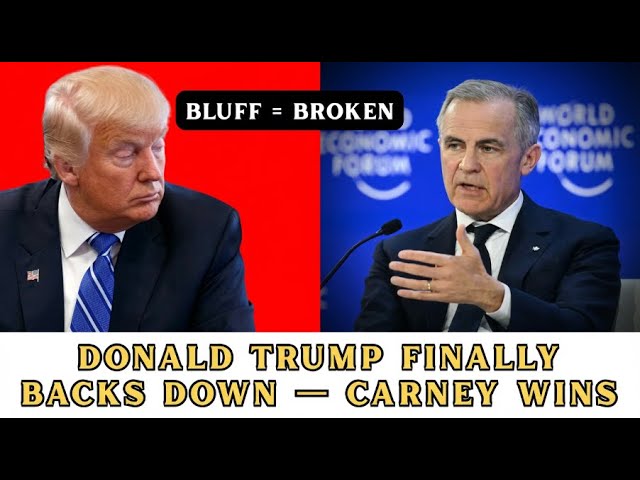
Did Trump “retreat”? Reuters and AP both described a step back from threatened Greenland tariffs after Trump spoke with NATO’s secretary general, with Trump shifting to a “framework” rather than immediate pressure. What matters politically is not whether Trump changed his views on Greenland, but whether allied alignment limited his room to maneuver.
If a threat is tested and then dropped, it leaves a residue: future threats can sound more like bluster than leverage — especially when met with calm, coordinated refusal rather than frantic negotiation.
That is the wager Carney appeared to be making: not that Trump will stop threatening, but that the threat itself can be devalued when the target stops acting cornered.