Europe Bets on Canadian Hydrogen, Leaving U.S. Gas on the Sidelines
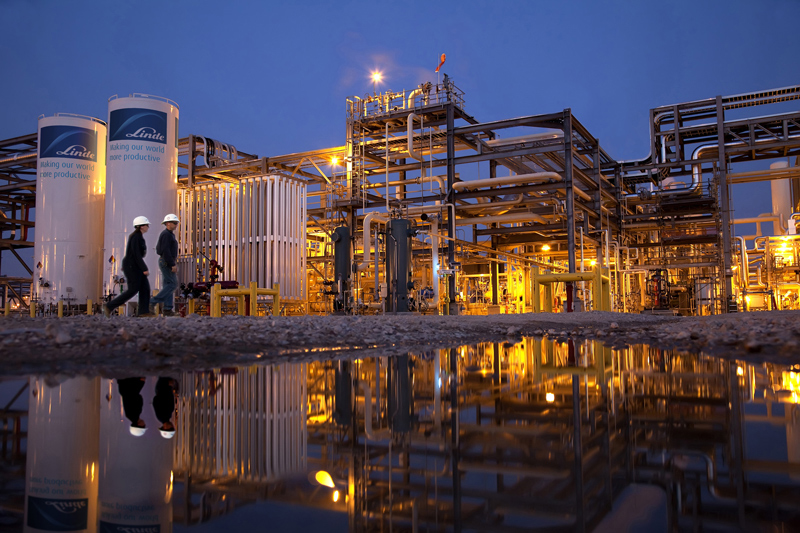
By early 2030, renewable hydrogen produced on the rocky Atlantic coast of Newfoundland could be powering Germany’s steel mills and chemical plants. A €400 million transatlantic deal approved this month by the European Commission suggests that the future of Europe’s energy security may run through Canada — not the United States.
When the European Commission quietly approved a €400 million German state-aid scheme for renewable hydrogen imports on January 15, the decision barely registered in Washington. In Berlin and Ottawa, however, it was understood as something much larger than a climate subsidy. It was a strategic pivot.
Half of the funding will come from Germany, half from Canada. The goal: to build 300 megawatts of electrolysis capacity in Newfoundland and Labrador, convert renewable hydrogen into ammonia, and ship it directly across the Atlantic to German ports — without American technology, American fuel, or American approval.
For Europe, the project promises long-term access to clean hydrogen at industrial scale. For Canada, it opens a multi-billion-dollar export market and cements its role as a core supplier in Europe’s post-fossil-fuel economy. For the United States, it signals a narrowing future for liquefied natural gas in a continent determined to decarbonize.
“This is not a pilot,” one European energy analyst wrote on X following the Commission’s approval. “This is infrastructure lock-in.”
A Legal Green Light With Strategic Consequences
The Commission approved the funding under Article 107 of the Treaty on the Functioning of the European Union, using its 2022 climate and energy state-aid guidelines. Teresa Ribera, the Commission’s executive vice president for a clean, just and competitive transition, framed the decision as essential to meeting Europe’s growing demand for renewable fuels while reducing dependence on fossil fuel imports.
The ruling explicitly cited the European Union’s REPowerEU strategy, developed after Russia’s invasion of Ukraine, which aims to eliminate reliance on Russian energy while accelerating the clean transition. What it did not mention was equally telling: American natural gas.
While U.S. LNG helped stabilize Europe during the immediate post-Ukraine crisis, Brussels has made clear that fossil fuels — regardless of origin — are a temporary solution. Binding regulations now require that 42 percent of hydrogen used in European industry be renewable by 2030, rising to 60 percent by 2035. Hydrogen produced from natural gas, even with carbon capture, does not qualify.
Canadian renewable hydrogen does.
Why Newfoundland Matters
On paper, Newfoundland and Labrador might seem an unlikely centerpiece of Europe’s energy future. With a population of just over 500,000, the province has long struggled with outmigration, unemployment and the decline of traditional industries.
But geographically and electrically, it is uniquely positioned.
Newfoundland’s grid is powered almost entirely by hydroelectricity. Churchill Falls alone generates more than 5,000 megawatts, supplemented by Muskrat Falls and Bay d’Espoir. That means electrolysis can run continuously, without the intermittency that complicates hydrogen production in wind- or solar-dependent regions.
The province is also closer to Europe than most of North America. Shipping routes from Newfoundland to Germany’s North Sea ports are shorter than those from the U.S. Gulf Coast, reducing transport costs and emissions. Existing port infrastructure at Come By Chance — originally built for oil and chemical exports — can be adapted for ammonia shipping far more quickly than greenfield projects elsewhere.
In an energy transition where logistics matter as much as technology, Newfoundland checks nearly every box.
German Industry Is Already Lining Up

The hydrogen produced in Canada is intended for Germany’s most carbon-intensive sectors. Steelmakers such as Salzgitter and Thyssenkrupp are converting blast furnaces to hydrogen-based direct reduction. Chemical giants like BASF are redesigning processes that currently rely on natural gas as both fuel and feedstock.
Germany’s import terminals at Wilhelmshaven and Brunsbüttel, now under construction, are being designed specifically for ammonia imports and hydrogen reconversion. Billions of euros are being invested on the assumption that overseas renewable hydrogen will arrive on schedule — and in volume.
Under the German subsidy scheme, producers bid the minimum price needed to make projects viable, while industrial buyers bid the maximum they are willing to pay. The government fills the gap. The mechanism, praised by energy economists on platforms like LinkedIn and Bloomberg Opinion, is intended to create genuine price discovery while accelerating scale.
Construction is expected to begin soon, with first deliveries targeted for the end of the decade — precisely when Germany’s emissions reduction deadlines tighten.
The United States Watches From the Sidelines
In Washington, the response has been muted. Energy policy debates remain focused on domestic gas production, LNG export capacity and political fights over permitting. On social media, climate-focused commentators have been blunter.
“Europe is building a future that U.S. gas simply doesn’t fit into,” one former Energy Department official wrote on Threads. “This isn’t about ideology. It’s about regulation and certainty.”
That certainty is where the United States struggles. European buyers are wary of long-term contracts tied to a country where climate policy swings dramatically with each election cycle. The Trump administration’s withdrawal from the Paris Agreement — and renewed skepticism toward climate regulation — has reinforced those concerns.
Even U.S. renewable hydrogen faces hurdles. Grid constraints, inconsistent standards and questions about additionality make compliance with European rules uncertain. Canadian projects, by contrast, are being designed explicitly to meet Europe’s strict criteria.
A Province Reinventing Itself
For Newfoundland and Labrador, the deal represents more than exports. Provincial officials have framed hydrogen as the cornerstone of economic diversification.
Hundreds of construction jobs are expected during the build-out phase, followed by permanent positions in operations, logistics and engineering. For a province long dependent on offshore oil, the transition is both symbolic and practical. Many of the skills — marine logistics, safety management, large-scale energy operations — transfer directly.
“This is the first time in decades that we’re not just shipping raw resources away,” a Newfoundland-based economist noted in a widely shared Facebook post. “We’re anchoring an industry.”
Lock-In Effects and a Narrowing Window
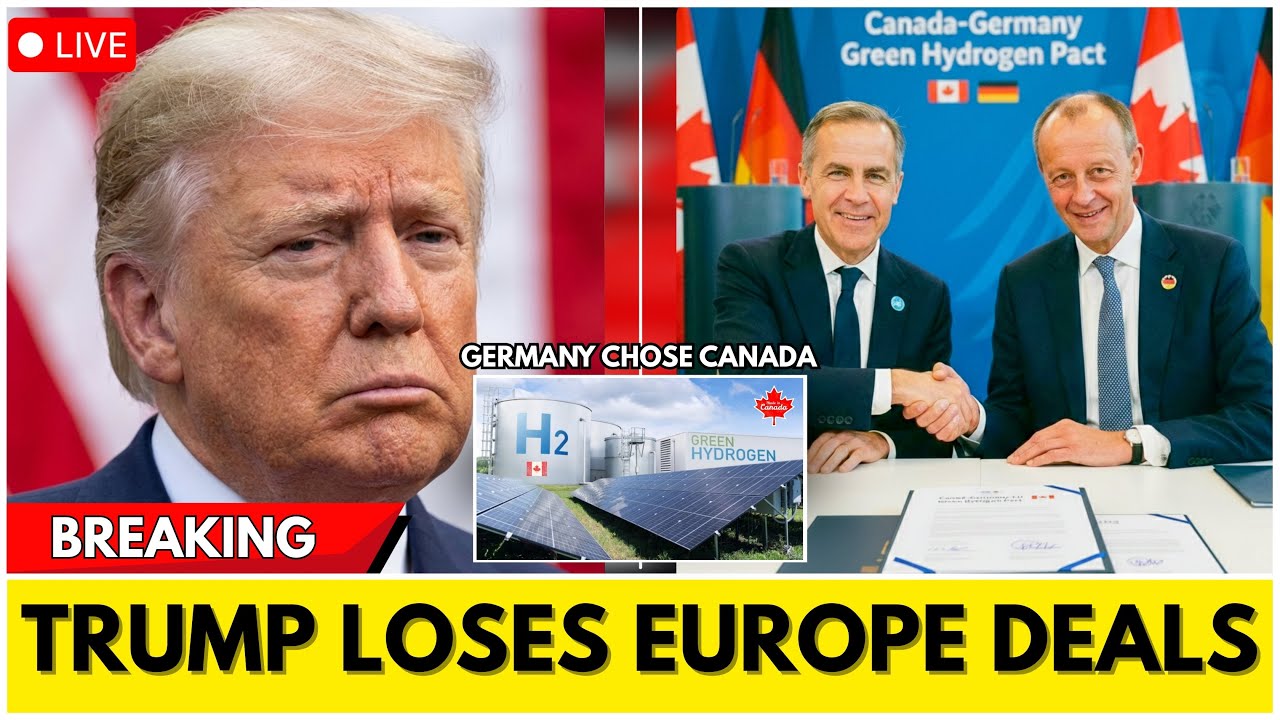
Energy infrastructure creates path dependence. Once terminals, pipelines and industrial conversions are built, reversing course becomes economically irrational. Thirty-year offtake contracts do not disappear with elections.
That is the strategic significance of the Commission’s decision. It is not merely approving funding; it is validating a supply chain that excludes the United States at a moment when Europe is redesigning its energy system from the ground up.
If the Canadian-German project succeeds, similar agreements with France, the Netherlands and Belgium are already being discussed in policy circles. Each one would further reduce Europe’s reliance on fossil fuels — and on American energy.
For decades, U.S. natural gas appeared destined to dominate Europe’s import market. Geography, infrastructure and commercial ties all pointed that way. But in the race to define the post-carbon economy, those advantages are eroding.
Canada saw the opening. Europe needed a partner. And the United States, preoccupied with old arguments, may have missed the moment when the future quietly sailed past its shores.