Lawmakers Clash Over Explosive Epstein Allegations as Unverified Claims Roil Washington

Washington — A House Oversight Committee hearing on Tuesday erupted into chaos after Representative Jamie Raskin of Maryland made a series of explosive allegations involving the federal government’s handling of the Jeffrey Epstein investigation, setting off a political firestorm that spread rapidly across social media but remains, as of now, unsubstantiated by publicly released evidence.
Mr. Raskin, a Democrat and a former constitutional law professor, asserted during questioning that his office had obtained internal FBI communications suggesting that inquiries related to Epstein and his associates were repeatedly curtailed over several years. He did not immediately release the documents in question, which he described as numbering in the thousands of pages, nor were they entered into the public congressional record during the hearing.
The claims, which were made under oath but without accompanying public documentation, immediately dominated political discourse online, with the hashtag #Raskin47 trending on X within an hour. Conservative and progressive commentators alike framed the moment as a potential turning point in the long-running controversy surrounding Epstein, the financier who died in federal custody in 2019 while awaiting trial on sex-trafficking charges.
A History of Distrust
The Epstein case has, for years, fueled public skepticism about elite accountability in the United States. Despite Epstein’s conviction in 2008 on state charges and his later federal indictment, questions have persisted about whether powerful associates escaped scrutiny. Ghislaine Maxwell, Epstein’s longtime confidante, was convicted in 2021 of sex-trafficking offenses, but prosecutors declined to name uncharged co-conspirators, citing legal constraints.
That history has made the case uniquely combustible, particularly in an era of deep mistrust in institutions. Any suggestion of a renewed cover-up, even absent evidence, spreads quickly.
What distinguished Tuesday’s hearing was not just the allegation itself, but the setting: a formal congressional proceeding involving the director of the FBI, Kash Patel, who was appointed earlier this year.
What Was Alleged
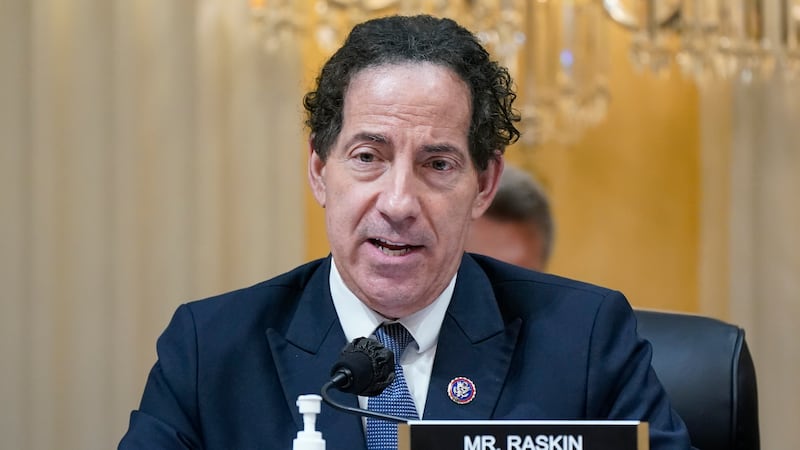
According to Mr. Raskin, the materials allegedly in his possession include internal FBI emails, memoranda, and directives dating from 2019 through 2025 that, he claimed, show repeated decisions to delay, narrow, or halt investigative steps related to Epstein-linked matters.
Mr. Raskin suggested that some investigative decisions were justified internally on grounds such as “political sensitivity,” “diplomatic considerations,” and “national security,” though he did not provide the underlying documents to reporters after the hearing.
At one point, Mr. Raskin referenced a directive he said bore Mr. Patel’s signature. Mr. Patel did not confirm or deny the authenticity of the document during the hearing, instead invoking his Fifth Amendment right against self-incrimination through counsel when pressed on specific questions.
Legal experts note that invoking the Fifth Amendment in congressional testimony is not, by itself, an admission of wrongdoing, despite frequent public misconceptions.
Immediate Fallout
The hearing was adjourned amid shouting from the audience and repeated calls for order from the committee chair. Within minutes, cable news networks cut into regular programming, while social media platforms lit up with speculation.
Influential accounts across the political spectrum framed the moment in starkly different ways. Progressive commentators described it as evidence of long-suspected institutional rot. Conservative figures, some of whom have criticized the FBI for years, portrayed the episode as confirmation of selective enforcement.
None of the major news organizations reporting on the hearing were able to independently verify Mr. Raskin’s claims by Tuesday evening.
Responses and Denials
The FBI issued a brief statement late Tuesday saying that it “categorically rejects any assertion that investigations are halted or directed based on political considerations” and emphasized that “no internal documents referenced in today’s hearing have been authenticated or released.”
A spokesperson for Mr. Patel declined to comment beyond the statement, citing ongoing legal considerations.
The White House also denied any involvement. “The administration does not direct or interfere with federal criminal investigations,” a senior official said, speaking on the condition of anonymity.
Mr. Raskin’s office said the documents would be made public “following appropriate review for classified or sensitive information,” but did not provide a timeline.
What Experts Say
Former federal prosecutors urged caution.
“Extraordinary claims require extraordinary evidence,” said Barbara McQuade, a former U.S. attorney and University of Michigan law professor. “Congress has broad oversight authority, but until documents are released and authenticated, these remain allegations.”
Others noted the political stakes. Mr. Raskin has been a prominent critic of former President Donald J. Trump and served as lead impeachment manager during Trump’s second Senate trial, making him a polarizing figure.
“This guarantees that any revelation—real or perceived—will be filtered through extreme partisan lenses,” said Julian Zelizer, a Princeton historian.
The Power of Viral Narratives
The speed with which the story spread highlighted how modern political narratives often outpace verification. Clips of the hearing, some edited or dramatized, accumulated millions of views on TikTok and YouTube within hours, often stripped of caveats or context.
Media researchers warn that Epstein-related content is especially prone to amplification because it intersects with legitimate grievances, conspiracy culture, and genuine historical failures.
What Happens Next
The Oversight Committee has not yet announced whether it will formally subpoena the documents Mr. Raskin referenced. Several members from both parties said privately that any such materials would need to be reviewed by committee staff and intelligence officials before release.
For now, the episode has raised more questions than answers: whether the documents exist as described, whether they support the conclusions drawn from them, and whether they will withstand legal and factual scrutiny.
Until then, what unfolded on Capitol Hill represents not proof of a cover-up, but a reminder of how unresolved scandals, institutional mistrust, and digital amplification can converge to shake Washington—sometimes faster than the facts can catch up.