Canada Draws a Line as Mark Carney Reframes Power, Alliances, and a Post-American Illusion
By Staff Writer
DAVOS, Switzerland — The laughter came first.
Before the standing ovation, before the carefully chosen historical references and the deliberate dismantling of diplomatic euphemism, the global audience at the World Economic Forum was laughing — not merely at a sketch comedy parody of Donald Trump, but at the unease that parody now represents.
In recent weeks, clips from Canada’s long-running satirical program This Hour Has 22 Minutes have gone viral across American social media platforms, circulating widely on X, TikTok, and YouTube. In the sketches, an exaggerated Trump claims responsibility for wars he allegedly “starts and then stops,” accepts imaginary awards ranging from a Nobel Peace Prize to a BET Award, and announces his intention to invade Greenland — all played for laughs, yet uncomfortably close to reality.
Comedy, in this case, was not a distraction. It was a prelude.

On Tuesday in Davos, Canada’s prime minister, Mark Carney, delivered one of the most consequential speeches of the forum — not because of rhetorical flourish, but because of its clarity. In an era where world leaders often speak in calibrated ambiguity, Carney chose bluntness. The target of his message was unmistakable, even when unnamed: a United States that has begun treating economic integration as a weapon rather than a shared good.
“We are in the midst of a rupture, not a transition,” Carney said, to sustained applause.
A Middle Power Speaks Plainly
Carney, who assumed office in March 2025 after a career spanning global finance and central banking, is not known as a charismatic politician. He does not dominate headlines the way his predecessor did, nor does he command the stage like populist leaders elsewhere. But his Davos address cut through the noise precisely because it avoided spectacle.
Drawing on the Czech dissident Václav Havel’s essay The Power of the Powerless, Carney described how political systems endure not merely through force, but through ritualized compliance — what Havel called “living within a lie.” In Carney’s telling, the modern international order has been sustained by a similar fiction: that rules apply equally, that trade is neutral, and that alliances are immune to coercion.
That fiction, he argued, no longer holds.
Over the past decade, and with increasing intensity in recent months, economic tools once framed as technocratic — tariffs, financial infrastructure, supply chains — have been deployed as instruments of pressure. Nowhere has that been clearer than in the renewed rhetoric surrounding Greenland, where President Trump has publicly threatened tariffs and coercive leverage against European allies while insisting the United States has a strategic right to control the territory.
Carney rejected that logic outright.
“We stand firmly with Greenland and Denmark,” he said. “Their future is theirs alone to determine.”
From Quiet Partner to Assertive Ally
For decades, Canada’s foreign policy rested on an assumption shared by many U.S. allies: that geography and alliance membership would automatically translate into security and prosperity. Carney acknowledged that assumption openly — and declared it obsolete.
Canada, he said, is recalibrating.
The country is increasing investments in Arctic defense, including radar systems, submarines, aircraft, and permanent deployments — “boots on the ground, boots on the ice,” as he put it. At the same time, Ottawa is opposing U.S. tariffs linked to Greenland and calling for focused, multilateral talks instead of unilateral pressure.
This is not a rejection of the United States, Carney emphasized, but a rejection of pretense.
The old order, he argued, is not returning. And nostalgia, he warned, “is not a strategy.”
Satire as Signal
The juxtaposition between Carney’s speech and the viral Trump parody circulating online has not been lost on observers.
Across American media — from MSNBC panels to commentary in The Atlantic and Politico — analysts have noted how satire has become a diagnostic tool, revealing truths that formal diplomacy often avoids. The Trump depicted in comedy sketches is impulsive, performative, obsessed with dominance and accolades — a caricature, yes, but one grounded in patterns that allies now openly factor into their strategic planning.
What once might have been dismissed as exaggeration now functions as warning.
As one former U.S. diplomat remarked on social media, “When allies are laughing, it’s already too late to reassure them with words.”
Value-Based Realism
Carney described Canada’s approach as “value-based realism” — a phrase borrowed from Finland’s president and increasingly echoed among middle powers navigating a fractured global system.
The concept is straightforward: uphold core principles — sovereignty, territorial integrity, human rights, and the prohibition of force — while acknowledging that interests diverge and progress is often incremental. It is neither moral absolutism nor cynical realpolitik, but an attempt to anchor pragmatism in values.
This framing resonated in Davos precisely because it spoke to countries caught between great-power rivalry. Middle powers, Carney argued, have the most to lose in a world of fortresses — and the most to gain from coordinated resistance to coercion.
“The powerful have their power,” he said. “But we have something too: the capacity to stop pretending.”
A Standing Ovation — and a Message
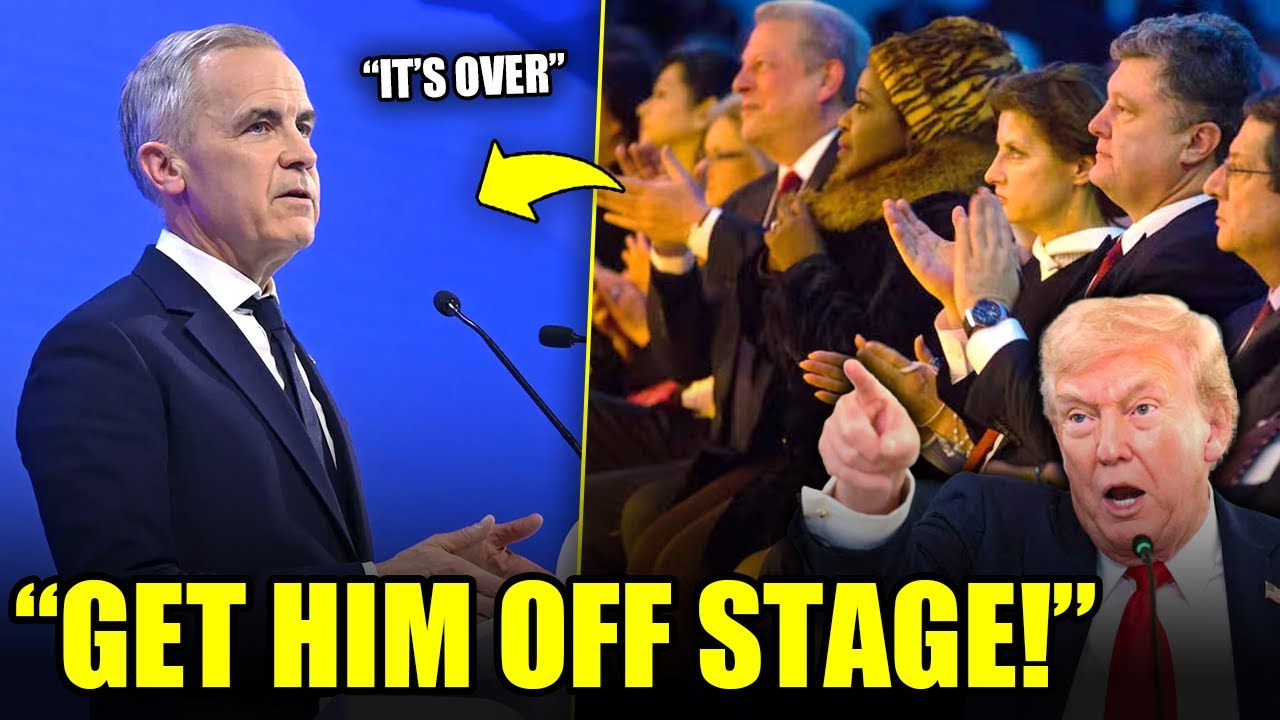
The standing ovation that followed was not merely for Carney’s delivery. It was for the articulation of a sentiment that has been building quietly among allies: that the rules-based order was never perfect, but pretending it still functions as before is now more dangerous than admitting its flaws.
In Washington, reactions have been mixed. Some commentators dismissed the speech as symbolic, while others saw it as a turning point — a sign that even America’s closest partners are no longer willing to absorb unpredictability as the cost of alliance.
Trump, for his part, has not directly responded. But his recent statements — including renewed boasts about coercive leverage and territorial ambition — have only reinforced the concerns Carney laid bare.
Comedy may soften the blow. Policy does not.
As Canada removes the sign from the window — refusing to perform rituals it no longer believes — the question facing the rest of the world is whether others will follow.
Not out of hostility toward the United States, but out of realism about what it has become.