When Late Night Meets the Internet’s Fact-Checking Test
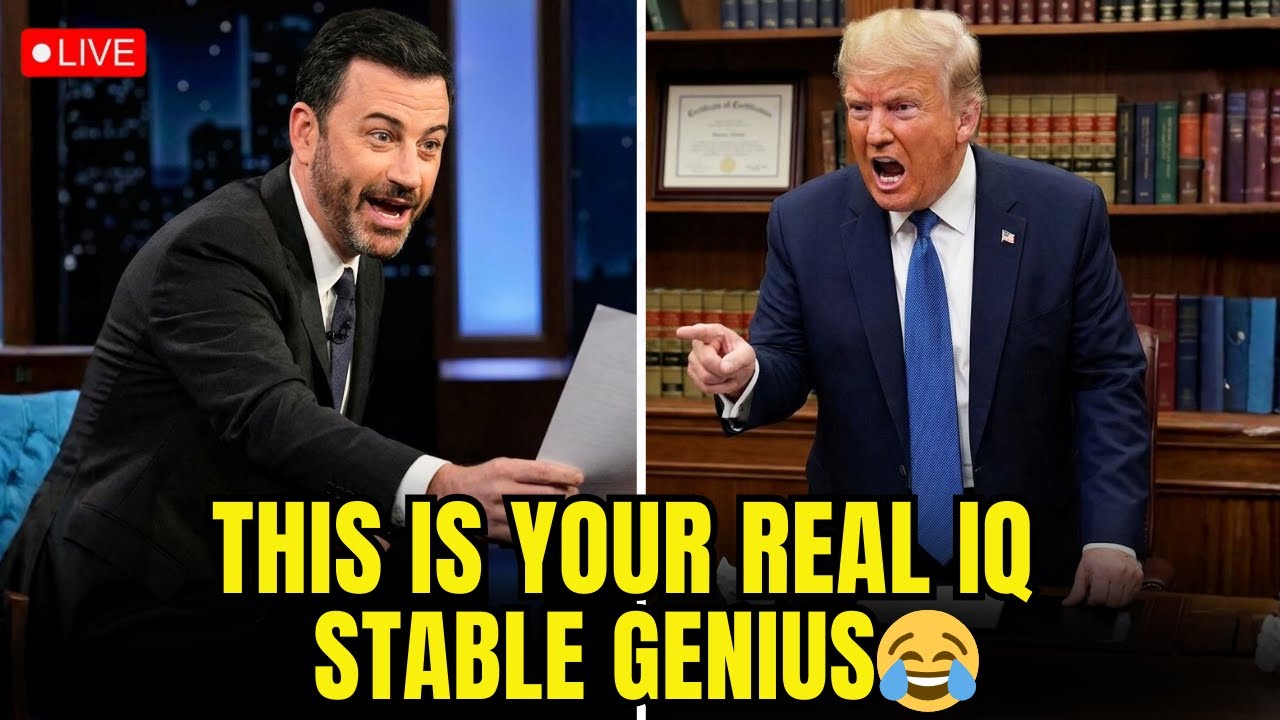
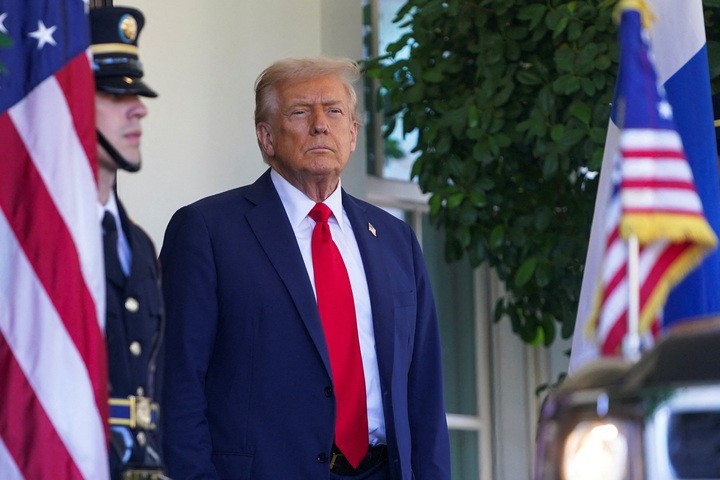
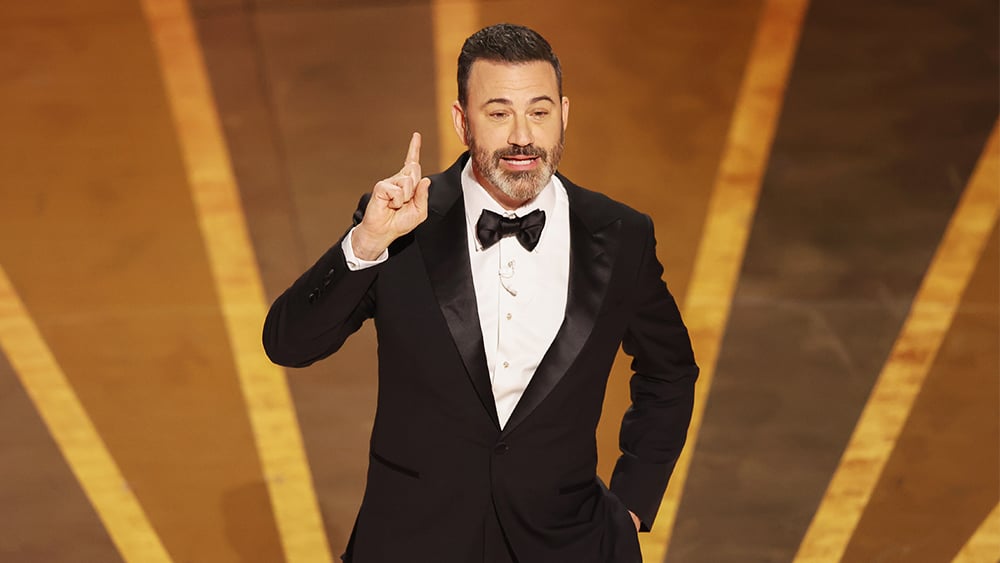
A viral story circulating across X, TikTok, and YouTube this week depicts a dramatic escalation in the long-running feud between late-night host Jimmy Kimmel and former president Donald Trump—one that, in its most sensational telling, turns a comedy monologue into something resembling a crime-scene investigation.
In the videos, Kimmel is said to have produced a box labeled “NMA, 1964,” allegedly containing records from New York Military Academy, and to have read aloud a purported IQ score belonging to Mr. Trump during a live broadcast. The clips culminate in a supposed real-time meltdown from Mar-a-Lago, complete with a toppled camera feed and a primal scream captured on a laptop microphone.
It is a gripping story. It is also, based on available evidence, fiction—or at best a composite satire stitched together from years of animus, internet rumor, and the public’s appetite for spectacle.
The Long Feud—and the New Claim
Mr. Trump and Mr. Kimmel have traded insults for years, with barbs exchanged on air and on social media. That dynamic is well-documented, as is Mr. Trump’s penchant for attacking media figures and Mr. Kimmel’s habit of responding in monologue form. What is new is the claim that a television host publicly revealed a former president’s educational testing records—specifically, a precise IQ score—on national television.
No reputable outlet has corroborated such an event. A review of broadcast transcripts, network schedules, and contemporaneous reporting shows no episode in which Mr. Kimmel produced authenticated school records or disclosed test results tied to Mr. Trump. Network representatives have declined to confirm the story, and no primary documents have surfaced.
Why the Claim Fails Basic Scrutiny
The story falters under even modest verification.
First, privacy and records law. Educational records in the United States—even those decades old—are subject to strict confidentiality rules. Institutions like New York Military Academy do not release student testing files to third parties, let alone to television producers, without explicit authorization or a court order. The notion that an intern could “pull files from the archives” and air them live contradicts standard legal practice.
Second, format and logistics. Late-night programs are tightly produced. Live split-screen “ambushes” of a former president broadcasting independently—while not impossible in theory—would require coordination and consent that the viral narrative conspicuously omits.
Third, the absence of corroboration. In the modern media ecosystem, a moment of this magnitude would generate immediate coverage from wire services, broadcast networks, and digital desks. None has reported it.
How the Internet Built a Convincing Illusion
The viral videos succeed because they deploy familiar tropes. They combine a cardboard box prop (a staple of late-night bits), archival aesthetics (“yellowed paper,” “faded marker”), and a pre-existing stereotype—Mr. Trump’s self-description as a “stable genius”—to create a plausible-sounding reveal.
Creators then layer in reaction footage—often unrelated clips of Mr. Trump speaking angrily at other times—edited to appear contemporaneous. The result feels authentic to viewers primed by years of political theater and distrust.
“This is how misinformation works in 2026,” said one media-literacy researcher who studies political satire online. “It borrows the grammar of journalism—documents, dates, numbers—without the verification.”
Satire Versus Assertion
Comedy has long relied on exaggeration, parody, and symbolic props. Mr. Kimmel, like his peers, routinely mocks public figures and their claims. But the viral narrative crosses from satire into assertive fact-claim by presenting specific, checkable data—an IQ score, a test date, an institution—and inviting viewers to treat them as genuine.
That distinction matters. Satire invites interpretation; factual claims invite verification. When the latter are false, the responsibility shifts from comedian to content distributor—the accounts and channels amplifying the claim without caveat.
Why the Story Resonates Now
The timing is not accidental. Mr. Trump’s public approval has fluctuated amid legal and political pressures, and late-night comedy has regained a sharper edge. Stories that promise a definitive unmasking—“records over rhetoric”—travel fast in polarized environments.
They also flatter the audience. As one viral caption put it, “the nerd had the archives.” The appeal lies in the fantasy of bureaucracy triumphing over bravado.
What Can Be Said With Confidence
What can be reported with confidence is narrower and more sober:
-
Mr. Trump and Mr. Kimmel remain engaged in a public feud.
-
No verified broadcast has revealed Mr. Trump’s educational testing records.
-
Claims of a disclosed IQ score from New York Military Academy lack evidence and contradict privacy norms.
-
Viral clips use editing and narrative framing to imply events that did not occur.
The Cost of Getting It Wrong
Misinformation of this sort does more than mislead. It erodes trust in legitimate reporting and blurs the line between comedy and documentation. For readers, the remedy is old-fashioned: look for primary sources, seek confirmation from multiple outlets, and be wary of stories that promise perfect narrative closure.
As the historian Jill Lepore once observed, facts are stubborn things—but they still require caretakers. In an era when a cardboard box can masquerade as an archive and a montage can pass for evidence, the burden falls on publishers to separate the punchline from the proof.
The emperor’s clothes may be debated nightly on television. His school records, for now, remain where they belong: off the stage and out of the feed.