As Trump Dismisses Canadian Cars, Canada Quietly Redraws the Trade Map
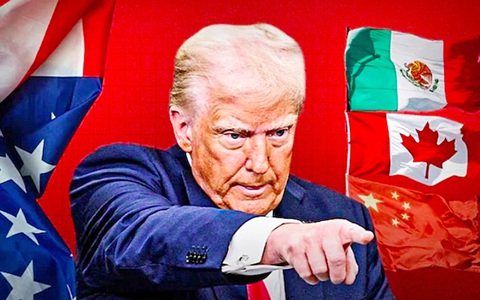
When President Donald Trump told reporters this week that the United States does not need cars made in Canada or Mexico, the remark landed with a familiar bluntness. “We want to make them here,” he said, dismissing decades of integrated North American manufacturing with a sentence that echoed his long-standing protectionist instincts.
The comment was not new. Mr. Trump has made similar claims repeatedly, often before audiences that strongly disagree with him. But the timing was striking. As those words circulated on cable news and across social media platforms in the United States, Canada’s prime minister, Mark Carney, was preparing for a high-profile overseas trip aimed at reducing his country’s reliance on American trade — including meetings in Beijing focused on expanding commercial ties after years of diplomatic frost.
Two narratives unfolded at once. One was loud, confrontational, and familiar. The other was quieter, more deliberate, and potentially more consequential.
Mr. Trump’s remarks were framed by allies as a defense of American workers. But to Canadian officials and trade analysts, they sounded like something else: a warning shot aimed at a partner that has begun to explore alternatives.
For decades, Canada built its industrial economy around access to the U.S. market. Under successive trade agreements — from NAFTA to its Trump-era successor, the USMCA — Canada invested billions of dollars into auto manufacturing, energy infrastructure, and cross-border supply chains. Factories were built, workers trained, and production synchronized around the assumption that integration brought stability.
That assumption now looks increasingly fragile.
An Industry Without Borders
The modern auto industry is not national. It is continental. A single vehicle assembled in Michigan or Ohio may include Canadian aluminum, Ontario-built engines, Mexican wiring harnesses, and components that cross the U.S.–Canada border multiple times before final assembly.
This reality is widely acknowledged by industry leaders and has been documented repeatedly by outlets such as Bloomberg, The Wall Street Journal, and CNBC. Yet it often disappears in political rhetoric.
When Mr. Trump says the United States does not need Canadian cars, he is technically referring to final assembly. But economists note that disentangling Canadian production from American manufacturing would raise costs significantly — not just for automakers, but for consumers.
“The supply chains are deeply intertwined,” said one trade analyst who has advised U.S. manufacturers and spoke on condition of anonymity. “Replacing Canada is not impossible, but it would be expensive, disruptive, and politically messy.”
That is precisely why Mr. Trump’s remarks carried weight. They were not simply about cars. They were about leverage.
A Shift in Ottawa’s Calculus
.png)
Canada has heard this message before. What has changed is how it is responding.
Mr. Carney’s trip to China, the first by a Canadian prime minister in eight years, reflects a broader recalibration in Ottawa. Canada is not abandoning the United States, officials insist. But it is no longer willing to structure its economic future around a single partner whose policies shift sharply with each election cycle.
In recent months, Canadian officials have spoken more openly — on public broadcasters, at international forums, and in interviews widely shared on social media — about “trade resilience” and “strategic diversification.” The language is careful, but the intent is clear.
The United States senses this shift. And that, analysts say, may explain the renewed edge in Mr. Trump’s tone.
“The fear isn’t Canadian cars,” said a former Canadian diplomat. “It’s Canadian choices.”
When a trading partner has alternatives, threats lose effectiveness. Tariffs become less frightening. Rhetorical pressure yields diminishing returns.
Insecurity at Home
The American auto industry itself is under strain. Rising labor costs, competition from Asian manufacturers, and an uneven transition to electric vehicles have left legacy automakers struggling to balance profitability with innovation.
These challenges are well documented in reporting from Reuters, Axios, and major U.S. business publications. Yet they are rarely addressed directly in political messaging.
Instead, blame shifts outward.
By dismissing Canadian production as unnecessary, Mr. Trump projects confidence. But behind the scenes, U.S. manufacturers continue to rely on Canadian inputs — from critical minerals to stable energy supplies and skilled labor pools that cannot be quickly replicated.
“This is not strength,” said one industry executive. “It’s insecurity expressed as bravado.”
Canada’s Quiet Leverage
Canada enters this moment with advantages that often go understated in American political discourse. It controls significant reserves of critical minerals needed for electric vehicles. It offers stable, low-emission energy. Its regulatory standards are trusted by global markets. And its workforce is deeply experienced in advanced manufacturing.
As global trade becomes more fragmented and geopolitically charged, those assets matter.
Canada’s approach has been notably calm. There have been no dramatic retaliatory threats, no public escalation. Instead, officials are building relationships, reopening diplomatic channels, and preparing contingencies.
This strategy has drawn less attention than Mr. Trump’s remarks, but it may prove more durable.
“Canada isn’t shouting,” said a trade policy researcher. “It’s positioning.”
A Changing Power Dynamic
The broader implication of this moment extends beyond the auto industry. It raises questions about how partnerships function in an era of transactional politics.
Trade, Canadian officials argue, cannot be sustainable if it depends solely on submission. Respect must be reciprocal. Stability must be mutual.
When one side signals that agreements are conditional and disposable, the other side adapts.
Mr. Trump’s words were meant to project dominance. Instead, they may accelerate the very shift he seeks to prevent.
The era of unquestioned Canadian dependence on the United States is ending — not through confrontation, but through preparation.
“When a country tells you it does not need you,” a senior Canadian official said privately, “the smartest response is not anger. It is readiness.”
Canada appears ready.
While Washington talks, Ottawa is moving. And in global trade, movement — not volume — is often how power quietly shifts.