🔥 BREAKING: COLBERT PLAYED THE CLIP TWICE… AND TRUMP’S REACTION BECAME THE REAL STORY ⚡
On late-night television, jokes usually move fast. A clip rolls, a punchline lands, the show advances. But on several occasions over the past decade, Stephen Colbert has broken that rhythm in a way that has proven unusually durable: he plays a clip of Donald Trump—and then plays it again.
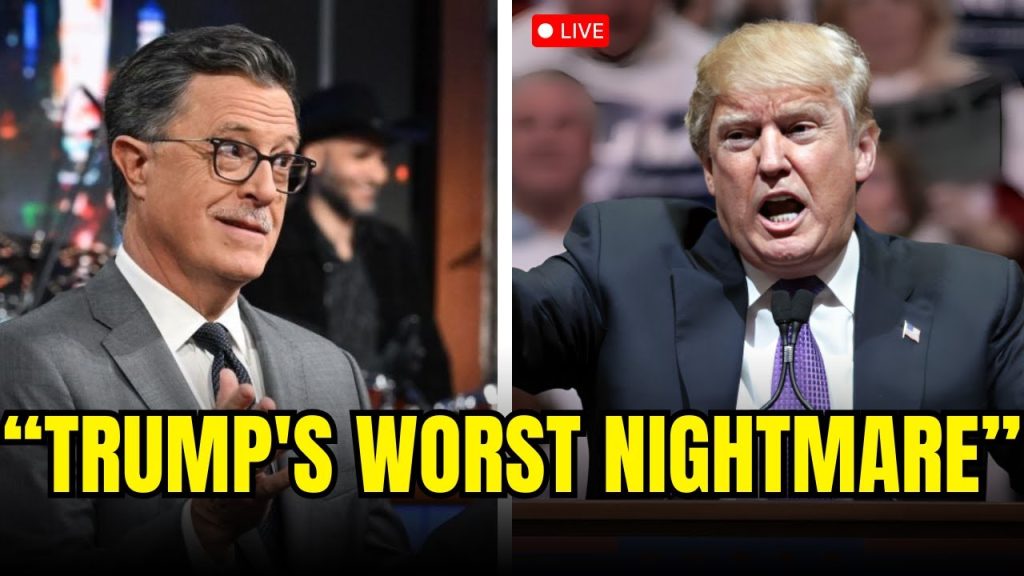
The maneuver is simple. It is also revealing. In an age of spin, context wars, and instant denial, repetition has functioned as a kind of editorial scalpel. The second playback does not add information; it removes excuses.
The technique resurfaced recently in viral commentary framing Mr. Trump’s reaction as “the real story” after Mr. Colbert replayed the former president’s boasts about acing a cognitive test. The framing is breathless, but the underlying dynamic is real—and instructive. What matters is not that the clip was funny the first time. It is that, the second time, it stopped being funny and started being undeniable.
Consider the original moment. In 2020, Mr. Trump described a cognitive assessment in surreal detail—animals, mazes, memory prompts—culminating in his proud recitation: “Person. Woman. Man. Camera. TV.” He offered the sequence as proof of exceptional intelligence. Mr. Colbert aired the clip on The Late Show with Stephen Colbert. The audience laughed.
Then Mr. Colbert stopped the show.
“Wait,” he said, and played it again—slower. Each word landed separately. The laughter sharpened. What had sounded like bravado on first hearing now sounded like self-parody. The material had not changed. The listener had.
This pattern has repeated across subjects. Mr. Colbert replayed Mr. Trump’s comments about his daughter Ivanka—twice—without commentary, letting the second pass drain the room of laughter. He replayed the former president’s remarks during a Covid briefing about disinfectant—twice—forestalling the later claim that the comments were sarcastic. In each case, repetition replaced interpretation.
That is the point. Most political damage control depends on speed: reframe quickly, declare context, accuse the critic. Repetition slows the moment down long enough for context to become inescapable. The second playback answers the question audiences instinctively ask the first time—Did he really say that?—with finality.

Mr. Trump’s responses to these segments have been as consistent as the segments themselves. He has attacked Mr. Colbert personally, derided the show’s ratings, and accused the host of lacking talent. What he has not done is deny the words. He cannot. The tape exists. Replaying it twice makes denial beside the point.
That reaction—anger directed at the messenger rather than the message—is why the replays endure. A confident public figure can ignore a joke. A secure one can laugh it off. Mr. Trump has repeatedly shown that he cannot tolerate his own words being heard without mediation. The fury that follows becomes evidence of vulnerability, not strength.
Psychologists have long noted the effect. The first exposure produces surprise; the second produces confirmation. In politics, confirmation is costly. It turns novelty into record. It converts a remark into a pattern.
The viral framing surrounding these clips often exaggerates—suggesting private “eruptions,” insider accounts, or decisive turning points. Those claims are typically unverified. What is verifiable is simpler and more consequential: repetition neutralizes spin. It does not editorialize. It documents.
This is why the tactic has proved more effective than ridicule alone. Late-night comedy traditionally relies on exaggeration. Mr. Colbert’s replay relies on restraint. He lets the material indict itself. No punchline competes with the tape.
In a media environment crowded with claims and counterclaims, the second playback performs a modest but powerful civic function. It asks viewers to listen again—carefully. Not to what a politician says about what he said, but to what he said.
That is why, in these moments, the reaction becomes the story. Not because of secret rage or backstage drama, but because the inability to endure one’s own words—heard twice—reveals a fragility that no amount of bravado can conceal.