By XAMXAM
For decades, American late-night television has functioned as a release valve: a place where the day’s excesses are softened into punch lines and the powerful are trimmed down to human scale. This week, however, the familiar rhythm shifted. What unfolded across two stages—on Jimmy Kimmel Live and The Late Show with Stephen Colbert—was not merely satire, but a coordinated-seeming refusal to absorb another round of insults quietly.
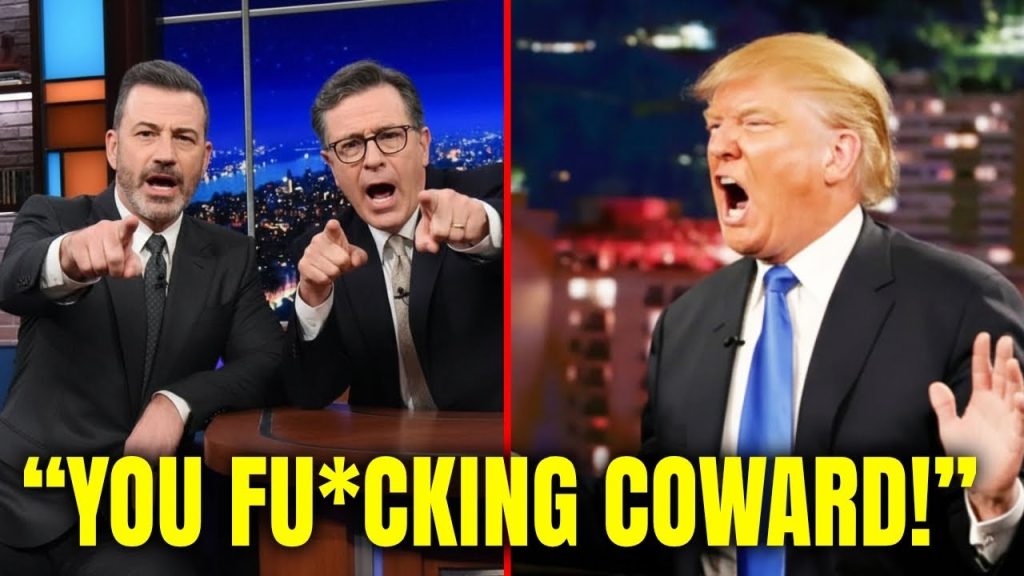
The spark was familiar. Donald Trump, speaking in public and posting online, dismissed late-night hosts as “untalented,” predicted their demise, and celebrated job losses in an industry he has long derided. In the past, such attacks have been treated as fuel—grist for jokes that fold outrage into entertainment and move on. This time, the response lingered, sharpened, and escalated.
On Kimmel’s stage, the tone began conversationally. He replayed Trump’s remarks, then paused—not for a rimshot, but for context. Celebrating layoffs, Kimmel said, is not a neutral act; it reveals a theory of leadership that equates power with humiliation. The line that followed—blunt enough to draw gasps—was less about provocation than boundary-setting. Kimmel framed the issue not as personal grievance but as civic expectation: leaders do not take pleasure in Americans losing their livelihoods.
Colbert, airing earlier in the evening, approached from another angle. He dissected a presidential address that had preempted prime-time programming, treating it less as a speech than as a performance. His critique relied on contrast. Emergencies are measured by urgency and clarity; campaign ads by self-congratulation. When the latter masquerades as the former, Colbert argued, satire becomes diagnosis. He used exaggeration, but the point was procedural: who gets the airwaves, and why.
What made the night feel different was not volume but alignment. Kimmel and Colbert did not repeat each other’s jokes; they reinforced each other’s frames. Kimmel emphasized leadership norms and empathy; Colbert emphasized institutional misuse and spectacle. Together, they offered a critique that was harder to wave away as partisan heckling. The audience reaction—laughter that tipped into applause—suggested recognition rather than surprise.
Late-night comedy has always borrowed from the language of journalism while disclaiming its obligations. This week, the borrowing ran in the other direction. Both hosts leaned on attribution (“he said,” “he posted”), replayed primary material, and invited viewers to judge the contrast between words and consequences. The effect was closer to a closing argument than a monologue, built from the subject’s own record.
There were excesses. Colbert’s metaphors stretched; Kimmel’s barbs cut sharply. But the core move was restraint. Neither host attempted to litigate every claim or predict every outcome. Instead, they questioned incentives. Why interrupt entertainment for a speech that announces success? Why rename civic spaces after the living? Why sell access—symbolic or otherwise—as a commodity? Satire, here, did not invent the premises; it interrogated them.

The reaction cycle followed the modern script. Clips circulated within minutes. Supporters cheered the “takedown.” Critics accused the hosts of bias and bad taste. Trump responded online, attacking ratings and talent, as he often does. Yet something else happened alongside the churn: a reframing of what late-night is allowed to do when provoked. Rather than absorb the insult and transmute it into irony, Kimmel and Colbert declined the role of foil.
This matters because late-night occupies a peculiar civic niche. It reaches audiences that skip cable news and scroll past editorials. It compresses argument into minutes. When it chooses to slow down—when it quotes, pauses, and compares—it can model a form of public reasoning that feels accessible without pretending to be neutral. That accessibility carries risk; it can oversimplify. But it also carries reach.
The pairing also underscored a generational shift. The era of the genial host who disarms through charm alone is fading. In its place is a posture that treats attacks on workers, institutions, and norms as fair game for sustained critique. Not every night. Not every joke. But when the subject escalates, the response may escalate too.
There is a temptation to declare winners and losers. That misses the point. The episode was less about humiliating a politician than about testing a boundary: how much contempt for others’ work, how much theatrical self-regard, and how much institutional misuse can be normalized before comedy stops smoothing the edges and starts drawing lines?
By the end of the broadcasts, nothing concrete had changed. No policy shifted. No office moved. But the register had changed. Two hosts, on two networks, signaled that ridicule would no longer be the only response to derision—and that sometimes the sharpest satire is simply insisting on standards.
In a media ecosystem trained to reward noise, that insistence felt, briefly, like quiet resistance.