🔥 BREAKING: SAMUEL L. JACKSON PLAYS SHOCKING AUDIO ON LIVE TV — STUDIO FALLS SILENT IN SECONDS ⚡
A dramatic video circulating online this week purports to show the actor Samuel L. Jackson confronting former President Donald Trump with a series of secretly recorded audio clips during a nationally televised interview — recordings that allegedly leave Mr. Trump “stunned into silence.”
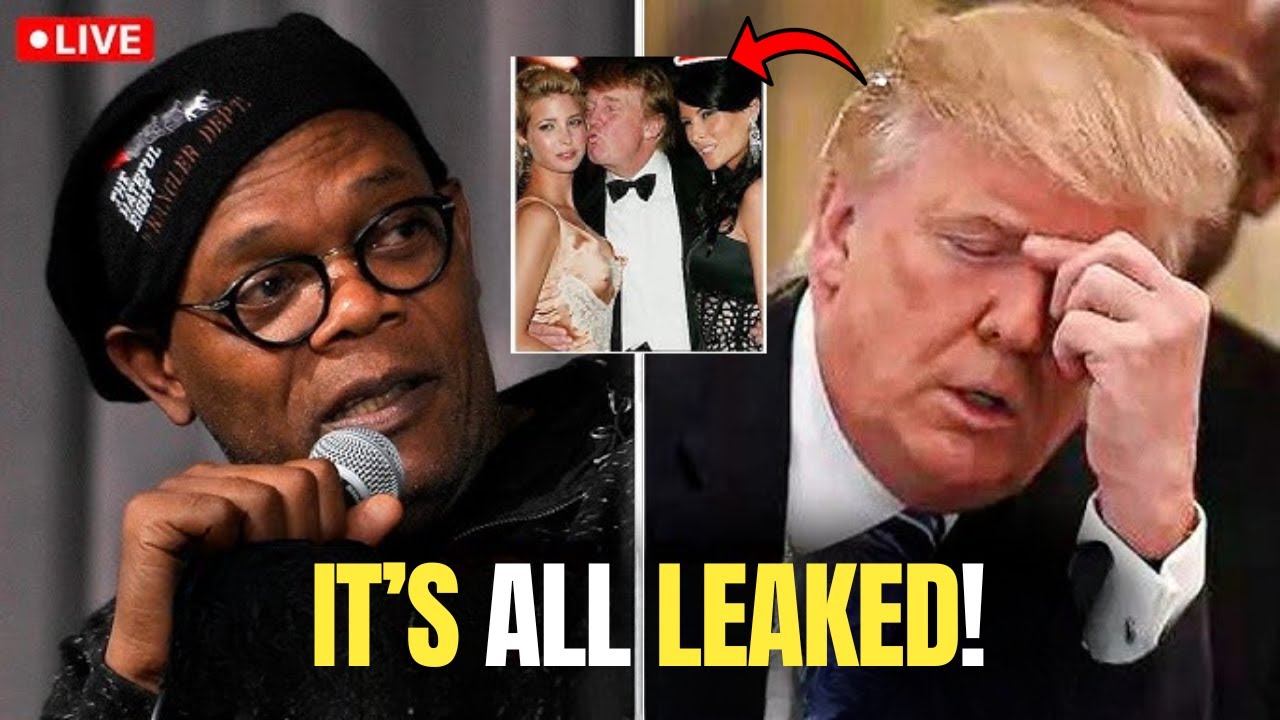
The clip, titled “Samuel L. Jackson Unleashes Shocking Audio — Trump Stunned Into Silence on Live TV,” has gained traction across social media platforms and YouTube, where it is presented as a dramatic reckoning. Its narration paints a cinematic scene: Mr. Trump seated confidently under studio lights, only to watch his composure erode as Mr. Jackson methodically plays incriminating audio from his phone.
But there is no evidence that such an interview ever took place.
The video’s transcript describes a tense studio encounter in which Mr. Jackson interrupts Mr. Trump mid-conversation, then plays a series of recordings — beginning with casual banter about golf outings and escalating to alleged remarks about financial manipulation, tax avoidance and belittling staff members. The narrative culminates in what it characterizes as a final, devastating clip: laughter at the expense of a wounded veteran, prompting audible disgust from the audience.
The account is structured like a courtroom drama. Mr. Jackson is portrayed as calm and prosecutorial, withholding emotion while letting the audio evidence speak. Mr. Trump, by contrast, is described as unraveling — shifting from confident deflection to visible panic, his voice cracking as each clip compounds the damage. By the end, according to the narration, he sits “sagged into his chair,” confronted by documents and recordings that leave him with no rebuttal.
Yet no major broadcast network has aired such an exchange. No independent reporting corroborates the existence of the alleged recordings or the described televised confrontation. A review of public interviews featuring the two men reveals no moment resembling the one depicted in the video.
In fact, the only verifiable public dispute between Mr. Trump and Mr. Jackson dates back years and centered on a comparatively minor disagreement: whether they had played golf together. In 2016, Mr. Trump wrote on Twitter that he did not know Mr. Jackson and had never golfed with him. Mr. Jackson, in separate interviews, insisted that they had met and played at one of Mr. Trump’s golf clubs. The episode became a brief pop-cultural footnote rather than a political flashpoint.
The YouTube video appears to build from that kernel of truth, weaving it into a far more explosive narrative. It blends snippets of older, publicly available remarks with dramatized voice-over and speculative detail. The pacing, language and staging resemble scripted entertainment more than documentary reporting.
This type of content reflects a broader trend in online media: the rise of politically themed “story videos” that adopt the tone and cadence of investigative journalism while relying heavily on embellishment or fabrication. Such videos often open with evocative second-person narration — “Picture yourself seated across from one of the most influential figures in America” — and employ heightened sensory detail to create the impression of immediacy and authenticity.
:max_bytes(150000):strip_icc():focal(511x0:513x2)/jackson-trump-0b75d7b5f2ee4dcea858fa766bf6f5fb.jpg)
Media analysts note that these productions can be persuasive precisely because they mimic the conventions of credible reporting: references to “evidence,” “official-looking files” and “nationally broadcast interviews.” But absent independent confirmation, those elements function as narrative devices rather than substantiated facts.
For Mr. Trump, who remains a dominant and polarizing figure in American politics, viral videos like this one can reinforce preexisting beliefs among supporters and critics alike. Admirers often dismiss such portrayals as politically motivated fiction, while detractors may share them as symbolic expressions of accountability, regardless of their factual basis.
Mr. Jackson, an Academy Award–nominated actor known for outspoken political views, has publicly criticized Mr. Trump in the past. But there is no record of him conducting a prosecutorial-style televised ambush complete with unreleased audio evidence and documentary files, as the video claims.
The episode underscores the increasingly blurred boundary between political commentary and entertainment in the digital age. On platforms driven by engagement metrics, emotionally charged narratives tend to outperform measured analysis. The result is a genre that borrows the authority of journalism while operating outside its verification standards.
Viewers encountering such content face a familiar challenge: distinguishing between dramatization and documentation. In traditional newsrooms, extraordinary claims require corroboration from multiple independent sources. In the online attention economy, by contrast, dramatic framing and confident narration can substitute for proof.
As of this week, neither Mr. Trump nor Mr. Jackson has addressed the specific video circulating online. Without verifiable evidence of the described interview or recordings, the confrontation remains what the platform hosting it suggests it may be: a piece of viral political storytelling rather than a record of events.
In a media landscape saturated with spectacle, the silence at the center of this story may be less about a stunned former president than about the absence of substantiation.