The Myth of the “Stable Genius,” Revisited: How a Viral Colbert Clip Turned Speculation Into Spectacle
For years, Donald Trump has returned to a single refrain when challenged by critics: his intelligence. He has described himself as a “very stable genius,” dismissed academic credentials as overrated, and framed instinct as a superior substitute for study. The claim has been repeated so often that it hardened into brand identity—one that supporters embraced and detractors mocked, but rarely examined with evidence.
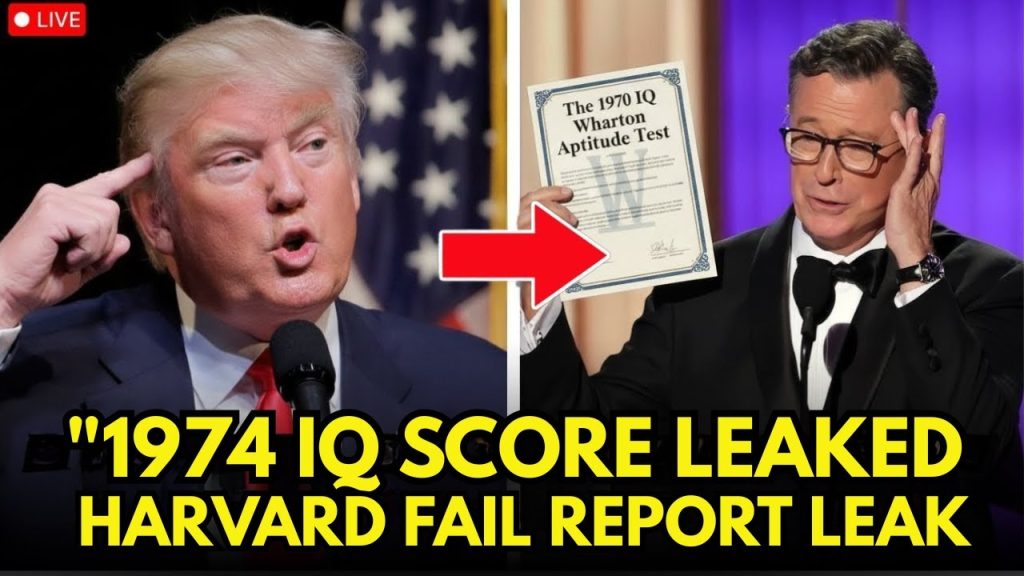
That is why a recent viral video, styled as a late-night exposé by Stephen Colbert, spread so quickly. The clip purports to show Mr. Colbert unsealing a long-hidden Wharton-era aptitude or IQ test on The Late Show with Stephen Colbert, revealing a score that would place Mr. Trump below the national average. The moment is framed as revelatory, even devastating: laughter drains from the room; the “genius” myth collapses under the weight of a number.
The problem is that the moment never happened.
There was no televised unsealing of Mr. Trump’s academic records. No authenticated SAT, IQ, or Wharton aptitude test has been released on Mr. Colbert’s program or by any credible institution. The segment circulating online is a piece of political fan fiction—constructed with the cadence of comedy, the authority of a sealed envelope, and the insinuations of investigative journalism, but without verification.
Its success reveals something important about the current media environment.
The video borrows the visual and rhetorical grammar of late-night television: the calm setup, the sudden seriousness, the envelope as prop, the audience’s silence standing in for proof. It leans on familiar reporting—Mr. Trump’s decades-long refusal to release academic records, prior claims by associates that his grades were closely guarded, and his public habit of demanding others’ credentials—to create plausibility. From there, it crosses a line, presenting invented specifics as fact.
This is not new territory for political misinformation, but it is an increasingly effective one. By anchoring speculation to a trusted cultural platform and a recognizable host, creators can bypass skepticism. Viewers are invited to experience the “reveal” emotionally, not analytically. The silence in the room does the work of evidence.
The choice of subject is no accident. Intelligence occupies a central place in Mr. Trump’s self-presentation. Unlike policy disputes or ideological battles, claims about cognitive ability are personal and symbolic. To puncture them—even fictionally—is to strike at the core of his persona. That makes the narrative irresistible to critics and shareable to audiences primed for a takedown.

Yet the distinction between satire, commentary, and fabrication matters. Mr. Colbert has, in real broadcasts, skewered the former president’s self-mythologizing, often by contrasting bravado with verifiable statements or documented behavior. Those segments function as comedy with an evidentiary spine. The viral clip removes that spine while preserving the posture.
The danger is cumulative. When audiences repeatedly encounter fabricated “receipts” that confirm their priors, they become less sensitive to the difference between documentation and performance. Over time, the very idea of proof is reduced to a well-edited pause and a confident voice.
There is also an irony at work. Mr. Trump’s academic records have long been the subject of curiosity precisely because they have not been released. That absence has invited speculation, satire, and rumor. Filling the void with invented detail may feel satisfying, but it ultimately weakens legitimate critique by replacing questions with claims that cannot be defended.
What remains true—and verifiable—is narrower and less cinematic. Mr. Trump has consistently promoted an image of exceptional intelligence while resisting transparency about his academic past. He has derided “elites” while citing his own education when convenient. Those contradictions are fair subjects for scrutiny. They do not require sealed envelopes or invented scores.
The viral clip’s reach says less about new information than about appetite. In an era saturated with outrage and performance, audiences are drawn to moments that promise decisive closure: a number, a reveal, a myth shattered on cue. Real accountability, by contrast, is incremental and unsatisfying.
The late-night studio described in the video will not appear in any broadcast archive. But the story’s popularity is a reminder of how easily authority can be simulated—and how readily it can be shared—when the line between satire and assertion is allowed to blur.
In the end, the “genius” debate remains unresolved not because evidence has been hidden in an envelope, but because spectacle has once again outrun verification.