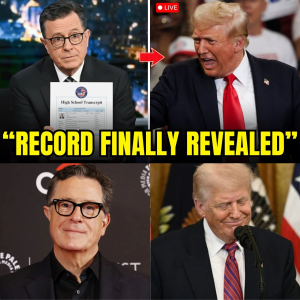
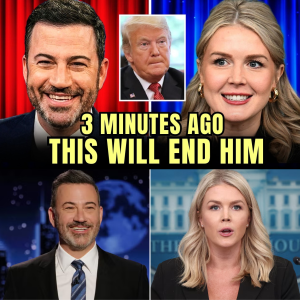
A Viral Late-Night “DNA Test” Story Shows How Rumors Now Outrun Reality
A sensational clip format has become familiar across American social media: a famous late-night host, a high-stakes confrontation, a “shocking revelation,” and a promise that the truth will finally be proven—often in real time, on camera.
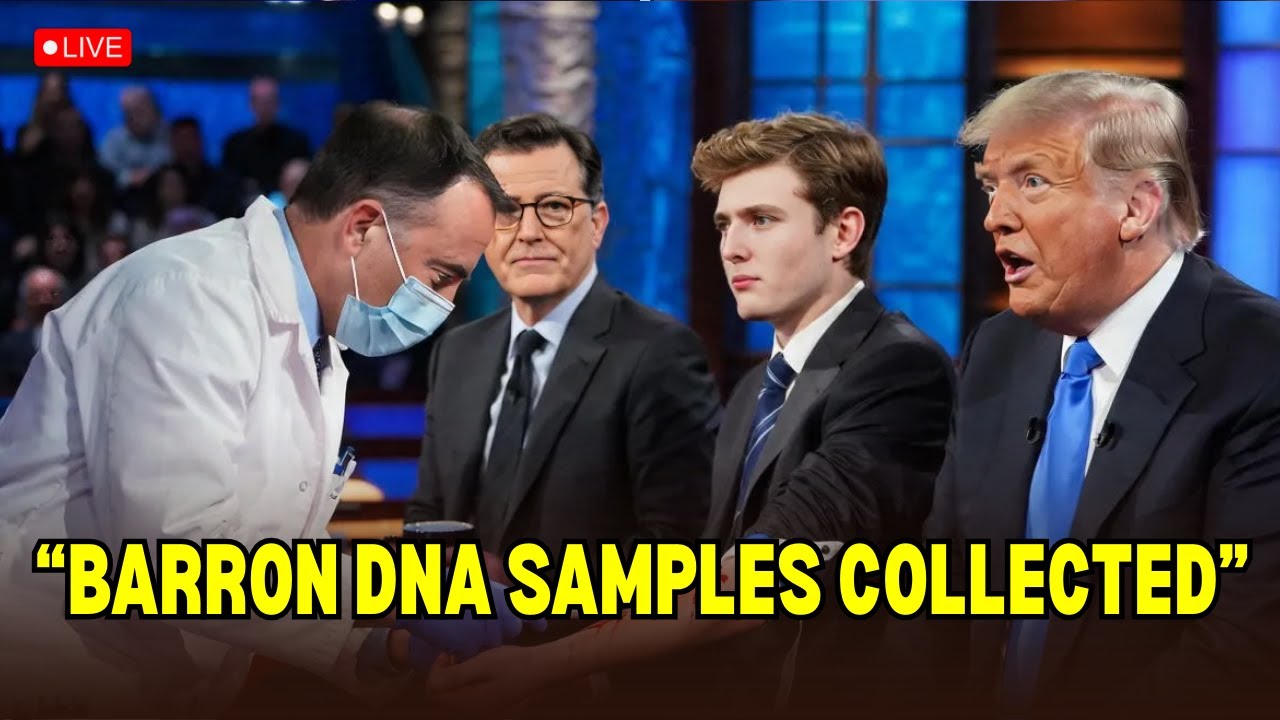
In recent days, one version of the trope has circulated widely in posts and reposts claiming that President Donald Trump appeared on The Late Show with his son Barron to “end the rumors,” only for Stephen Colbert to introduce lab technicians onstage for an immediate blood draw. The story is tailored for maximum suspense: a minor in the spotlight, a dramatic reversal, a neat resolution through “science,” and a powerless politician left “speechless.”

There is just one problem: there is no credible evidence that any such episode occurred.
Search results and platform posts show the narrative proliferating through attention-driven channels—Facebook groups, pages with recycled “breaking news” templates, and YouTube videos that trade in implausible twists and emotionally charged claims. Many of these posts are not linked to any network broadcast, verified transcript, or reputable newsroom coverage. Instead, they resemble a broader genre of viral content built less on documentation than on what media researchers describe as “narrative plausibility”: the feeling that something could have happened, especially if it conforms to a public figure’s established media image.
Fact-checkers have repeatedly documented similar rumor ecosystems around Barron Trump and other political figures. In 2025, Snopes reported that AI-generated or fabricated videos helped drive a false claim that Barron Trump debated Rep. Jasmine Crockett on live television—an event for which no legitimate broadcast evidence existed. Snopes has also compiled a broader collection of recurring Barron Trump rumors, noting how quickly fringe claims can reappear in new packaging as audiences and platforms shift.
The mechanism is straightforward. A creator starts with familiar ingredients—late-night television, a polarizing politician, and a “secret” allegedly withheld from the public—then adds props that signal authority: a “report,” a “lab,” a “technician,” a “DNA test.” The presence of scientific imagery, even when fictional, can make a claim feel more legitimate. In the attention economy, certainty is profitable, and ambiguity is not.
The platforms do the rest.
On Facebook, the story often appears in groups or pages that use sensational headlines and highly dramatized language. Posts may describe “confirmed” results or “explosive” confrontations, even when they provide no sourcing beyond the post itself. Examples of these formats are easy to find: pages have promoted claims about Colbert “exposing” Trump-related “test results” with no corroboration from CBS or established outlets. Other posts push similarly styled “DNA revelation” narratives as if they were breaking news.

Meanwhile, YouTube offers a parallel pipeline: long-form videos with thumbnail text designed to mimic news urgency—“EXPOSED,” “CONFIRMED,” “MELTDOWN”—paired with commentary that treats internet chatter as established fact. The structure can resemble tabloid television, but without the editorial constraints that would normally govern claims about identifiable individuals, especially minors.
The cultural logic is also hard to ignore. Late-night television, particularly in the Trump era, has become a proxy arena for political conflict—one where audiences expect confrontation, humiliation, and viral one-liners. The problem is that the audience’s expectation for spectacle can be exploited. A fake “late-night moment” is now a kind of fan fiction for the algorithm: easy to imagine, easy to share, and difficult to fully debunk once it has traveled.
Even when mainstream outlets engage, they often do so by fact-checking adjacent false claims rather than the specific rumor at hand. Yahoo News, for example, has published fact checks about fabricated stories involving Barron Trump “shutting down” political opponents—illustrating how quickly invented scenarios become content fodder across platforms. The details vary, but the pattern is consistent: a viral claim with political stakes, a dramatic “public” showdown, and a payoff that feels satisfying in the way real life rarely is.

There is another ethical boundary that these viral narratives cross: they center a minor.
Minors connected to public figures are not automatically exempt from public interest, but American journalistic norms generally treat them with heightened caution. The “lab technicians onstage” motif is designed to produce suspense and moral clarity. Yet in the real world, a televised blood draw involving a teenager would raise significant questions about consent, privacy, and safeguarding—questions that credible networks and producers would not treat as a punchline. The fact that the story ignores these issues is not evidence of its boldness; it is one of the tells that it is not a real broadcast.
It can be tempting to treat these stories as harmless entertainment—one more exaggerated narrative in a crowded feed. But the consequences are not trivial. Rumors presented as “confirmed” can harden into belief, particularly when they are repeated across multiple pages and accounts. Researchers call this the “illusory truth effect”: repetition increases perceived accuracy, even when a claim is initially recognized as dubious.
The most resilient rumors also tend to be those that cannot be easily resolved by ordinary means. They involve private family matters, unverifiable insider scenes, or supposed documents that are never actually produced. The DNA-test narrative is, in that sense, a perfect device: it promises definitive proof while ensuring the audience never has to see legitimate proof at all.
For consumers, the best defense is basic verification—checking for a real air date, an official network clip, a transcript, or coverage from a reputable outlet. For platforms, the challenge is structural: their systems reward engagement, and engagement rewards sensational claims. Even fact-checks can inadvertently spread the underlying rumor by giving it fresh visibility.
And for journalism, the moment is a test of restraint. Reporting on viral falsehoods requires a careful balance: explaining what is circulating without laundering it into legitimacy. The point is not to pretend that these narratives do not exist; it is to describe them accurately—as viral claims that exploit trust in familiar institutions like late-night TV, lab science, and “breaking news” language.
In the end, the real story is less about any one fabricated segment than about the environment that makes it plausible enough to share. In a media landscape built for speed and spectacle, a fictional “DNA test on live TV” can travel farther than a correction.
Reality, by contrast, takes longer.