While President Donald Trump spent the final months of 2025 threatening tariffs and ridiculing Canada as a potential “51st state,” a quieter realignment was taking shape far from Washington. In Mexico City and Ottawa, policymakers were drawing a different lesson from the turbulence of the past year: American reliability could no longer be assumed, and North America’s middle powers would need each other.
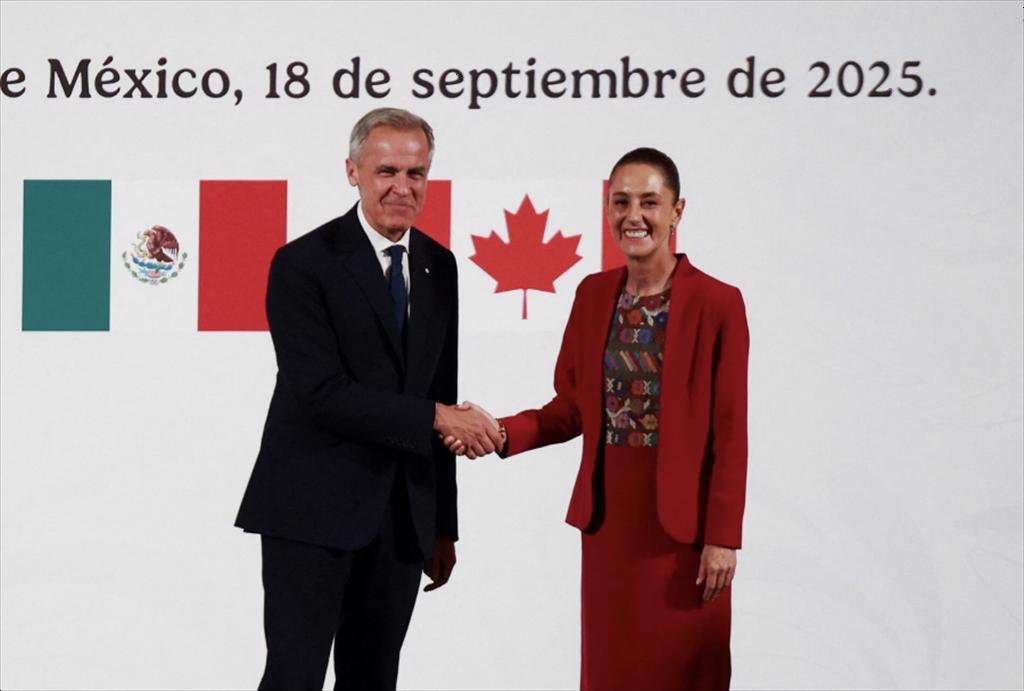
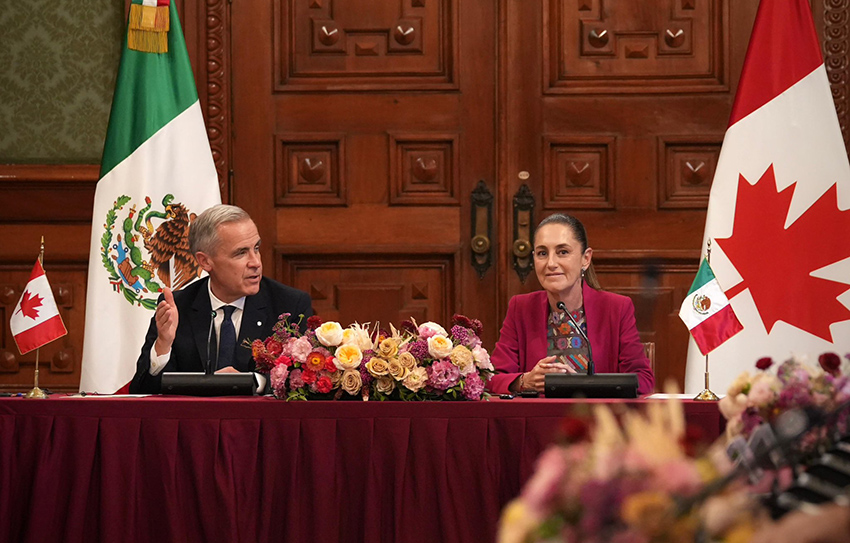
That realization crystallized on Sept. 18, 2025, when Prime Minister Mark Carney stood beside President Claudia Sheinbaum and announced what both governments called a comprehensive strategic partnership. The language was careful, almost understated, but the message was unmistakable. For the first time in decades, Canada and Mexico were deliberately positioning themselves not merely as junior partners in a U.S.-led system, but as strategic counterparts capable of building resilience together.
The shift did not come out of nowhere. Trade between Canada and Mexico has grown steadily since the advent of NAFTA in 1994, rising from less than $5 billion to roughly $56 billion by 2024. Mexico is now Canada’s third-largest single-country trading partner, and Canada ranks fifth for Mexico. But volume alone does not explain the urgency now driving policy. What is different is intent.
Under Mr. Trump’s second administration, tariffs became a tool not just of negotiation but of intimidation. Blanket 25 percent duties on Canadian and Mexican goods, followed by threats of escalation to 35 percent, were announced, paused, reinstated, and revised with little warning. Negotiations were suspended over political slights. Companies scrambled to rework supply chains, document compliance, and hedge against sudden rule changes. Even when exemptions were granted, uncertainty remained the dominant condition.
For Ottawa and Mexico City, this volatility forced a reckoning. The question was no longer how to restore the old equilibrium with Washington, but how to function if that equilibrium never returned. The answer, increasingly, was deeper bilateral coordination.
Mr. Carney’s visit to Mexico City underscored that approach. Beyond rhetoric, Canada committed funding to joint initiatives on migration integration and fentanyl prevention, and announced an unprecedented trade mission scheduled for February 2026. According to Canadian officials, it will be the largest trade delegation the country has ever sent to Mexico, spanning advanced manufacturing, clean energy, information technology, agriculture, and creative industries.
The timing is strategic. A mandatory review of the Canada–United States–Mexico Agreement is set to begin in July 2026. By launching the trade mission months earlier, Canada aims to embed hundreds of new commercial relationships before any renegotiation begins. Those ties, once established, become facts on the ground—harder to unravel at the bargaining table.
Mexico, for its part, brings assets Canada increasingly values: a large manufacturing base, extensive trade agreements beyond North America, and proximity to Latin American and Pacific markets. Discussions now extend to logistics that bypass the United States entirely, including routing Mexican exports through Canadian ports to Asia. The objective is not diversification for its own sake, but the removal of leverage—the ability to keep trade flowing even if Washington applies pressure.
This emerging alignment also blunts the divide-and-conquer dynamics that tariffs were meant to create. When Canada and Mexico coordinate, threats aimed at isolating one or the other lose potency. Both governments arrive at negotiations less exposed, with credible alternatives already in motion.
None of this amounts to a rupture with the United States. Canada and Mexico remain deeply integrated into the American economy, and neither is abandoning trilateral cooperation. But the center of gravity is shifting. Where North American trade once revolved almost entirely around Washington, Ottawa and Mexico City are building direct channels that do not require U.S. mediation.
There are risks. Managing a closer partnership demands sustained political attention, and both countries must still navigate their own domestic pressures. Yet the logic driving this realignment is likely to outlast any single presidency. Infrastructure, supply chains, and institutional ties have a permanence that tariff announcements do not.
Ironically, a strategy meant to force compliance may be producing the opposite result. Faced with unpredictability, Canada and Mexico are choosing coordination over competition, resilience over dependence. By the time the next round of trade talks begins, the landscape will already have changed—and not in Washington’s favor.