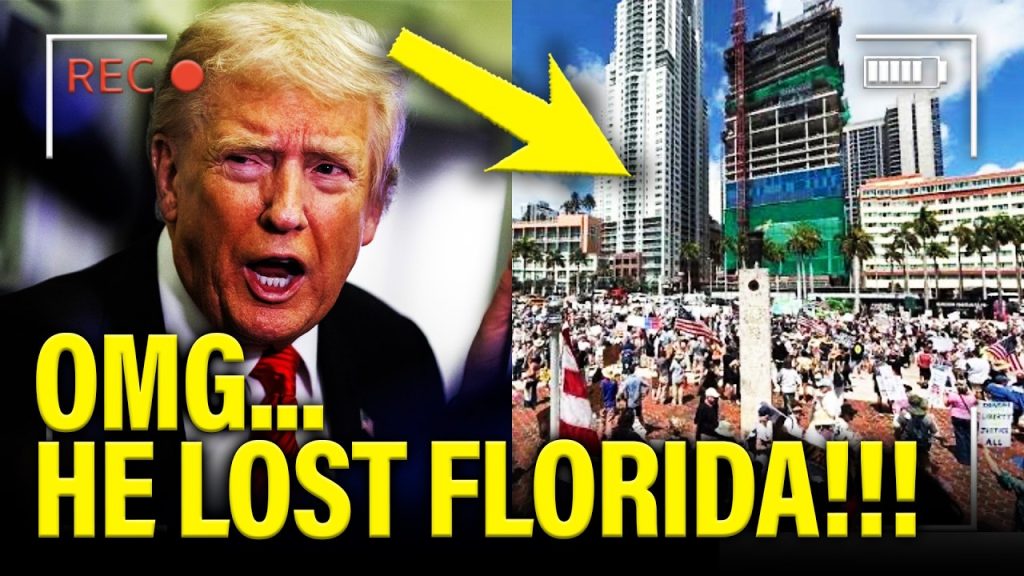
In Florida, a state long treated by Donald Trump as reliable political terrain, the ground has begun to shift in ways that are difficult to dismiss. Recent polling, a string of unexpected election results, and growing public dissent within Republican ranks have combined to produce what analysts increasingly describe not as a single setback, but as a broader collapse in political momentum — unfolding at a moment when Trump and his allies can least afford it.
The warning signs are no longer subtle. New surveys show Trump’s approval rating in Florida slipping into net-negative territory, with the decline accelerating rather than stabilizing. For a politician who has relied on Florida not only as an electoral asset but as a symbolic stronghold, the numbers have landed with unusual force. This is not a marginal dip explained away by methodology. It is a sustained erosion.
Recent special elections elsewhere have amplified the unease. In districts Trump once carried comfortably, Democratic candidates have overperformed by striking margins, defeating Trump-endorsed Republicans in territory previously considered safe. Republican leaders have been careful with their language, but the concern is visible. Even Florida’s Republican governor, once aligned closely with Trump’s orbit, has publicly cautioned his party against ignoring these signals, calling the political environment “not something that can be dismissed.”
Those comments were notable less for their content than for their source. In Florida Republican politics, distance from Trump has historically carried risk. Now, that calculus appears to be changing.
The shift is perhaps most evident in South Florida, where demographic complexity has long resisted national political generalizations. In Miami, voters recently elected a Democrat as mayor for the first time in nearly three decades, rejecting a Trump-endorsed Republican candidate by a wide margin. The result was not framed as ideological realignment so much as frustration — with affordability, governance, and what many voters described as empty political theater.
Immigration policy has become a focal point of that frustration. Republican members of Congress in the region spent years assuring immigrant communities that Trump’s rhetoric would not translate into broad enforcement against long-settled families. Those assurances have unraveled. Temporary protected status has been revoked for multiple groups. Deportations have increased. Federal programs affecting seniors, health care, and food assistance have been cut or placed at risk.
For many voters who supported Trump despite misgivings, the disconnect between promises and outcomes has become personal. Health insurance costs have surged. Housing affordability has deteriorated. Seniors on fixed incomes report new anxiety about benefits they once assumed were secure. In interviews and town halls, former Trump voters increasingly describe a sense of betrayal rather than ideological disagreement.

This erosion has placed Republican incumbents in vulnerable districts under intense scrutiny. In Florida’s 27th Congressional District — a seat covering the heart of Miami — criticism has sharpened around the gap between messaging and results. Community leaders and challengers accuse the incumbent of prioritizing loyalty to Trump over the material needs of constituents, pointing to votes that reduced health care subsidies, threatened nutrition assistance, and failed to protect immigrant families.
What distinguishes this moment from past cycles is the breadth of dissatisfaction. It spans Cuban, Venezuelan, Haitian, and Nicaraguan communities, as well as younger voters and seniors. The unifying factor is not ideology, but cost of living. Miami has become one of the most expensive cities in the country, and voters increasingly link that reality to federal policy decisions they see as reckless or performative.
Trump’s broader political narrative has also begun to strain under repetition. His rhetoric continues to frame opponents as extremists while casting himself as a defender of freedom. Yet critics argue that policies enacted under his influence — from attacks on press freedoms to threats against universities and dissenting institutions — mirror the authoritarian tactics many Florida voters fled in their countries of origin. That contradiction is now being voiced openly in communities where such comparisons were once politically taboo.
Even cultural issues that once energized Trump’s base appear to be losing potency. Voters interviewed in South Florida describe moments that served as personal breaking points: controversial foreign policy gestures, inflammatory social media posts, or racially charged imagery that crossed from provocation into offense. Each voter cites a different “last straw,” but the pattern is consistent — tolerance has limits.
Strategists note that Trump’s difficulties in Florida are not solely the result of Democratic messaging, but of cumulative credibility loss. The promises were expansive. The outcomes, for many voters, have been constricting. In politics, repetition can reinforce loyalty, but it can also exhaust it.
Whether this collapse in momentum translates into electoral defeat remains uncertain. Florida has drifted rightward in recent cycles, and Trump retains a loyal core of supporters. But the warning signs are now embedded in measurable behavior: declining approval, unexpected losses, public defections, and rising engagement among voters who once tuned out.
For Trump, the timing is particularly unforgiving. Florida is not just another state. It is a symbol of dominance, a fundraising hub, and a testing ground for national narratives. Losing control of that terrain — even partially — undermines the aura of inevitability that has long shielded him from internal party challenge.
Political collapses are rarely dramatic in the moment. They unfold through accumulation: a poll here, a loss there, a promise remembered too clearly. Florida now appears to be in that phase. Not a spectacle. A reckoning.