Tariffs on Canadian Potash Are Squeezing American Farmers — and Raising the Stakes for the Food Supply
When President Trump imposed a 10 percent tariff on Canadian potash fertilizer, the move was framed as a necessary step in recalibrating trade relationships. But in farm country, where margins are thin and planting decisions are measured in dollars per acre, the policy has landed with a thud.
Potash — a potassium-rich mineral essential for plant growth — is not a peripheral input in American agriculture. It is foundational. Corn, soybeans and wheat, the backbone of the nation’s crop system, all depend on it. Without adequate application, yields decline. With higher costs, profits evaporate.
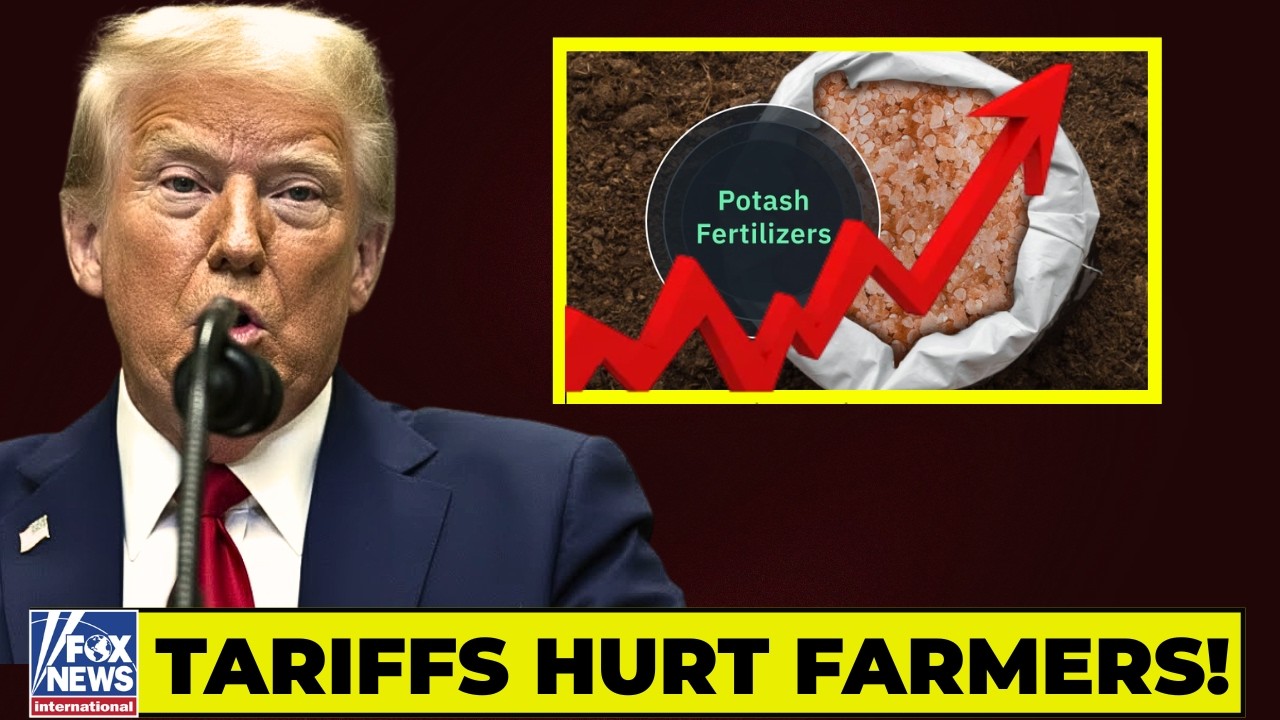
The United States imports roughly 87 percent of its potash from Canada, according to data from the U.S. Geological Survey and trade records analyzed over the past three years. Domestic production covers less than 8 percent of annual demand. In 2023, American farmers used about 5.3 million tons of potash, while U.S. mines produced only about 400,000 tons.
Canada’s dominance is not accidental. The province of Saskatchewan sits atop some of the world’s largest and highest-quality reserves, supported by infrastructure developed over decades. Canadian producers, led by companies such as Nutrien, which operates six of Canada’s 10 active potash mines, supply more than 40 countries.
By contrast, the United States has potash deposits in states including New Mexico, Utah and Michigan, but lacks the extraction capacity to scale production quickly. Industry analysts estimate that expanding or constructing new fertilizer facilities could take 10 to 15 years and require billions of dollars in investment.
For farmers, that timeline is academic. The impact is immediate.
Fertilizer accounts for between 30 and 45 percent of annual operating costs for many row crop producers, according to the U.S. Department of Agriculture Economic Research Service. When tariffs raise the price of potash, farmers face a stark choice: absorb higher input costs and risk operating losses, or reduce application rates and accept lower yields.
Neither option is attractive in a year when the American Farm Bureau Federation estimates farmers could lose an average of $150 per acre, with nationwide losses exceeding $15 billion. The American Soybean Association has warned that producers may face the longest stretch of substantial losses in two decades.
The White House has sought to cushion the blow. In December, the administration announced a $12 billion bridge assistance program for farmers, with $11 billion earmarked for row crop producers. But economists note that subsidies offset symptoms rather than causes. When tariff policy raises input costs, government payments funded in part by tariff revenue do little to change the underlying economics.
Joe Jansen, an agricultural economist at the University of Illinois, has argued that tariff-protected domestic production tends to increase, not decrease, costs for farmers. Shielding American producers from cheaper imports may encourage investment, but it also removes downward price pressure. In commodity markets, where farmers cannot easily pass higher costs to buyers, those increases come directly out of their margins.
The political calculus is delicate. Rural voters play an outsized role in congressional elections, and elevated input costs are expected to persist into 2026. At the same time, tensions with China have already disrupted export markets. Chinese purchases of U.S. soybeans were delayed deep into the 2025 harvest season, depressing prices for one of America’s most valuable crops.
Some policymakers have floated the idea of diversifying imports, including sourcing from Russia or Belarus. But that shift carries geopolitical risks. Saskatchewan’s premier has warned that cutting off Canadian supply could push the United States toward more politically fraught dependencies.
Meanwhile, inflation data suggest broader economic reverberations. Producer prices have risen since the administration’s April 2025 tariff escalation, and consumer inflation has ticked upward. Food prices are particularly sensitive to fertilizer costs; every percentage point increase in input expenses eventually filters through the supply chain.
Veronica Nigh, chief economist at the Fertilizer Institute, has cautioned that policy volatility — alternating between tariff threats and partial relief — discourages long-term investment. Companies considering multibillion-dollar projects seek predictability. Without it, expansion plans stall.

The administration has recently eased tariffs on certain grocery items, signaling awareness of consumer strain. But potash remains subject to the 10 percent duty, a figure reduced from an initial 25 percent after pressure from lawmakers in agricultural states.
The central tension is clear. The United States seeks to assert leverage in global trade negotiations and encourage domestic production. Yet in the case of potash, the country lacks the reserves and infrastructure to replace Canadian supply in the near term. Until that gap narrows — a process likely measured in decades, not seasons — tariffs function less as protection and more as a tax on American farmers.
For families planting this spring, the debate is not theoretical. It is calculated in fertilizer invoices and yield forecasts. And for consumers, it may soon be visible in grocery bills.
Trade policy often unfolds in abstractions — percentages, deficits, negotiating leverage. But in the American Midwest, its consequences are tangible. The health of the food system depends on a mineral mined largely north of the border. Making it more expensive may prove a costly way to test the limits of economic nationalism.