When Barack Obama chooses to speak, it is rarely impulsive. His public interventions since leaving office have been deliberate, spaced apart, and framed less as partisan counterpunches than as reflections on power, language, and consequence. That is what made his recent remarks—responding to a racially charged video shared and later deleted by Donald Trump—stand out so sharply. They were not theatrical. They were not shouted. They were clinical, precise, and difficult to dismiss.
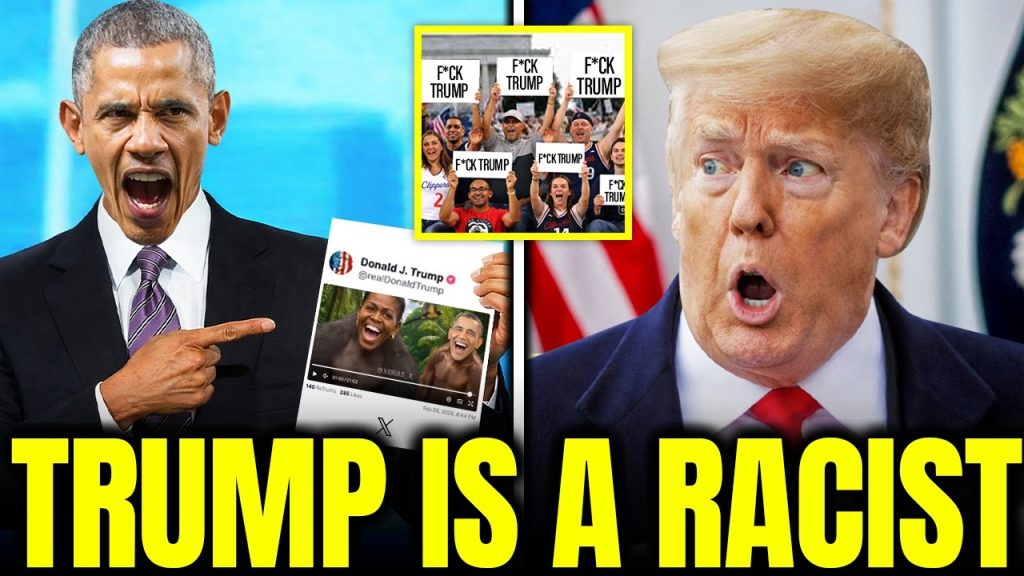
The episode began when Trump circulated a video online that depicted Obama and former first lady Michelle Obama using racist imagery. The post was removed after backlash, and the White House suggested it had been shared without full review. But the explanation did little to contain the reaction. Republicans and Democrats alike condemned the imagery, and civil rights leaders called it a line that should never have been crossed, even by Trump’s standards.
Obama’s response arrived later, and it avoided the trap of spectacle. He did not focus narrowly on the video itself. Instead, he placed it within a longer pattern—one he argued Americans had been encouraged to normalize. Racist language, he said, does not function merely as provocation or “trolling.” When it comes from the highest office, it becomes permission. Permission to dehumanize. Permission to divide. Permission to treat entire communities as political props.
That framing mattered. Trump’s defenders have often argued that his rhetoric should not be taken literally, that it is exaggerated entertainment, or that critics are overly sensitive. Obama rejected that premise outright. Words, he argued, shape behavior. They guide policy. They signal whose dignity is protected and whose is negotiable. In that sense, the video was not an aberration but an escalation—one more data point in a long record.

Obama’s remarks also drew a contrast between leadership styles. He described governance as a discipline that requires restraint and moral clarity, particularly in moments when outrage is tempting. Trump, by contrast, has repeatedly treated outrage as a resource—something to be mined for attention, loyalty, and dominance of the news cycle. The difference, Obama suggested, is not merely stylistic. It is ethical.
This argument resonated because it echoed a broader fatigue in the electorate. Years of incendiary rhetoric have lowered the bar for what qualifies as disqualifying behavior. Racist tropes that once would have ended political careers are now debated as “context” or “intent.” Obama’s intervention challenged that drift. He did not ask audiences to be shocked. He asked them to be honest.
The response rippled quickly through media and popular culture. On The Late Show with Stephen Colbert, the incident was dissected not just as a scandal, but as a case study in normalization. The studio reaction—initial silence followed by laughter and applause—captured the tension at the heart of the moment. Humor provided relief, but it did not erase the discomfort. If anything, it underlined it.
Trump, predictably, rejected the criticism. He dismissed the backlash, framed himself as misunderstood, and redirected attention to familiar grievances. But that response, too, fit the pattern Obama had outlined. Deflection instead of accountability. Escalation instead of reflection.
What made Obama’s remarks unusually forceful was their refusal to personalize the issue. He did not dwell on his own offense or on Trump’s intent. He spoke instead about impact. About how rhetoric aimed at immigrants, Black Americans, and other marginalized groups does not dissipate once a post is deleted. It lingers in institutions, in enforcement decisions, in how neighbors perceive one another.

Political historians note that former presidents often avoid direct condemnation of successors, preferring to protect the office rather than critique the occupant. Obama’s decision to speak so plainly signaled that he believed the moment required it. Not because the video was uniquely offensive—though it was—but because the cumulative effect of such moments has reshaped public expectations of leadership.
In that sense, the speech functioned less as a rebuttal and more as a warning. Democracies, Obama implied, do not erode only through laws or coups. They erode through language that redefines who belongs. Through repetition that dulls outrage. Through silence that masquerades as neutrality.
The enduring power of the moment lay in its restraint. Obama did not demand cancellation or punishment. He demanded recognition. Recognition that racism, when weaponized by a president, is not a sideshow. It is a governing philosophy. And recognition, he argued, is the first step toward accountability.
Whether that call will change behavior remains uncertain. Trump has built his political identity on defying condemnation, and his supporters often interpret criticism as validation. But Obama’s intervention shifted the frame. It made it harder to dismiss the episode as just another controversy in an endless cycle.
Instead, it forced a more uncomfortable question: how much has already been accepted as normal? And at what cost?
By choosing clarity over confrontation, Obama left the country with a choice rather than a slogan. Ignore the pattern and accept the erosion. Or acknowledge it—and decide that some lines, once crossed, must still matter.