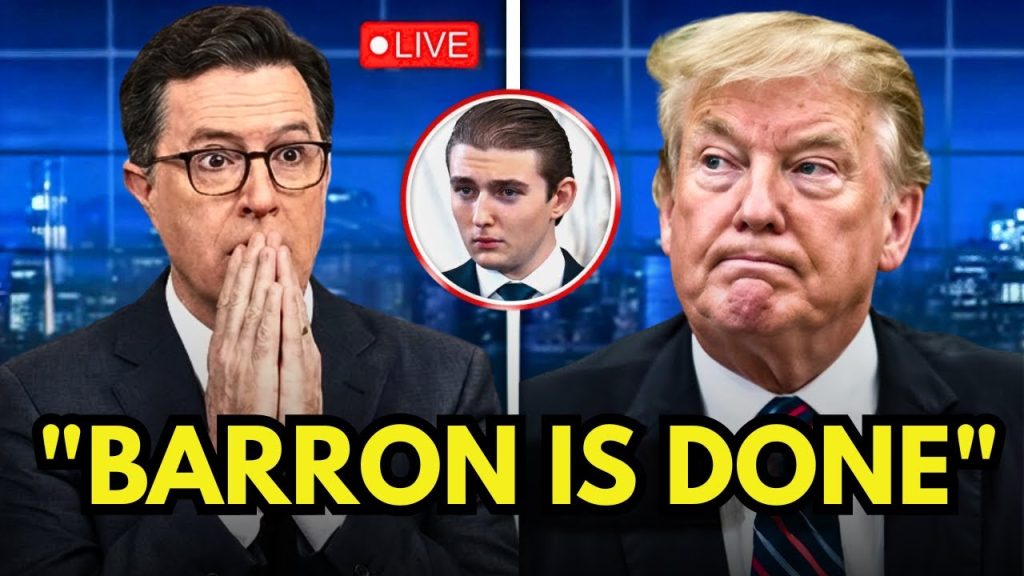
A dramatic video circulating widely on social platforms this week claims to capture a defining moment of political theater: Stephen Colbert delivering an eight-second verbal reversal so devastating that Donald Trump is said to have audibly gasped, stunned into silence, after an alleged insult from his son, Barron Trump.
The clip is slickly edited, tightly narrated, and rich with cinematic tension. It describes a prestigious “National Summit on Truth and Democracy,” a live television setting heavy with historical gravitas. Barron Trump, the video asserts, interrupts a veteran journalist with a cutting remark about generational power and “bloodlines.” Trump beams with pride. Then Colbert, abandoning satire for solemn authority, calmly dismantles both son and father in a matter of seconds.
It is a compelling story. It is also, based on all verifiable evidence, a fictional one.
There is no public record of such a summit taking place. No broadcast transcript, no reputable media report, no independent footage places Stephen Colbert, Donald Trump, and Barron Trump together on a live televised stage in the manner described. The quoted dialogue attributed to Barron Trump does not appear in any authenticated source, nor does the climactic “eight-second flip” attributed to Colbert. As with many viral political clips, the authority of the narration substitutes for documentation.
The format is by now familiar. Real public figures are placed into an invented setting that closely resembles reality, borrowing credibility from names, tones, and recognizable public personas. Colbert is cast not as a late-night comedian, but as a moral adjudicator. Trump is portrayed as performative and indulgent. Barron Trump, largely absent from public political life, is positioned as an emerging symbol of dynastic power. The scene functions less as reportage than as allegory.
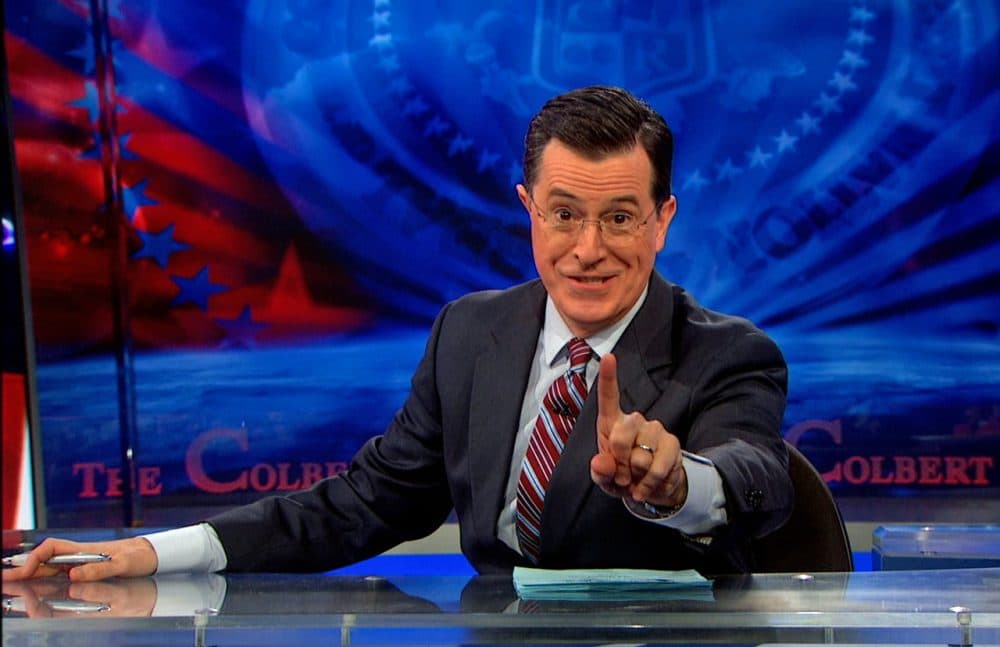
What gives the video its traction is plausibility. Stephen Colbert is known for sharp reversals and rhetorical traps. Donald Trump is associated with visible reactions to public confrontation. These established traits allow audiences to suspend skepticism, especially when the moment aligns with an emotional desire: the idea that cruelty is exposed instantly, publicly, and decisively.
Yet plausibility is not proof. If a sitting or former president were publicly rebuked on live television in such personal terms, it would generate immediate coverage across major outlets. It would be clipped, debated, contextualized, and archived. None of that exists here. The absence of secondary confirmation is not incidental; it is decisive.
The inclusion of Barron Trump raises additional ethical concerns. Unlike his parents, Barron Trump has not chosen a public political role. He has not campaigned, governed, or offered policy positions. Viral narratives that script him as an aggressor or ideological heir collapse the distinction between public accountability and private identity. Even when framed as commentary, the effect is to assign agency and intent without evidence.
Media analysts note that such videos thrive in algorithmic environments precisely because they resolve tension quickly. Eight seconds is not an accident; it is an attention-optimized unit. The promise of instant reversal—of power undone without mess or ambiguity—fits the rhythms of platforms that reward compression over complexity.
The clip also reflects a broader cultural pattern: a growing appetite for moments where moral clarity arrives cleanly and decisively. In an era of prolonged conflict and unresolved debates, audiences gravitate toward stories in which composure defeats aggression in real time. These narratives offer relief, even if they are imagined.

None of this diminishes the real conversations such videos gesture toward. Questions about legacy, media power, intergenerational influence, and the boundaries of public discourse are legitimate and urgent. Stephen Colbert’s actual work often interrogates those themes through satire and critique. Donald Trump’s public conduct has prompted sustained scrutiny. But those realities do not justify treating fabricated scenes as factual events.
The danger is not merely misinformation, but habituation. When fictionalized political confrontations circulate unchecked, they begin to occupy the same mental space as documented history. Over time, the distinction erodes. Viewers remember the feeling of the moment, not whether it happened.
Responsible consumption requires a different discipline. Before sharing or endorsing such clips, basic questions matter: Where did this occur? Who else reported it? Is there unedited footage? In this case, the answers point consistently in one direction.
The story is powerful because it is symbolic, not because it is true.
In the end, the most revealing aspect of the video may be what it says about audience expectations. Many people want to see cruelty answered swiftly, lineage exposed, and authority reclaimed through calm precision. That desire is understandable. But journalism, unlike fiction, does not exist to satisfy narrative longing. It exists to establish what happened.
Here, what happened is simpler and quieter: a viral clip constructed to feel real, shared because it feels right, but unsupported by fact. The real lesson is less cinematic, but more durable. In a media environment saturated with performance, verification remains the only reliable measure of truth.