When the Insult Becomes the Headline
Donald J. Trump has long understood the power of a nickname.
From “Low Energy” to “Crooked” to “Little,” the tactic has been a staple of his political arsenal — a way to shrink opponents into caricatures and frame conflict as entertainment. It is branding as bludgeon, delivered in punchy syllables designed to travel fast.
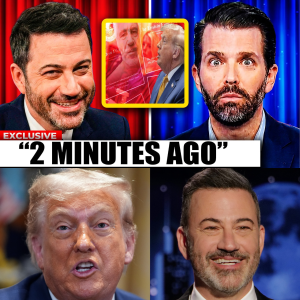
So when Trump recently labeled late-night host Jimmy Kimmel “President Dementia” in a late-night post, it was not a policy dispute. It was a familiar maneuver: humiliation as strategy, mockery as dominance.
The target, however, was not a rival candidate but a comedian.
Trump’s relationship with Kimmel has been combative for years. Kimmel has made Trump a recurring character in his monologues, slicing speeches into punchlines and turning rhetorical tangents into viral montages. Trump, who monitors television with a critic’s intensity, has treated those jokes not as satire but as affront.
This latest exchange unfolded in a way that underscores how modern political feuds are staged — not only in rallies and press conferences, but in studios and on timelines.
Kimmel did not respond online. He did not fire back on social media. Instead, he waited for the stage.
When he walked out that evening, the audience already knew about the insult. Kimmel held up a printed copy of Trump’s post, reading the nickname aloud without embellishment. Spoken plainly, it sounded less menacing than juvenile.
Then he pivoted.
Rather than defend himself directly, Kimmel reframed the attack. “When someone has to call other people demented,” he told the audience, “it usually means they’re terrified of being compared to a record that doesn’t lie.” The room erupted — not only in laughter, but in recognition.
The joke worked because it turned the insult inside out. By accepting the label and shrinking it into absurdity, Kimmel robbed it of its intended force. “Honestly, ‘President Dementia’ is kind of flattering,” he added. “At least it includes the word president.”
It was the kind of line that travels — concise, reversible, meme-ready. But beneath the punchline was a sharper question.
Kimmel asked what such insults accomplish. Do groceries cost less? Are schools safer? Does anyone sleep better because a former president typed a nickname after midnight?
The laughter gave way to applause. In posing the question, Kimmel shifted the terrain from personality to substance. The insult was not dangerous because it hurt feelings; it was hollow because it offered nothing else.
For Trump, whose political persona has thrived on spectacle, this kind of reframing presents a challenge. His instinct is escalation. When criticized, he responds not with retreat but amplification. The louder the noise, the more the spotlight widens.
But the economy of late-night comedy operates differently. Timing can outweigh volume. Silence can be strategic. By waiting for the studio, Kimmel controlled the rhythm of the exchange. He turned Trump’s insult into a prop — a printed “receipt” — and used it as the setup rather than the climax.
The episode also highlights a broader cultural tension. In recent years, late-night hosts have functioned as quasi-political commentators, blending satire with civic critique. Their influence is amplified by social media, where monologues are clipped into shareable segments within minutes.
Trump understands this ecosystem. His attacks on comedians are not incidental; they are an acknowledgment of their reach. When he mocks Kimmel’s ratings or talent, he signals that he is watching — and that he considers the jokes consequential.
In the dramatized aftermath of this exchange, Trump reportedly doubled down online, dismissing Kimmel as irrelevant while continuing to reference him. The paradox is familiar: the more a political figure claims indifference, the more the public perceives attention.
What made this moment resonate was not that a comedian “won” a feud. It was the inversion of power. Trump attempted to dominate through belittlement; Kimmel responded with composure. The insult was loud; the rebuttal was measured.
“Disagreement is fine,” Kimmel said in closing. “Debate is healthy. But humiliation isn’t leadership.”
In American politics, insults are rarely about persuasion. They are about performance. A nickname is a headline in miniature, a shorthand for a narrative. But headlines, like jokes, can be repurposed.
Kimmel did not outshout Trump. He outtimed him. He transformed a smear into a setup, then into a mirror. And mirrors, as any performer knows, are unforgiving — especially to those who depend on reflection as applause.
In the end, the exchange may be remembered less for the insult itself than for the question it prompted: What is a country to do with leaders who prefer labels to answers? The audience, at least for one night, seemed to know which line deserved the last word.