Bipartisan U.S. Senators Travel to Greenland to Reject Trump’s Threats and Reaffirm NATO Commitments
A rare bipartisan delegation delivers an unmistakable message to Greenland and Denmark: Congress will not support any attempt by Donald Trump to threaten sovereignty, undermine NATO, or destabilize the Arctic region.
NUUK, Greenland — In a moment of unusual bipartisan unity, a delegation of ten United States senators and representatives traveled to Greenland this week to deliver a clear and direct message to the people of Greenland and Denmark: the U.S. Congress does not support Donald Trump’s threats toward Greenland, Denmark, or the NATO alliance.
Standing alongside Greenlandic lawmakers, Danish officials, and the prime ministers of both Greenland and Denmark, members of the delegation emphasized sovereignty, territorial integrity, and self-determination — principles that have defined NATO since its founding and that, they warned, are now being publicly challenged by the former and potentially future U.S. president.
The delegation included Republicans, Democrats, and independents, underscoring the gravity of the moment. Among them were Senator Lisa Murkowski of Alaska, Senator Chris Coons of Delaware, Senator Jeanne Shaheen of New Hampshire, and other senior lawmakers with extensive experience in foreign policy and national security.

“This Is Not Republicans Versus Democrats”
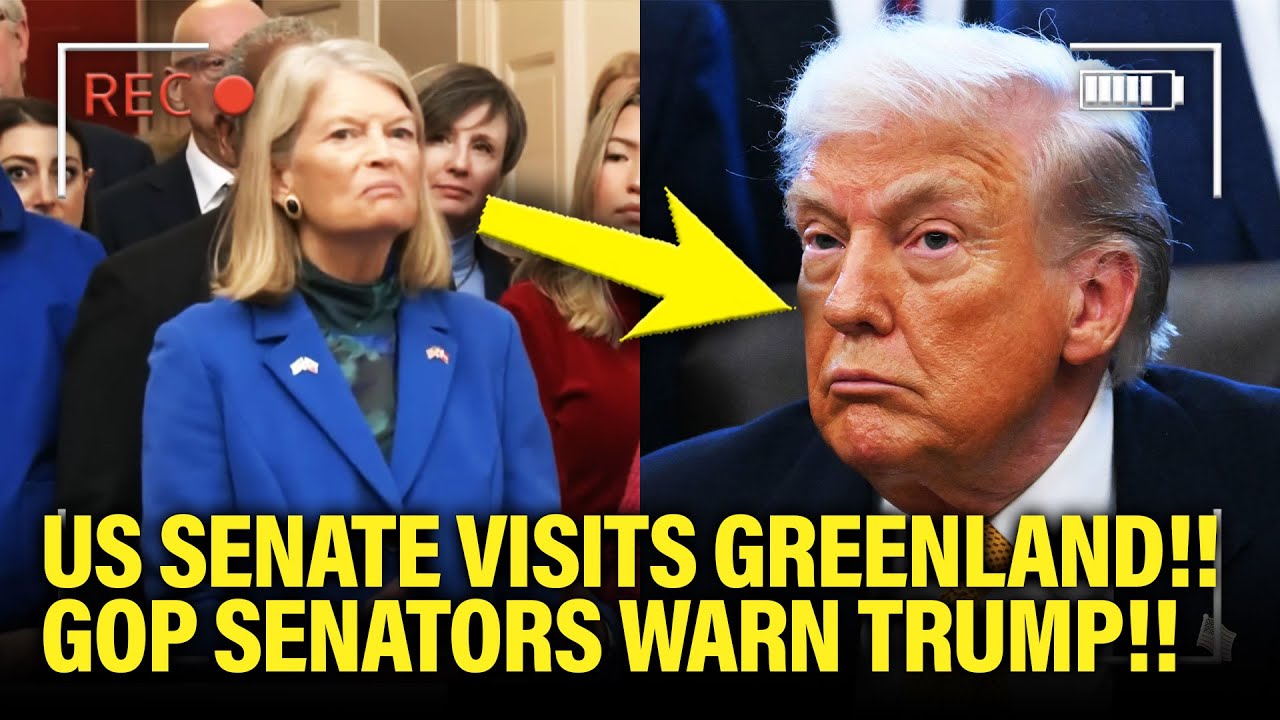
Speaking in Nuuk, Senator Murkowski emphasized that America’s alliances are not partisan property.
“When it comes to relationships with our friends and our allies — as we have here in Denmark and Greenland — this is not a subject of Republicans versus Democrats,” Murkowski said. “It is a recognition of a strong and continuing relationship over decades. These relationships require care, dialogue, and respect.”
Her remarks were delivered after meetings with the prime ministers of Greenland and Denmark, as well as earlier discussions in Washington with the foreign ministers of both governments.
The symbolism was deliberate. Congressional presence, Murkowski said, “means a lot,” particularly at a moment when rhetoric from the U.S. executive branch has created anxiety in allied capitals.
A Direct Rejection of Military Threats
Senator Coons, who led the delegation, framed the visit as both reassurance and warning.
“We spoke with clarity about the importance that the people of Greenland make their own decisions about their future,” Coons said. “We reaffirmed the core principles of sovereignty, territorial integrity, and self-determination.”
Those words carried particular weight following repeated statements by Donald Trump suggesting that the United States could acquire Greenland by force — remarks that have alarmed NATO allies and unsettled Arctic security dynamics.
Senator Jeanne Shaheen was even more explicit.
“An American military takeover of Greenland would threaten NATO as we know it,” she said. “Even the suggestion does real damage — not just to relationships with Greenland and Denmark, but to America’s own national security.”
Shaheen warned that such rhetoric “plays directly into the hands of our greatest adversaries, Russia and China,” by eroding trust among allies and weakening collective deterrence.
Greenland’s Response: Dialogue Over Fear
Greenlandic officials welcomed the delegation as a stabilizing force.
“It was really important for us to attend this meeting with the senators and representatives,” a Greenlandic lawmaker said. “Dialogue is first and foremost important for us, and we hope this is the first of many.”
While officials emphasized cooperation through NATO, they also acknowledged the emotional toll of the recent rhetoric. Danish and Greenlandic leaders have publicly stated that some residents — including children — fear waking up to the possibility of an American invasion.
Those fears, lawmakers stressed, are not hypothetical in a world where great-power aggression has returned to Europe.
A Historical Echo — and a Russian Advantage
Several members of Congress drew parallels to a lesser-known but significant episode in 2019, when Danish intelligence services uncovered a Russian false-flag operation designed to spread rumors that the United States intended to seize Greenland.
The objective then was to fracture NATO unity.
“This is exactly the kind of discord Russia tried to manufacture covertly,” one lawmaker noted. “Now it’s being done openly — and that is far more dangerous.”
By forcing NATO to confront instability on its western flank, critics argue, Trump’s Greenland rhetoric diverts attention from the alliance’s eastern front, particularly Ukraine — a shift that directly benefits Vladimir Putin.
“If NATO is distracted defending Greenland from American belligerence,” one member of Congress said, “it weakens our ability to defend Ukraine and the Baltic states.”

The Strategic Reality: Cooperation Already Exists
From a defense standpoint, lawmakers emphasized that the United States already has everything it needs in Greenland through existing treaties.
The U.S.–Greenland defense agreement dates back to 1951. At its peak, the United States operated 17 military bases on the island. All but one were closed by American decision — not Greenlandic resistance.
“If the United States wants to build bases, develop critical minerals, or expand Arctic defense,” Senator Shaheen said, “all we have to do is partner. That door is already open.”
Threats, she added, are not only unnecessary — they are counterproductive.
Congressional Red Lines
Behind the diplomatic language lies a clear warning.
Multiple senators privately and publicly signaled that any attempt by a U.S. president to use military force against Greenland or a NATO ally would trigger immediate congressional action, including impeachment and conviction proceedings.
Congress, they stressed, retains constitutional authority over war powers — and bipartisan opposition to such an action is overwhelming.
Recent polling shows that 86 percent of Americans oppose the use of military force in Greenland.
The Larger Pattern
The Greenland delegation reflects a broader trend: institutions asserting themselves against unilateral, destabilizing executive behavior.
Where rhetoric escalates, Congress is signaling restraint. Where threats emerge, alliances are being publicly reinforced.
This is not merely a dispute over territory. It is a test of whether the post–World War II alliance system — built on law, consent, and cooperation — can withstand a return to coercive power politics.
A Message Beyond Nuuk
The message delivered in Nuuk was not only for Greenland and Denmark.
It was for Moscow, Beijing — and Washington.
Sovereignty is not negotiable. Alliances are not transactional. And threats, even when spoken casually, carry consequences.
For now, the U.S. Congress has drawn a line — and, unusually, it has done so together.