Canada’s $244 Billion Defense Pivot to Europe Signals a Quiet Collapse of America’s Most Reliable Alliance
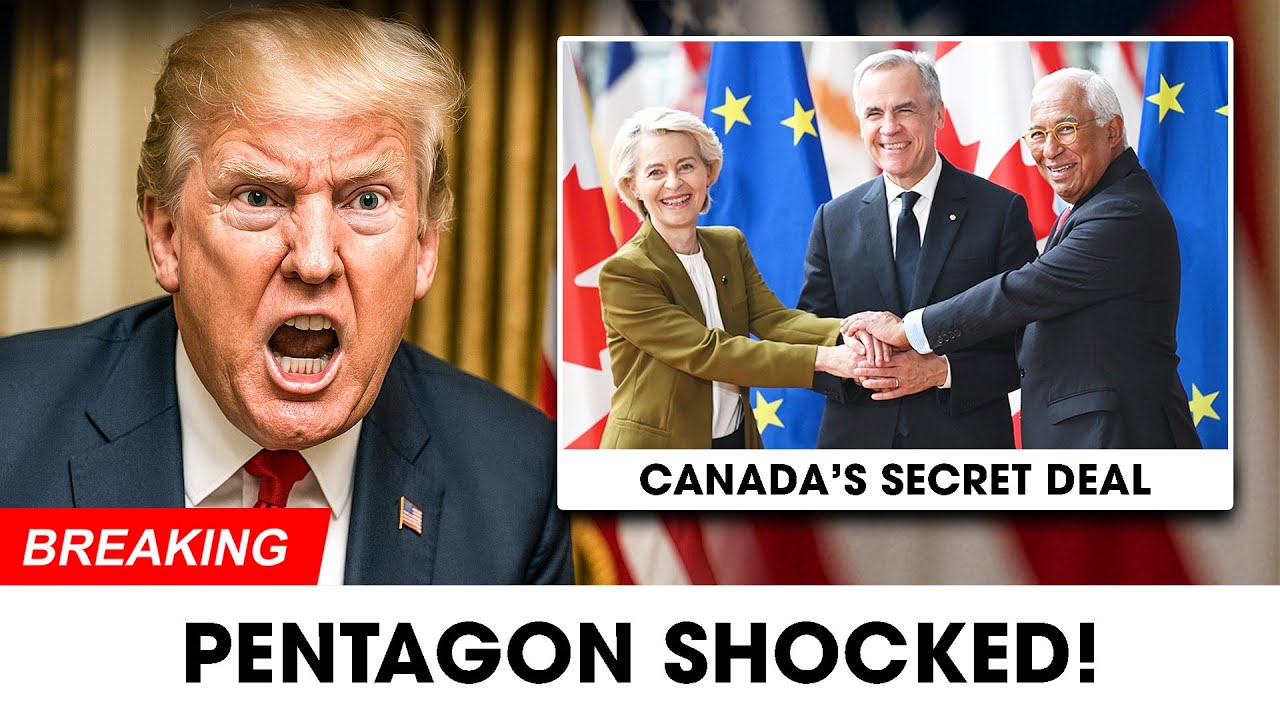
While President Donald Trump was publicly threatening Canada with sweeping 35 percent tariffs and mocking the idea of turning America’s closest neighbor into its “51st state,” a far more consequential shift was unfolding quietly in Brussels—one that senior officials inside the Pentagon reportedly did not fully grasp until it was too late to reverse.
On December 1, 2025, Canada secured access to a sweeping European defense financing framework worth up to 244 billion Canadian dollars, becoming the first and only non-European country admitted into the European Union’s most ambitious military initiative since the Cold War. The United States, long considered indispensable to European security, was left entirely outside the deal.
The agreement marks a profound strategic rupture, not just in trade or procurement, but in the architecture of Western alliances that has defined global security for decades.

At the heart of the shift is the European Union’s Security Action for Europe (SAFE) initiative, a €150 billion program designed to accelerate Europe’s military autonomy by 2030. Structured around low-interest loans backed by the EU’s AAA credit rating, SAFE is channeling unprecedented capital into missiles, ammunition, drones, air defense systems, cyber warfare capabilities, and space-based technologies.
Europe’s motivation is clear. Russia’s prolonged war in Ukraine, combined with Trump’s repeated public doubts about NATO and his willingness to weaponize trade against allies, convinced European leaders that their security could no longer rest solely on Washington’s guarantees.
SAFE was initially designed as a closed system, limited strictly to EU member states. Britain, despite its historic military ties, was denied access after Brexit. Australia lobbied aggressively and failed. Even the United States—Europe’s largest military ally—was excluded.
Canada’s admission therefore landed like a geopolitical thunderclap.
For decades, Ottawa’s defense ecosystem revolved almost entirely around Washington. More than 70 percent of Canada’s defense spending flowed to American contractors. Canadian firms operated largely as component suppliers within U.S.-led systems, bound by American standards, procurement rules, and political leverage. That dependence left Canada with little room to maneuver whenever relations with Washington soured.

And under Trump, they repeatedly did.
Throughout his presidency, Trump imposed tariffs on Canadian goods, threatened the country’s auto industry, and publicly disparaged Canadian leaders at international summits. Tensions escalated sharply in mid-2025 after Canada supported recognition of a Palestinian state at the United Nations, prompting Trump to threaten a blanket 35 percent tariff regime.
What Washington failed to anticipate was how quickly Canada would adapt.
Following Prime Minister Justin Trudeau’s departure amid a domestic political crisis, Mark Carney, the former governor of both the Bank of Canada and the Bank of England, entered politics with a blunt message: Canada could no longer entrust its future to an unpredictable partner willing to use coercion against allies.
Within months of taking office, Carney quietly laid the groundwork for a strategic realignment. In June 2025, Canada signed a defense cooperation agreement with the European Union that was widely dismissed at the time as symbolic. In reality, it served as the legal gateway to SAFE.
By December, Canada was in.
The implications are sweeping. Canadian defense companies can now bid directly on EU-funded projects across 27 countries—contracts potentially worth tens of billions of dollars annually. Even more striking, Canada secured exemptions allowing its firms to supply up to 80 percent of component value in certain high-priority systems, far above the standard EU threshold. These sectors—drones, missile components, advanced sensors, cybersecurity—are precisely where American firms have traditionally dominated global markets.
U.S. defense contractors, by contrast, are excluded entirely.
Canada also gains access to the EU’s low-interest financing mechanism, enabling long-term production planning on a scale rarely possible in defense manufacturing. New factories, expanded production lines, and tens of thousands of skilled jobs can now be planned decades in advance, anchored not to Washington but to Brussels.
To manage the shift, Ottawa has created a permanent defense investment authority tasked with integrating Canadian firms into Europe’s military supply chains over the next 30 to 45 years. Officials familiar with the agency’s mandate say its goal is to facilitate defense transactions worth tens of billions annually by the end of the decade.
The strategic meaning is difficult to overstate. The postwar Western alliance was built on the assumption that American security guarantees were unquestionable. SAFE—and Canada’s inclusion—signals that assumption is no longer universal.
Europe chose Canada not for its size, but for its predictability. Ottawa does not threaten tariffs over political disagreements, does not cast doubt on alliances for domestic applause, and does not treat trade as a blunt instrument of control.
For Canada, the agreement is not without risk. Navigating the EU’s complex bureaucracy will be challenging, and retaliation from Washington remains a real possibility. But the calculation is clear: diversifying away from near-total U.S. dependence is worth the cost.
For the United States, the damage is already done. When a nation’s closest ally concludes that long-term security is safer in Brussels than in Washington, the issue is no longer policy disagreement. It is a breakdown of trust.
This is the price of mistaking threats for strategy—and of turning alliances into leverage instead of partnerships.