BREAKING: Trump’s “Governor” Insult May Have Just Cost the U.S. Its Most Important Trade Ally
Mark Carney’s Calm Response Is Quietly Rewriting the Future of North American Trade
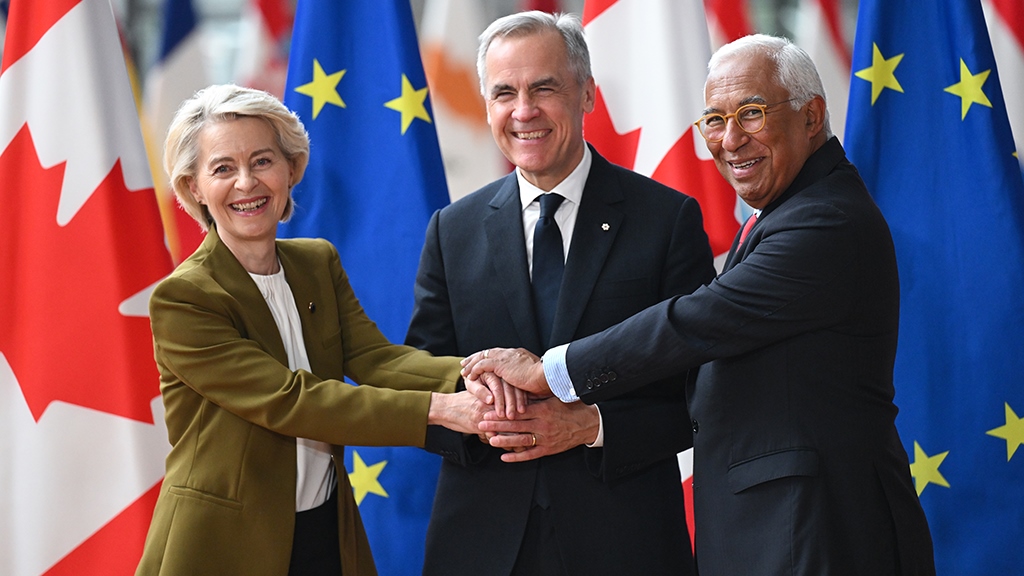
When Donald Trump recently referred to Canadian Prime Minister Mark Carney as “Governor” and threatened 100% tariffs, many expected outrage, retaliation, or at least a sharp diplomatic rebuke. Instead, Carney offered something far more dangerous to Washington: calm clarity. Speaking to reporters in Ottawa, Carney brushed aside the insults without anger or defensiveness, framing Trump’s remarks as pre-positioning for negotiations. It was a response that revealed not weakness, but strategy.
“Trump is a strong negotiator,” Carney said evenly. “Some of these comments and positioning should be viewed in that broader context.” Then came the line that truly mattered: “I won’t respond to every social media post or comment made by the president.” In one sentence, Carney signaled that while Trump was focused on insults, Canada was focused on alternatives.
That contrast may determine the fate of the Canada–United States–Mexico Agreement (CUSMA) when it comes up for mandatory review on July 1, 2026—a date now looming as one of the most consequential trade deadlines of the decade.

Why Trump’s Insults Are Backfiring
For decades, Canada’s economy lived in the shadow of the United States. Roughly 75% of Canadian exports flowed south of the border, giving Washington enormous leverage. When Trump imposed tariffs, Canada negotiated. When he threatened to kill NAFTA, Canada scrambled to save it. Dependency meant vulnerability.
Trump appears to believe the same playbook still applies. By calling Carney “Governor,” posting fake maps showing Canada as the 51st state, and threatening punitive tariffs, Trump seems convinced that humiliation will force compliance. But every insult is doing the opposite. It is giving Carney political cover to do what previous Canadian leaders could not: prepare the country to walk away.
Canadian voters will not punish a prime minister for resisting a deal after months of being publicly mocked and threatened. In fact, they are rallying around him. Carney’s approval ratings jumped after Trump’s annexation jokes went viral, transforming what might have been risky trade diversification into a patriotic necessity.
The Silent Shift: Canada Builds Its Exit Options
While Trump fires off posts, Carney is quietly restructuring Canada’s economic future. His government has moved to secure new export routes to China, striking deals that lower tariffs on Canadian canola, pork, and seafood in exchange for concessions on electric vehicles. Quebec is expanding electricity partnerships with Europe, reducing reliance on U.S. grids. British Columbia is accelerating LNG infrastructure aimed at Asian markets, while Ottawa rolls out “Buy Canadian” procurement policies redirecting an estimated $70 billion away from American suppliers.
These moves are not symbolic. They are structural. They mean that when CUSMA enters its review phase, Canada will no longer be negotiating from desperation. It will be negotiating from choice.
The Trade Bomb Hidden Inside CUSMA
Most coverage of Trump’s tariff threats misses the real ticking time bomb: the CUSMA sunset clause. Starting July 1, 2026, the three countries must choose whether to extend the agreement for another 16 years, trigger annual reviews for a decade, or withdraw entirely.
If even one country refuses to extend, the deal does not end immediately. Instead, it enters a 10-year annual review cycle, creating rolling uncertainty until 2036. Businesses freeze long-term investments. Supply chains fragment. Every year becomes a new negotiation.
This clause was designed to give the United States leverage. Trump demanded it in 2017 to force future concessions. But leverage cuts both ways. Carney has realized that triggering annual reviews may be politically safer than accepting American demands that strip Canada of control over dairy policy, digital regulation, cultural protection, and permanent sectoral tariffs on steel, aluminum, and autos.
Trump’s Demands—and Canada’s Calculus
Washington has already outlined its priorities. Trump’s trade team wants Canada to dismantle dairy supply management, stop subsidizing softwood lumber, repeal digital media regulations affecting U.S. tech companies, and potentially replace the trilateral framework with bilateral deals. In essence, the U.S. is asking Canada to surrender sovereignty in exchange for continued access to a market it is already diversifying away from.
Carney has not yet submitted Canada’s formal priorities—and that delay is strategic. Every new insult strengthens his domestic mandate to say no. Even if he personally wanted compromise, how does he sell concessions after months of being called “Governor” and watching his country treated as subordinate?
Davos Changed the Game
Carney’s speech at Davos marked a turning point. Warning middle powers about economic coercion by great powers, he told global leaders, “If you are not at the table, you are on the menu.” The line earned a standing ovation—and infuriated Trump. Shortly afterward, Trump lashed out, claiming “Canada lives because of the United States” and threatening tariffs over a China deal he had praised just days earlier.
The message was clear: Canada was no longer acting like a dependent. It was acting like a peer.
The Political Trap Trump Built for Himself
Ironically, Trump now needs Canada more than Canada needs him. U.S. automakers rely on Canadian parts. Steel producers need Canadian iron ore. New England depends on Canadian electricity. Midwest refineries rely on Canadian oil. Nearly 150 U.S. industry leaders have warned Congress that CUSMA is essential to American economic stability.
Yet Trump continues to insult the very leader whose signature he needs in four months. Each jab narrows Carney’s room to compromise and widens the path toward annual reviews—or withdrawal.
A Deadline Approaches
July 1, 2026, is only 156 days away. Behind closed doors, draft proposals will begin circulating much sooner. Trump’s team may push for pre-emptive concessions. Carney’s strategy is the opposite: concede nothing, build alternatives, and let Trump talk.
The result is a stunning reversal. What was meant to weaken Canada may become its escape clause from American economic dominance. Trump thought calling someone “Governor” would strip authority. Instead, it may strip the United States of its most reliable trading partner.
Final Takeaway
This is not just a war of words. It is a battle over leverage, sovereignty, and the future of North American integration. And for the first time in decades, Canada is entering negotiations with a credible walk-away option.
Trump still has time to change course—to negotiate with Prime Minister Carney as an equal. But every day he chooses insults over diplomacy, the alternative becomes more likely: a slow, deliberate decoupling that reshapes continental trade for a generation.
What Trump intended as strategy may go down as the most consequential act of self-sabotage in modern trade history.