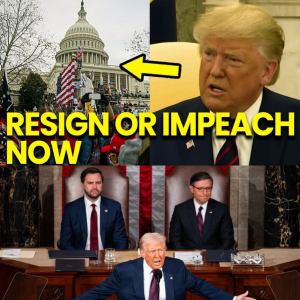
🚨 Trump Faces Political Pressure as Jack Smith’s Report Reignites Impeachment Debate ⚡
Washington — A newly released final report from Special Counsel Jack Smith has intensified debate in the nation’s capital, laying out in detailed terms what he describes as sufficient evidence to have convicted President-elect Donald Trump on charges related to efforts to overturn the 2020 election and the handling of classified documents.
According to Smith’s report, investigators concluded that the evidence gathered met the “beyond a reasonable doubt” standard — the legal threshold required to secure a criminal conviction in federal court. However, despite that assessment, the Department of Justice ultimately dropped the prosecutions after Trump won the 2024 election and prepared to return to office. The reason, Smith emphasized, was not evidentiary weakness but adherence to a longstanding DOJ policy prohibiting the criminal prosecution of a sitting president.
The report’s publication has shifted attention from the courtroom to Congress, where lawmakers now face renewed calls to determine whether impeachment proceedings are warranted.

The DOJ Policy at the Center of the Decision
The Department of Justice’s Office of Legal Counsel has maintained for decades that a sitting president cannot be criminally prosecuted while in office. The rationale rests on concerns about separation of powers and the potential constitutional crisis that could arise from prosecuting a sitting chief executive.
As a result, once Trump secured victory and returned to presidential status, the department concluded it was bound by its own institutional policy to halt further criminal proceedings.
In his testimony before Congress, Smith stated plainly that his team believed criminal conduct occurred. He also emphasized that the inability to prosecute under DOJ policy does not eliminate the underlying findings or the legal conclusions drawn from the investigation.
“This was not a matter of insufficient evidence,” Smith said during questioning. “It was a matter of constitutional structure and Department policy.”

Evidence and Allegations
Smith’s report addresses two primary legal tracks: alleged efforts to interfere with the certification of the 2020 election results and the retention of classified documents after leaving office.
On the election-related matter, prosecutors argued that Trump engaged in actions designed to disrupt the lawful transfer of power. On the classified documents front, investigators examined whether sensitive materials were improperly retained and whether efforts were made to obstruct recovery.
While those allegations remain unadjudicated in court due to the DOJ policy constraint, the report details interviews, documentary evidence, and grand jury materials gathered over the course of the investigation.
Importantly, no court has rendered a final verdict on these matters. The report reflects prosecutorial conclusions, not judicial findings of guilt.
Impeachment as the Remaining Constitutional Path
With criminal prosecution paused, attention has turned to Congress. Under the U.S. Constitution, impeachment is a political — rather than criminal — mechanism designed to address misconduct by federal officials, including the president.
Smith noted during testimony that while DOJ policy restricts prosecution, it does not prevent Congress from exercising its impeachment authority.
That distinction is critical. Unlike criminal proceedings, impeachment does not require proof “beyond a reasonable doubt.” The House of Representatives determines whether to impeach by majority vote, and the Senate conducts a trial requiring a two-thirds vote for conviction and removal.
Some Democratic lawmakers have already described Smith’s report as a potential “roadmap” should they regain control of the House in the 2026 midterm elections. They argue that if criminal courts are constitutionally constrained, Congress has a duty to evaluate the evidence under its own authority.
Republican lawmakers, meanwhile, have largely dismissed the report as politically motivated and argue that voters rendered their judgment by electing Trump again.
Presidential Immunity and Its Limits
The legal debate also intersects with ongoing questions about presidential immunity. While a sitting president may be shielded from prosecution under DOJ policy, that protection does not equate to permanent immunity.
Once a president leaves office, prosecution can theoretically resume, subject to statutes of limitation and judicial review.
Legal scholars note that this dynamic creates a complex constitutional balancing act. On one hand, the presidency must function without constant threat of indictment. On the other, accountability mechanisms must remain intact.
“This situation underscores the tension between executive independence and the principle that no person is above the law,” said one constitutional analyst.

Political Ramifications
Politically, the release of Smith’s report could shape the 2026 midterm elections. If Democrats campaign on accountability themes and regain a House majority, impeachment proceedings could become a realistic possibility.
Conversely, if Republicans maintain or expand their majority, impeachment is unlikely to advance, and the matter may remain primarily within the sphere of public and historical debate.
Public reaction remains sharply divided. Supporters of Trump argue that repeated investigations amount to partisan targeting, while critics contend that institutional accountability should not hinge on electoral outcomes.
A Shift from Courts to Congress
In practical terms, the legal cases were paused not because prosecutors lacked confidence in their evidence, but because Trump’s return to office activated DOJ’s longstanding policy constraint.
That shift places the constitutional spotlight squarely on Congress. Whether lawmakers choose to act — and how voters respond — will determine the next phase of this evolving political and legal chapter.
For now, the report stands as a detailed prosecutorial record without a courtroom verdict. The ultimate question is no longer whether evidence exists, but which branch of government, if any, will act on it.
As Washington absorbs the implications, one reality is clear: the intersection of criminal law, executive power, and constitutional accountability has entered a new and complex phase — one that may define the contours of presidential authority for years to come.