Democrats Move to Impeach Homeland Security Secretary Kristi Noem, Citing Abuse of Power and Self-Dealing
WASHINGTON — House Democrats have introduced three articles of impeachment against Homeland Security Secretary Kristi Noem, accusing her of obstructing congressional oversight, violating the public trust through aggressive immigration enforcement, and engaging in self-dealing tied to a lucrative federal advertising contract.
The impeachment resolution, introduced by Representative Robin Kelly of Illinois, has already drawn the support of more than 70 Democratic lawmakers, according to aides familiar with the effort. House Minority Leader Hakeem Jeffries has signaled support for the inquiry, elevating the measure from symbolic protest to a coordinated test of Democratic unity ahead of the 2026 midterm elections.
Though Democrats remain short of the 218 votes required to approve impeachment in the House, party leaders say the effort is designed not only to advance accountability but to force a public reckoning over executive power, government corruption, and immigration enforcement practices under the Trump administration.
“This is about the rule of law,” one Democratic aide said. “And about whether federal power is being used to protect the public—or to reward political allies.”
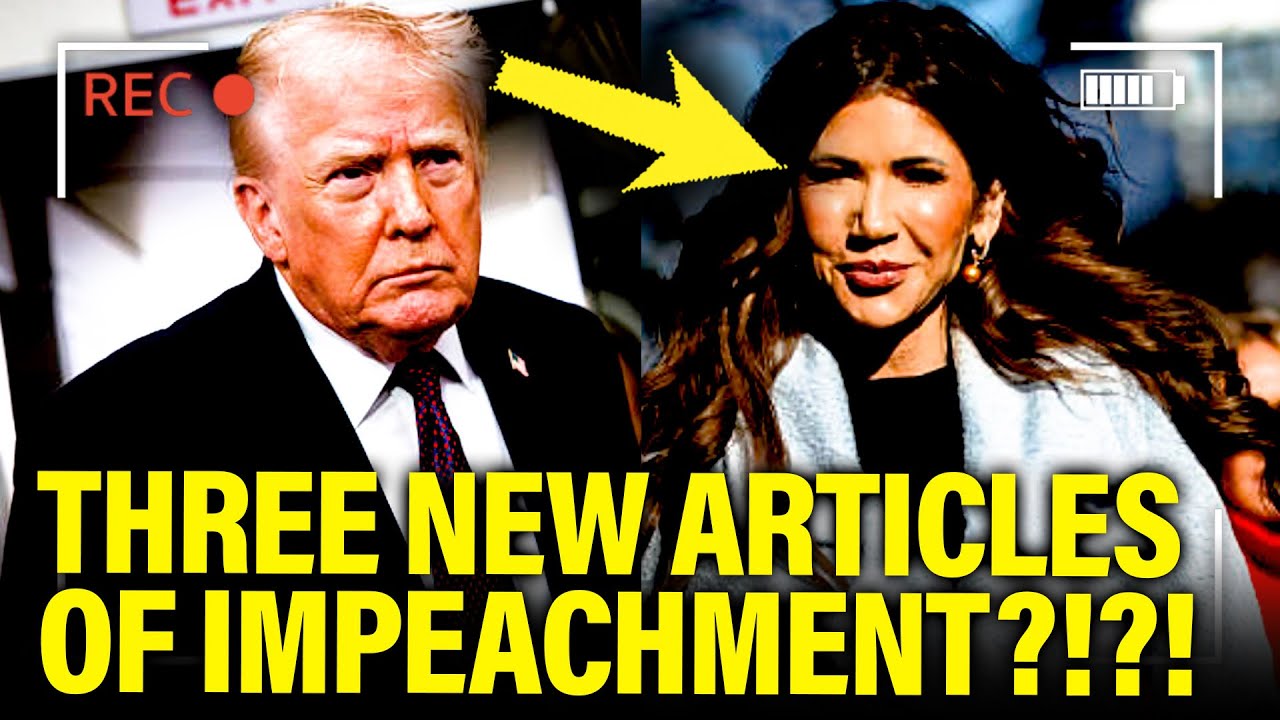
The Articles of Impeachment
The impeachment resolution outlines three core allegations against Secretary Noem:
-
Obstruction of Congress,
-
Violation of the Public Trust, and
-
Self-Dealing and Abuse of Office.
Each article draws on recent court rulings, investigative reporting, and internal government actions that critics say reflect a pattern of executive overreach.
Obstruction of Congressional Oversight
The first article centers on allegations that the Department of Homeland Security (DHS), under Noem’s leadership, deliberately obstructed lawful congressional oversight of Immigration and Customs Enforcement (ICE) facilities.
Federal judges have repeatedly warned DHS that delaying or denying access to members of Congress—sometimes for days—violates longstanding appropriations law that explicitly authorizes such oversight. In one recent hearing, a federal judge openly questioned DHS’s compliance with court orders requiring congressional access.
“How is this not a violation of the court’s order?” the judge asked, according to court transcripts.
The impeachment resolution alleges that Noem authorized or tolerated these delays as a means of shielding ICE operations from scrutiny at a time of heightened controversy over immigration enforcement.
Use of Force and Civil Rights Concerns
The second article accuses Noem of violating the public trust through enforcement policies that critics say resulted in civil rights abuses, unlawful detentions, and in some cases, the deaths of American citizens during ICE operations.
Civil rights lawsuits are currently pending in Minnesota, Illinois, California, Oregon, and Washington, alleging unconstitutional arrests, excessive force, and denial of due process during federal immigration raids.
Local officials, including Minneapolis Mayor Jacob Frey, have publicly warned that aggressive ICE actions are undermining public safety rather than improving it.
“When peaceful residents are being swept up without warrants or due process, that’s not law enforcement,” Frey said in a recent interview. “That’s a breakdown of trust.”
The impeachment resolution argues that Noem failed to impose adequate safeguards or accountability mechanisms, even as courts expressed alarm over DHS’s conduct.

Allegations of Self-Dealing
The third and most politically explosive article focuses on allegations of self-dealing tied to a $200 million federal advertising campaign promoting DHS initiatives.
According to reporting by ProPublica, the contract was awarded without competitive bidding to Strategy Group, a firm with longstanding political and professional ties to Noem dating back to her time as governor of South Dakota.
The firm employs advisers closely aligned with former President Donald Trump, and its leadership includes the husband of a senior DHS spokesperson. The ads prominently feature Noem herself in stylized, high-production appearances, raising questions about whether public funds were used to advance her personal political profile.
Federal procurement rules typically require competitive bidding to prevent favoritism and conflicts of interest. The impeachment resolution alleges those safeguards were bypassed.
“There is no transparency here,” one Democratic investigator said. “And no independent review of who benefited.”
Political Stakes and the Road to 218
While Democrats currently lack the votes to impeach Noem outright, party leaders argue the effort mirrors other accountability campaigns that initially appeared unlikely.
Supporters point to the recent success of a bipartisan discharge petition demanding the release of records related to Jeffrey Epstein—an effort that began with limited backing but steadily gained momentum.
“This is how accountability works,” said a Democratic strategist. “You make it an issue voters can’t ignore.”
Democratic leaders say the impeachment push aligns with a broader anti-corruption platform they plan to emphasize in upcoming elections, focusing on conflicts of interest, government transparency, and executive accountability.
“This becomes a question every member of Congress will have to answer,” the strategist added. “‘Were you for accountability—or did you look the other way?’”
A Broader Pattern of Institutional Strain
The move against Noem comes amid broader turmoil across the federal government. The Justice Department has seen nearly 3,000 attorneys resign or be dismissed in the past year, according to Reuters, fueling concerns about political pressure inside independent institutions.
Federal judges have increasingly warned that executive agencies are testing constitutional limits by defying court orders and congressional authority.
Legal scholars say impeachment efforts, even when unlikely to succeed immediately, serve as a constitutional pressure valve.
“Impeachment is not just removal,” said one former federal prosecutor. “It’s investigation, exposure, and accountability.”
What Happens Next
House committees are expected to begin preliminary review of the impeachment articles in the coming weeks, though leadership has not committed to a floor vote timeline.
Republican leaders have dismissed the effort as partisan theater, while the Department of Homeland Security has denied wrongdoing and defended the advertising contract as lawful and necessary.
Still, the issue is unlikely to fade.
As one senior Democratic lawmaker put it: “This isn’t going away. Not for Kristi Noem—and not for the voters watching closely.”