The exchange was brief, tense, and revealing in ways that had little to do with raised voices. When Senator Dick Durbin asked Attorney General Pam Bondi who ordered federal investigators to flag references to Donald Trump in the Epstein files, he posed what should have been a routine oversight question. Instead, he encountered a wall of refusal. Bondi would not say who made the decision. She would not explain the process. She would not even acknowledge whether such an order existed.
In Washington, refusals are not unusual. But the significance of this moment lay not in a single unanswered question, but in what it suggested about how power is being exercised — and shielded — inside the Department of Justice.
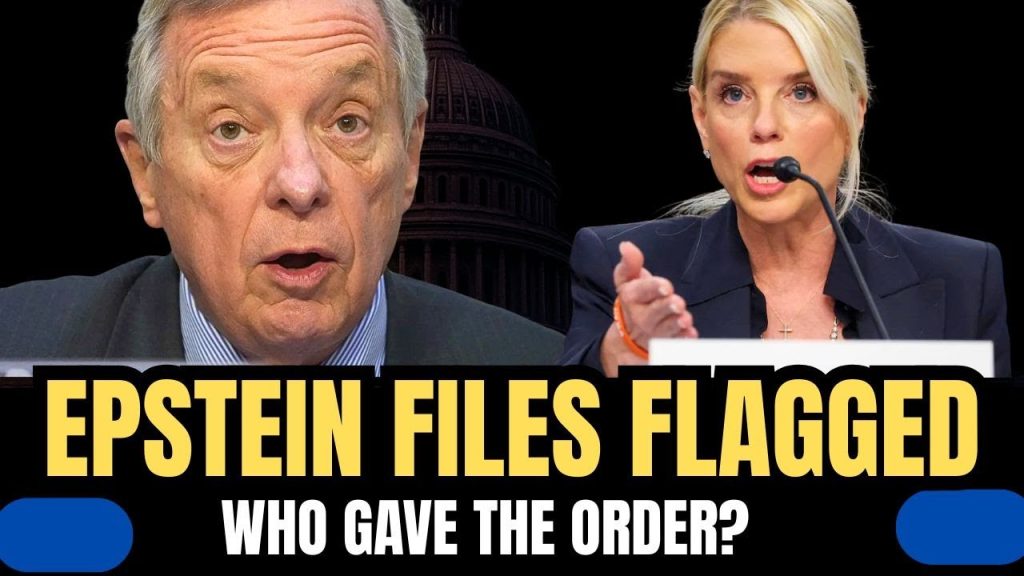
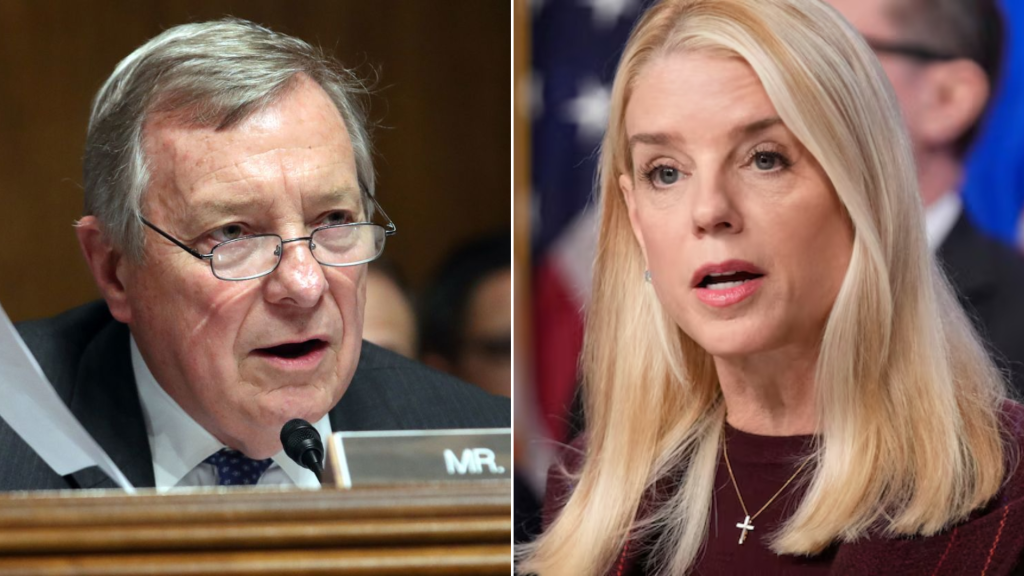
Durbin’s line of questioning followed a careful logic. He began not with Epstein, but with process: whether the attorney general had consulted with the White House before National Guard troops were deployed to states whose governors had not requested federal assistance. Bondi declined to answer, citing internal communications. When pressed, she pivoted sharply, attacking Durbin’s home state of Illinois and its crime statistics. The move was familiar, transforming a legal inquiry into a political counteroffensive.
For Durbin, the refusal mattered precisely because it blocked Congress from determining whether constitutional boundaries had been respected. The question was not whether the deployment was justified, but whether the law had been followed. Without even an acknowledgment of consultation, oversight stalls.
The hearing then turned to the issue that has increasingly come to define the Justice Department’s credibility battle: the Epstein files. Earlier this year, Bondi publicly stated that the Epstein client list was “sitting on my desk.” That remark created an expectation that such a list existed and was under review. Months later, the department released an unsigned memo stating that there was no incriminating client list, offering little explanation for the apparent contradiction.
Durbin pressed on the unsigned memo. In government, signatures are not ceremonial. They establish responsibility. An unsigned document diffuses accountability, making it difficult for Congress or the public to know who stands behind a conclusion. Bondi offered no direct explanation for why such a consequential statement lacked attribution.
The most consequential moment came when Durbin cited a whistleblower disclosure alleging that FBI personnel were directed to review roughly 100,000 Epstein-related records on an accelerated timeline and to flag any documents mentioning Donald Trump. Durbin’s question was narrow and precise: Who gave that order?
Bondi refused to answer.
Flagging references to a name does not, in itself, imply wrongdoing. Investigators often categorize documents for efficiency. But selectively flagging records tied to a specific individual raises obvious oversight concerns. Was the directive routine, or was it exceptional? Was it issued by career officials, political appointees, or someone outside the department? Transparency about decision-making authority would have strengthened public trust. Silence did the opposite.
Throughout the exchange, Bondi invoked confidentiality. But confidentiality has limits, especially when Congress is exercising its constitutional duty to oversee the executive branch. Oversight does not require disclosure of sensitive evidence. It requires disclosure of who made decisions and under what authority. When even that information is withheld, the issue shifts from privacy to power.
Bondi attempted to deflect by accusing Durbin of previously blocking the release of Epstein flight logs. The dispute devolved briefly into a procedural argument over committee rules and written requests. But the deflection served a purpose: it shifted attention away from the current Justice Department’s conduct and toward partisan recrimination. In doing so, it underscored Durbin’s broader point. When accountability questions are consistently reframed as political attacks, legal clarity becomes collateral damage.
What emerged from the hearing was not proof of misconduct, but evidence of a governing posture that treats oversight as optional and explanation as a liability. The Department of Justice occupies a singular role in American democracy. It is charged with enforcing the law impartially, including against the most powerful actors in the system. That authority depends not only on statutes, but on norms — the expectation that the department will explain itself to a co-equal branch of government.
When senators cannot get straight answers about troop deployments, legal advice on foreign gifts, or internal document review procedures, the problem is not media spectacle or partisan noise. It is institutional erosion. Each unanswered question sets a precedent. Each deflection normalizes opacity.
Durbin ended his questioning with a quiet warning: these questions will eventually be answered. Oversight hearings are not verdicts. They are records. They preserve inconsistencies, refusals, and silences for future scrutiny — by courts, inspectors general, historians, or subsequent administrations.
Democratic systems rarely collapse in dramatic moments. They weaken gradually, as unanswered questions become routine and accountability is framed as hostility. What this hearing revealed was not just a clash between a senator and an attorney general, but a test of whether transparency remains a governing principle or an inconvenience to be managed.
In that sense, the most telling answer was not spoken at all.