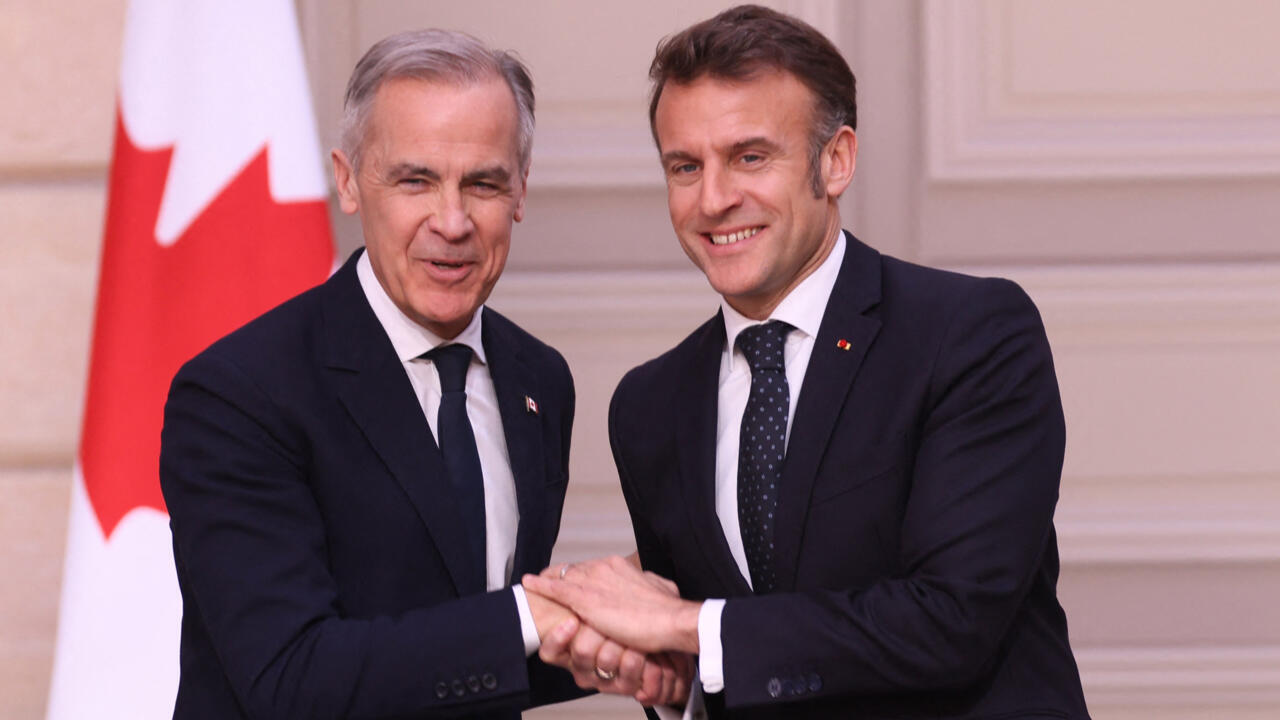
For decades, the choreography of Canadian diplomacy followed a familiar script. A new prime minister would travel first to Washington, reaffirm the intimacy of the relationship, and signal continuity in a transatlantic order built around American leadership. That ritual ended quietly — and decisively — when Mark Carney chose Paris and London for his first foreign trip instead.
The choice was more than symbolic. It reflected a calculation forming across allied capitals: that the United States, under Donald Trump, could no longer be assumed as the organizing center of Western security and economic coordination. What has followed is not a rupture, but something more consequential — a gradual redirection of alliances that places Europe and Canada in closer alignment, while Washington finds itself increasingly peripheral.
That shift became unmistakable in early January, when Emmanuel Macron told French ambassadors that the United States was “breaking free from the international rules it once promoted.” Within a day, Frank-Walter Steinmeier warned that the world was sliding toward a “law of the strongest,” naming American behavior alongside Russia’s invasion of Ukraine as evidence of systemic breakdown. These were not improvisations. They were prepared speeches, delivered to diplomatic corps, intended to be heard.
Canada had already moved. In June 2025, Ottawa and the European Union signed a comprehensive security and defense partnership — a formal framework coordinating defense procurement, cyber security, artificial intelligence governance, and military capability development. The language was bureaucratic. The implications were not. For the first time, Canada began to restructure its defense posture around European, rather than American, supply chains and planning.
At the center of that shift is SAFE, Europe’s joint defense procurement mechanism — a collective purchasing pool designed to standardize equipment and reduce reliance on non-European suppliers. Canada’s participation, finalized later in 2025, marked a quiet but profound departure. For generations, Canadian defense spending flowed overwhelmingly to American contractors, under American strategic assumptions. Now, procurement decisions are increasingly negotiated through European frameworks, with Washington treated as optional rather than indispensable.
The political catalyst for this reorientation was not abstract distrust, but a series of concrete shocks. Trump’s repeated threats to annex Greenland, his refusal to rule out military force, and his dismissal of allied sovereignty rattled capitals already uneasy about tariff threats and unilateral interventions. Greenland — a self-governing territory of Denmark — became the rallying point. In January, Canada joined France, Germany, Britain, and several other NATO allies in issuing a joint statement affirming Greenland’s sovereignty. Such coordination against an American territorial claim would have been unthinkable a decade ago.

Canada went further. It announced plans to open a consulate in Greenland, signaling diplomatic presence not as a mediator for Washington, but as a partner to Copenhagen. The message was unmistakable: Canada would anchor its Arctic posture alongside Europe, not subordinate it to American ambition.
Public opinion has followed policy. Polling across Europe shows a collapse in trust toward the United States as a reliable partner, with majorities in Germany and France doubting American commitments under NATO. In Canada, opposition to becoming a “51st state” has hardened into near-consensus. These sentiments matter because they shape what becomes politically irreversible. Alliances are sustained not only by treaties, but by publics willing to underwrite them.
What makes the current realignment especially consequential is its institutional depth. Defense partnerships, procurement contracts, and shared standards create what economists call path dependency. Once supply chains are built, equipment standardized, and training aligned, reversal becomes costly and unlikely — regardless of who occupies the White House. The Canada–Europe architecture now taking shape is designed to endure beyond electoral cycles.
This does not mean the end of transatlantic cooperation. American firms will still compete for contracts; U.S. diplomacy will still matter. But the era of automatic American centrality — the assumption that allied strategy flows through Washington by default — is fading. Canada and Europe are not opposing the United States so much as planning without it.
The irony is that this realignment was not driven by European assertiveness alone, but by American miscalculation. Trump’s threats assumed that power compels compliance, that allies lack alternatives. The opposite proved true. Faced with unpredictability, allies did what states have always done: they diversified risk.
History rarely turns on a single decision. It shifts when habits break. Canada’s pivot toward Europe, reinforced by European leaders’ blunt reassessments of American reliability, marks one such break. The Atlantic alliance is not collapsing. But it is being rewired — and Washington, for the first time in generations, is no longer holding all the switches.