He Wrote His Teacher a Love Letter About His Future. Six Weeks Later, His Mother Called 911.
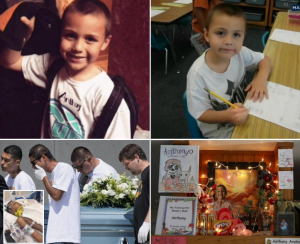
It is the last day of school, June 2018.
Anthony Avalos is ten years old. He sits at his desk at El Dorado Elementary School in Lancaster, California, and he writes a letter to his fourth-grade teacher. His handwriting is careful. His sentences are earnest in the way that only a child’s sentences can be earnest — wide open, unguarded, full of a faith in the future that has not yet been worn down by experience.
Dear Mrs. Bell, he writes. Thank you for teaching me everything you could it was such a blessing to meet you. I just hope that when I’m going to 6th that you can come to New Vista so I can see you still. I hope that you can come to my high school, middle school and college. That way we will see each other for school years without a problem because how close we are and how we are best buddys/friends. I just want to stay with you forever but I can’t. I just hope you have a good rest of your life because you already know that I’m going to have a good life. Love Anthony Avalos your friend.
He folds the letter. He hands it to Harmony Bell.
And then he goes home.
He will never come back.
The Boy Who Carried a Bible
To understand what happened to Anthony Avalos, you have to first understand who he was — not as a victim, not as a case number, not as a symbol of systemic failure, but as a specific, irreplaceable human being who existed for ten years on this earth and left marks on the people who knew him that will never fully fade.
He was the fastest runner in his fourth-grade class.
He was on the honor roll.
When a new student joined his class, Anthony asked to move his desk to the neighboring seat — not because the teacher told him to, but because he wanted to be the friend the newcomer needed. That is not a typical thing for a ten-year-old to do. It requires a level of empathy, a capacity for reading other people’s loneliness, that most adults haven’t fully developed. Harmony Bell, his teacher, noticed it immediately.
She also noticed that Anthony was often nervous. He held his Bible tightly throughout the school day. If it fell to the floor — even accidentally — he would shake with tears. There was something fragile underneath the brightness, something that flinched at sudden movement and clung to anything stable.
He collected his thoughts before speaking. When he needed to calm down, he asked Bell if he could step outside the classroom and take a few deep breaths. She always said yes.
In family photographs, Anthony usually has a wide smile. He is holding a report card, or wearing a blue dinosaur T-shirt, or standing straight and proud in a vest and striped tie with his head high like he already knows he is somebody. In others, he looks pensively at the camera, and there is something in his eyes that is very old and very tired.
He was ten years old.
And he had been fighting for his life since he was four.
Two Teenagers and a Child
Anthony Avalos was born on May 4, 2008, in Lancaster, California — a flat, sun-baked city in the Antelope Valley, about 70 miles north of downtown Los Angeles, where the desert stretches out to the horizon and the wind comes across the valley in hot, relentless gusts.
His parents were teenagers when he was born.
His father, Victor Avalos, was barely out of childhood himself. He left for Mexico shortly after Anthony was born, and would spend the rest of his son’s life watching him grow up through occasional video chats — brief digital windows into a life he was not present for. He never saw Anthony in person again after those earliest months.
His mother was Heather Maxine Barron. She was young, financially stretched, raising multiple children on part-time wages from a Subway restaurant and $793 a month in welfare benefits. By her mid-twenties, she would have six children, seven including a pregnancy. She was not equipped — not financially, not emotionally, not psychologically — for what she had taken on.
That is not an excuse for what she would eventually do. It is a context. Because this story is not simply about a monster who appeared out of nowhere and destroyed a child. It is about a system that was handed every warning it needed, in every format imaginable, by teachers and counselors and relatives and deputies and school vice principals — and that system looked at a child in danger and decided, again and again and again, that he was fine.
He was not fine.
He had not been fine since he was four years old.
The First Call
February 2013. Anthony is four years old.
His mother brings him to a health clinic. He has said that someone close to the family sexually molested him. He is four. He is using words that four-year-olds only know if something has happened to them.
The clinic reports it. The Los Angeles County Department of Children and Family Services — DCFS — opens a case. Investigators conclude that the abuse did occur.
And then they close the case. Because Heather Barron promises she will get Anthony help. Promises she will keep him away from the alleged abuser.
They take her word for it.
They do not set up ongoing supervision. They do not verify the counseling. They do not follow up to confirm that the four-year-old boy who was sexually abused is being protected from the person who abused him.
They close the file.
It is the first of thirteen calls.
“A Thousand Weeks”
Anthony is six years old when the second major alarm sounds.
His aunt, Crystal Diuguid, goes to therapy. And in that therapy session, she tells her therapist something that she can no longer carry alone: that Anthony’s mother is beating him. Locking him in a room with no access to food. No access to a bathroom. Hours at a time.
The therapist does exactly what she is required by law to do: she calls the child abuse hotline.
A DCFS caseworker goes to Anthony’s school and interviews him. He confirms everything. He is six years old and he tells a stranger that his mother beats him and locks him in a room and he is not surprised that she is asking because this is simply what his life is.
The caseworker finds evidence of neglect. She refers the family to what is called the Voluntary Family Maintenance program — a program designed, ostensibly, to help low-risk families stabilize while keeping children out of foster care. The internal software used by DCFS rates Anthony’s situation as “HIGH RISK” and recommends increased intervention.
The caseworker overrides the software recommendation.
Anthony stays home.
A counselor assigned to the family — a woman named Wendy Wright — begins working with them and immediately sees what is happening. She watches Heather Barron grab one of Anthony’s siblings and drag him violently across a room. She hears Barron consistently refer to her children in degrading terms. She observes “nothing but anger toward those children.”
She calls the hotline.
The DCFS worker who receives her report asks the supervisor on the case — a man named Mark Millman — about it. Millman’s response, later quoted in case notes, is this: “Given the children and their age and their behavior, she is doing all she can.”
The case stays open on paper. Anthony stays home.
Then in September 2015, Anthony is nine years old and enrolled at Lincoln Elementary. He tells Vice Principal Gia Greaux that his mother beats him. Locks him in a room. No food. No water. No bathroom. He also describes something new — something Kareem Leiva has introduced into the household.
He calls it “the captain’s chair.”
It requires Anthony to hold a deep squat, knees bent, arms outstretched, for extended periods. Not for a minute or two. For hours. His knees. His thighs. His arms. Held in that position until his muscles give out and he collapses.
Greaux calls the hotline.
And then Anthony’s uncle, David Barron, hears from the children directly. They tell him about being locked in a room. About Leiva dangling Anthony’s younger half-brother upside down from a staircase. About being whipped across the face and legs with a belt. About being so hungry that they hoard food wherever they can find it.
David and his wife physically block Heather from taking the children. They call 911.
When a sheriff’s deputy arrives and asks the children how long this has been happening, the children answer from the background.
“A thousand weeks,” they say.
A thousand weeks.
David and his wife take the children home. They feed them. They let them sleep in beds. Anthony tells his uncle he is part of the Barron family now. He says he is never going to go back to his mother.
“Heather is my old mom,” he tells the DCFS caseworker who comes to interview him. “This is my new house. I am part of the Barron family now. I’m never going to see Heather again. She locks us up in our rooms and makes us starving.”
The caseworker, a young worker named Ikea Vernon, calls the counselors who have been working with the family for seven months. They are supportive of Heather Barron. They say they have never heard anything from the children about abuse.
Vernon chooses to believe the counselors over the children.
She calls David and Maria Barron to tell them they cannot keep the children. When they show up at the DCFS office demanding answers, she turns them away — incorrectly telling them they can only get information from Anthony’s mother. She does not tell them they could file a formal petition asking the court to intervene.
The children go back to their mother.
A month later, Anthony and his siblings recant everything they told investigators.
This is not unusual. This is, in fact, one of the most documented phenomena in child abuse cases — the recantation. A child who has been abused goes home to the abuser. The abuser is the parent. The abuser controls the food, the shelter, the safety, the future. The child says whatever the abuser needs them to say in order to survive.
Caseworker Vernon later testifies before a grand jury that her decision to close the case rested on the children recanting their accounts. She then admits, in that same testimony, that she was unaware that abuse victims frequently retract their statements.
She was a child protective worker who did not know that abused children recant.
The computer scores the family’s risk again.
“HIGH RISK.” Recommends greater intervention.
Vernon and her supervisor decide against further action.
The case is closed.
The Man in the Doorway
Kareem Ernesto Leiva enters this story in 2015, and everything accelerates.
Heather Barron’s brother David had met Leiva at a shipping facility in Santa Clarita, where both men worked. He introduced the two, and they began a relationship that would, within months, reveal itself to be something David could not have anticipated when he made that introduction. The guilt that David Barron has carried since 2018 is its own form of devastating — the knowledge that he, trying to do something kind for his sister, brought the instrument of his nephew’s death into the room.
Leiva was thirty years old in 2015. He had a history. Two separate women had filed restraining orders against him, telling judges that he had beaten them with their children present. Court records existed. They were accessible. DCFS workers never pulled them.
They also never tried to interview Leiva directly. Even though they suspected he was at the home regularly on nights and weekends. Even though multiple abuse reports named him specifically. They never located him. Never spoke to him. Never looked at his record.
Within months of entering the home, the father of one of Heather’s younger children calls police. Leiva has violently grabbed the two-year-old boy by the ear, leaving it bruised and cut. A sheriff’s deputy responds, interviews the toddler, and sees the injuries himself.
The detective who receives the report makes no attempt to find Leiva. Recommends no charges. Closes the investigation.
Here is a man with a documented history of violence against women and children. He is now in a household with seven children. Multiple reports link him to specific physical harm. And the system — the sheriff’s department, DCFS, the contracted counselors — processes every alarm and produces the same output.
Nothing.
The children remain.
Leiva remains.
What Happened in That Apartment
By June 2018, Anthony has not been under formal DCFS supervision for more than a year. The agency lost track of him when Heather Barron moved the family and transferred him to El Dorado Elementary, where his history was unknown and he was free to be, for a brief stretch, simply a boy in a classroom.
His teacher Harmony Bell sees a child who is bright and kind and nervous in ways she cannot quite name. He holds his Bible. He takes deep breaths. He writes her a letter about their future friendship.
On June 18, 2018 — two weeks after the last day of school — Anthony says something to his mother.
He tells her he likes boys.
He is ten years old. He is telling his mother something true about himself, something vulnerable, something that he has perhaps been carrying for a while. Heather Barron hears it. And Kareem Leiva — who has made his homophobia explicit to multiple family members, who has been heard calling Anthony a slur, who has reportedly expressed discomfort at even being in proximity to gay people — overhears the conversation.
What follows is five days.
Five days that Anthony Avalos endures things that should not be possible in a country with mandatory reporting laws and child welfare agencies and school counselors and police departments and all the mechanisms that a society builds to protect children from exactly this.
He is whipped across his entire body with a belt and a looped cord. He is held upside down by his feet and dropped headfirst onto the floor — not once, not twice, but repeatedly. Hot sauce is sprayed directly into his eyes, his nose, his mouth. He is forced to kneel on dry uncooked rice on a hard floor — not for minutes but for hours, from the time he comes home until it is time for bed, his bare knees grinding against the rough grains until they are raw and scabbed and never given enough time to heal.
He cannot eat on his own.
At one point, he cannot walk.
He lies unconscious on his bedroom floor for hours. No medical attention is called.
A shirt is stuffed into his mouth to muffle the sounds.
His siblings — some as young as seven and eight years old — watch. They are ordered to fight each other. They are told that eating is a privilege. If they urinate while locked in a room, Leiva pushes their face into the puddle.
Anthony’s eight-year-old sister will later tell investigators, with the specific precision of a child who watched something so many times that it became routine, that her brother was made to kneel on the rice “a lot.” That it was “a common practice.” That his knees were scabbed. That they never healed.
The 911 Call
June 20, 2018. 12:15 in the afternoon.
Heather Barron calls 911.
She tells the dispatcher that her son is unresponsive. That he has “suffered injuries from a fall.”
Paramedics arrive. They find Anthony inside the apartment. He is barely alive.
They take him to the hospital in grave condition.
At UCLA Mattel Children’s Hospital in Los Angeles, a physician named Dr. Andranik Madikians is part of the team that receives Anthony. He looks down at the ten-year-old boy on the gurney and says something out loud that he will likely never stop hearing himself say:
“Oh my God. How does this happen?”
It is not a medical question. He knows how it happens medically. He can see the bleeding in the skull, the bruising that covers the body from head to toe, the evidence of malnutrition that has taken a ten-year-old boy and reduced him to skin and bones.
What he cannot comprehend — what none of them in that trauma bay can comprehend — is the human question underneath the medical one. The question of how a child arrives at this point. The question of who knew and what they did.
Anthony Avalos is four feet and six inches tall. He weighs seventy-seven pounds.
He is ten years old.
He should weigh at least eighty-five pounds. He should weigh more. His body has been starved for so long that it has consumed itself. The bruising goes from head to toe, no part of him left untouched. The injuries to his head are catastrophic — the kind that come from being dropped on it, repeatedly, from height, by a grown man.
Maria Barron — Anthony’s aunt, David’s wife, the woman who tried for years to make the system hear what was happening to her nephew — learns he is at the hospital. She goes immediately.
In the hallway of UCLA Mattel Children’s Hospital, she finds Heather Barron. Heather hesitates. She does not want to let Maria see Anthony.
And so Maria Barron does something that should not have been necessary. She crouches down to the floor — in the hallway, on the linoleum, on her hands and knees — and she begs. She tells Heather she is sorry for every abuse report she ever filed. She takes back the truth. She performs apology on the floor of a hospital hallway, willing to say anything, willing to be anything, to get to her nephew.
Heather relents.
Maria goes in.
Anthony Avalos dies the next day — June 21, 2018.
He would have been eleven years old in less than a year.
What the System Knew
In the weeks and months after Anthony’s death, the full record of what DCFS knew and when they knew it is laid out before grand jurors, investigators, and eventually the public.
Between February 2013 and April 2016 — a period of more than three years — there were at least thirteen calls to the child abuse hotline regarding Anthony’s welfare. The callers included his classroom teacher. His school’s vice principal. His aunt. His uncle. A therapist. A sheriff’s deputy. Multiple counselors. These were not anonymous calls from strangers speculating about something they might have seen. These were people who knew Anthony personally, who had looked at his body and seen marks, who had heard him describe his life in specific and heartbreaking detail.
DCFS followed up on eight of those calls.
Twelve different social workers had contact with the family at various points.
The department’s own risk-scoring software flagged the case as “HIGH RISK” — and recommended escalated intervention — on multiple separate occasions.
Every single time, a caseworker or supervisor overrode the recommendation.
One caseworker — Anna Sciortino — documented that she saw “visible marks and bruises” on one of Anthony’s siblings but told the hotline she doubted the abuse claim and wanted it recorded only “to cover our butts.”
Sheriff’s Deputy Billy Cox — who had been disciplined previously for failing to investigate a child abuse case — received an abuse referral related to Anthony’s family and testified afterward that it was “routine and common practice” for deputies to “basically rubber-stamp” DCFS referrals and send them through without conducting independent investigations.
The same counselor who had withheld information about Gabriel Fernandez’s injuries — Barbara Dixon, who received legal immunity for her testimony in the Fernandez case — was subsequently assigned to work with Anthony’s family. In her case notes on Anthony, Dixon counseled the ten-year-old to listen to his mother more attentively and to finish his homework. Her notes across a year of sessions were often copy-pasted from one session to the next. They did not mention the new abuse allegations that arrived at the hotline while she was working with the family.
A DCFS supervisor who had previously been disciplined for his mishandling of the Gabriel Fernandez case was also involved in Anthony’s case.
The same supervisor. The same pattern. A different child. The same result.
Shadow of Gabriel Fernandez
You cannot tell Anthony Avalos’s story without acknowledging the shadow that falls across it — the shadow of another boy, another apartment, another set of adults who should have protected him and didn’t.
Gabriel Fernandez died in 2013, five years before Anthony. He was eight years old. He lived in Palmdale, California — about fifteen minutes from Lancaster. He was tortured and murdered by his mother and her boyfriend. Four DCFS caseworkers were later criminally charged with child abuse and falsifying public records in connection with their handling of his case.
His story became a Netflix documentary. His name became a reckoning. Politicians gave speeches. Reforms were promised. The county commissioned reports. A child fatality review board was convened. Systems were analyzed. Recommendations were made.
And then, five years later, in a city fifteen minutes away, another boy died.
The county’s own review after Anthony’s death stated that the cases were “very dissimilar.” But the DCFS records, the grand jury transcripts, and the investigative reporting tell a different story. In both cases, workers carried out superficial investigations. In both cases, they failed to follow proper protocols. In both cases, the risk-scoring software said “high risk” and humans overruled it. In both cases, the children recanted under pressure and caseworkers used those recantations to close investigations.
The State Auditor of California, reviewing DCFS in the wake of these cases, delivered a finding so damning that it deserves to be quoted directly: although the county had “extensively studied past child fatality cases such as Gabriel Fernandez’s, yielding key recommendations that would save lives,” the department “has not ensured that its reviews improve the services it provides.”
They studied Gabriel Fernandez.
They learned the lessons.
They did not apply them.
Anthony Avalos paid for that failure with his life.
The Arrest
In the days following Anthony’s death, something happens that investigators later identify as significant: Kareem Leiva, during his initial police interview, makes suspicious comments.
Sheriff Jim McDonnell does not elaborate publicly on what those comments are. But they are enough.
On July 5, 2018 — two weeks after Anthony dies — Leiva is arrested. Heather Barron is arrested separately. Both are charged with first-degree murder with the special circumstance of torture.
On August 28, 2019, the Los Angeles County District Attorney’s Office announces it is seeking the death penalty against both of them. It is a charge that reflects the gravity of what was done — the deliberate, sustained, methodical destruction of a child over days, by the two people most responsible for his safety.
Both plead not guilty.
The case moves toward trial slowly, as major murder cases with voluminous evidence tend to do. Then a change in Los Angeles County’s political landscape changes the calculus: incoming District Attorney George Gascón, elected in 2020, subsequently drops the death penalty option for both Barron and Leiva.
The decision is controversial. Anthony’s family is angry. The children who survived — his siblings, the ones who watched and were locked in and were starved alongside him — deserve to see the full weight of the law brought down. The family says so, publicly and clearly.
But the machinery of justice grinds forward on its own timeline, not theirs.
The Trial
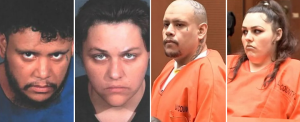
The case of People v. Heather Barron and Kareem Leiva goes to trial in early 2023.
It is a non-jury trial — meaning the decision rests not with twelve ordinary citizens but with a single judge. Los Angeles Superior Court Judge Sam Ohta presides.
The evidence presented is extensive. Investigators have spent years building a case from the medical records, the autopsy findings, the 911 call recordings, the DCFS files, the school records, the hotline call transcripts. They have testimony from Anthony’s teachers. From his aunt and uncle. From the physicians at UCLA Mattel Children’s Hospital who received him and tried to save him. From the siblings who survived.
The siblings’ testimony is among the most difficult any courtroom has ever been asked to absorb. These children — some of whom were as young as six and seven during the worst of the abuse — describe specific acts in specific detail with the flat, matter-of-fact delivery of children describing something that was not an event but a condition, not an incident but a way of life.
The rice. The belt. The head drops. The hot sauce. The locked room. The urine. The shirt in the mouth. The hunger. The earned privilege of food.
“A lot,” Anthony’s eight-year-old sister says when asked how often her brother was made to kneel on the rice. “His knees were scabbed. They never healed.”
Deputy District Attorney Jon Hatami prosecutes the case with the kind of righteous precision that only comes from being deeply, personally invested in the outcome. He has been with this case since the beginning. He knows Anthony’s story not as a file but as a life.
“There were injuries to Anthony’s side and his hip area, both his left hip and his right hip, and his arms, and even injuries to his feet,” Hatami tells the court. “At one point Anthony could not walk, was unconscious lying on his bedroom floor for hours, was not provided medical attention, and could not eat on his own.”
The prosecution also addresses the question of motive — specifically, the role that Anthony’s disclosure about his sexuality played in the escalation of violence in those final five days. Prosecutors argue that when Anthony told his mother he liked boys, and when Leiva overheard it, it triggered an attack that went beyond the already horrific baseline of abuse in that home. It was, in the prosecution’s argument, an act of hatred directed at a child for who he was — or who, at ten years old, he was beginning to understand himself to be.
Heather Barron and Kareem Leiva had been heard, by multiple witnesses, expressing contempt for gay people. Barron had used slurs to describe her own son. Leiva had told family members he was uncomfortable being near gay people. And now, when a ten-year-old boy said something honest and true and vulnerable to his mother, that hatred turned lethal.
Guilty
On March 7, 2023, Judge Sam Ohta delivers his verdict.
Heather Maxine Barron: guilty of first-degree murder. Guilty of torture.
Kareem Ernesto Leiva: guilty of first-degree murder. Guilty of torture.
Both face life in prison without the possibility of parole.
Los Angeles County District Attorney George Gascón releases a statement: “The brutality that was meted out on this young child was unimaginable. No child should endure this kind of violence and torture at the hands of the people who are supposed to love and protect him from harm.”
On April 25, 2023, both Barron and Leiva are formally sentenced. Life in prison. No parole. No future outside a California state prison.
In July 2025, the California Court of Appeal reviews the convictions and upholds them. The sentences stand.
Thirty-Two Million Dollars
There is another number in this story that matters.
In May 2022 — before the trial, before the convictions — Los Angeles County settles a civil lawsuit filed on behalf of Anthony’s family for thirty-two million dollars.
Thirty-two million dollars is the county’s acknowledgment, expressed in the only language that institutions fully understand, that what happened to Anthony Avalos was not just a family tragedy. It was an institutional failure. A governmental failure. A collective failure of every agency and system and individual who received a warning about this child and did not act on it.
It is the largest child welfare settlement in Los Angeles County history.
It does not bring Anthony back.
It does not unscar his siblings, who grew up in that apartment and carry what they saw and heard and experienced inside their bodies and their memories in ways that will take years of careful, patient therapy to begin to address — if they are ever fully addressed at all.
It does not tell Harmony Bell, who kept the letter her student wrote to her about his future, anything she doesn’t already know when she reads those words in the quiet of her own home: I just hope you have a good rest of your life because you already know that I’m going to have a good life.
He did not get a good life.
He got ten years, two months, and seventeen days.
What the Aunt Carries
Maria Barron has given interviews. She has testified before grand juries. She has sat in courtrooms and listened to prosecutors describe what happened to her nephew in the clinical language of legal proceedings, and she has had to hold herself together while those words — dropped on his head, unable to walk, seventy-seven pounds — entered the air of rooms where justice was being done for a child who deserved justice before he needed it.
She has said, in the aftermath of the verdict, that Anthony was brave.
“I know that he was brave,” she said. “He has always been brave. Because of him, his siblings are finally free.”
That is true. The arrest of Barron and Leiva meant that Anthony’s siblings were removed from that home. Whatever those children will face as they grow up — and they will face things, because you cannot be locked in a room and starved and made to watch your brother destroyed and emerge from that without marks — they are free. They are away from Leiva. They are alive.
Anthony was ten years old and he could not save himself, but his death saved them.
Maria carries that. She carries the memory of crouching on the floor of a hospital hallway, begging a woman who had tortured her nephew for permission to say goodbye to him. She carries the memory of walking into that hospital room and finding a boy who was four and a half feet tall and weighed seventy-seven pounds.
She has said she would do it all again — the phone calls, the reports, the confrontations, the trips to the DCFS office, the fights. She would do all of it again.
The tragedy is that she did all of it, and it was not enough. Not because she didn’t try hard enough. But because the system that was supposed to act on what she told them chose, again and again, not to.
The Letter
Harmony Bell kept the letter.
There is no record of what she does with it now — whether it is in a drawer, or framed, or in an envelope somewhere that she opens sometimes and then closes again. But she kept it. And in the keeping of it, she is doing something important: she is insisting that Anthony Avalos existed, that he was more than what happened to him, that his truest self was the boy who moved his desk to sit next to the new kid and held his Bible and asked to step outside to take deep breaths and wrote his teacher a love letter about wanting to stay with her forever.
He was the fastest runner in his class.
He was on the honor roll.
He asked, when a new student arrived, if he could move his seat to be close to that person — because he knew what loneliness felt like, and he did not want anyone else to feel it alone.
He wrote: I just want to stay with you forever but I can’t. I just hope you have a good rest of your life because you already know that I’m going to have a good life.
He did not get that life.
Heather Barron and Kareem Leiva took it from him over five days in June 2018, in an apartment in Lancaster, California, while thirteen previous warnings lay in closed DCFS files and a risk-scoring computer’s recommendations lay overridden in a database.
They are in prison now. For life.
The system that failed Anthony paid thirty-two million dollars and issued reports and made recommendations.
And somewhere in Los Angeles County right now, there are other children with DCFS cases. There are files with “HIGH RISK” assessments and caseworkers who are overworked and underpaid and making judgment calls under pressure. There are children who are recanting abuse allegations because the alternative is going back to the person who hurt them and saying they lied. There are teachers who are calling hotlines. There are aunts and uncles who are physically blocking mothers at their doorsteps.
The question that Anthony Avalos’s story leaves ringing in the air — unanswered, insistent, impossible to ignore — is not whether the system has changed. It is whether it has changed enough. It is whether the thirty-two million dollars and the guilty verdicts and the appeals court rulings and the reports and the recommendations have produced something different in the day-to-day reality of child welfare work in Los Angeles County.
Whether somewhere right now, a caseworker is looking at a “HIGH RISK” rating on their screen and doing what the system recommends instead of overriding it.
Whether the next Anthony Avalos — because there is always, in these stories, a next one — comes home from school and sits at his desk and writes his teacher a letter about his future.
And gets to live it.
Heather Maxine Barron and Kareem Ernesto Leiva are both serving life sentences without the possibility of parole at California state correctional facilities. Their convictions were upheld by the California Court of Appeal in July 2025. Los Angeles County settled a civil lawsuit with Anthony’s family for $32 million in May 2022. Anthony Avalos was born on May 4, 2008. He died on June 21, 2018. He was ten years old.