How Jimmy Kimmel and Arnold Schwarzenegger Exposed Donald Trump’s Most Enduring Vulnerability
LOS ANGELES — Donald Trump has long insisted that he is immune to ridicule. Court cases, investigations, electoral losses — none, he suggests, truly matter. But there is one arena where criticism consistently provokes an immediate reaction: television.
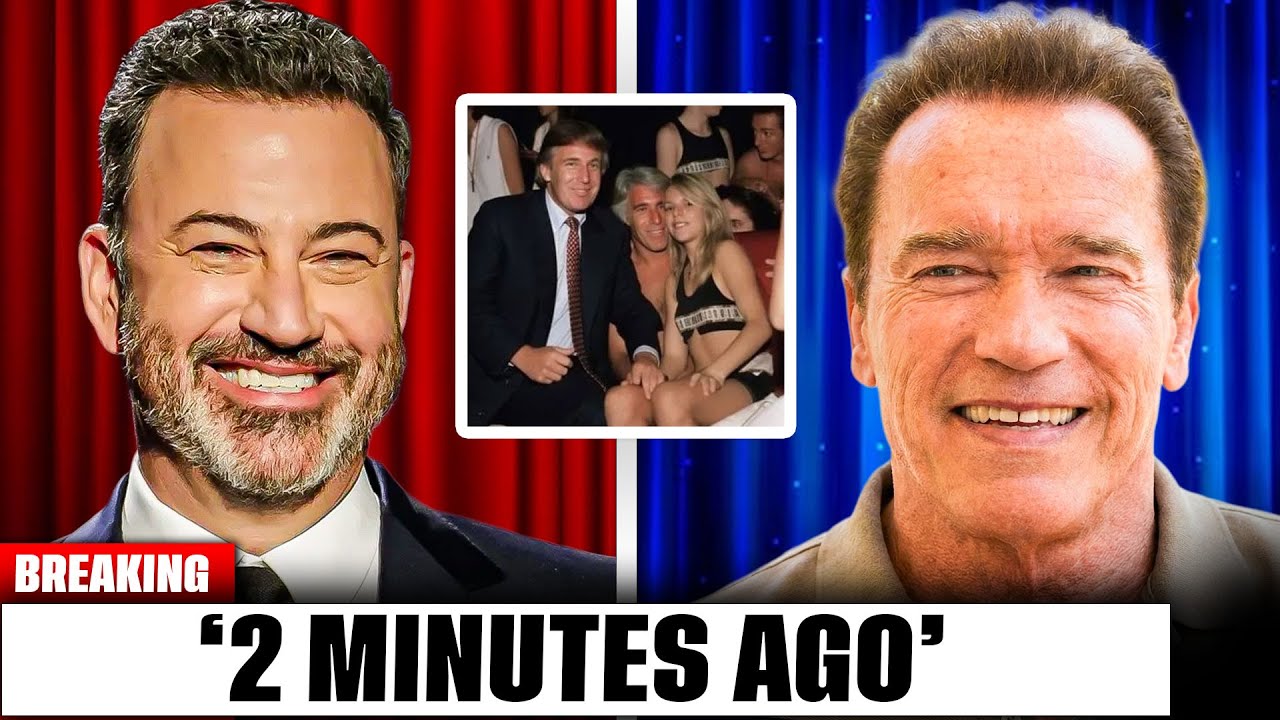
That vulnerability was on full display in October 2023, when Jimmy Kimmel Live! returned from a five-month writers’ strike and booked its first guest: Arnold Schwarzenegger.
The segment, lighthearted on the surface, detonated a political nerve that Trump has never managed to protect — his carefully constructed image of physical dominance, personal success, and ratings supremacy. In a matter of minutes, the exchange undermined one of Trump’s most transparent falsehoods and reignited a feud that has followed him from reality television into the presidency itself.
The Lie That Wouldn’t Die
The episode traces back to August 2023, when Trump was booked into the Fulton County Jail in Georgia on charges related to efforts to overturn the 2020 election. His booking record listed his height as 6 feet 3 inches and his weight as 215 pounds.
The number was widely ridiculed. Photographs showed a man whose appearance bore little resemblance to that measurement. But Trump did not retreat. As he has often done, he doubled down — because admitting a lie would have meant puncturing the mythology he has spent decades cultivating.
Jimmy Kimmel, then off the air due to the Writers Guild strike, later admitted that the booking record was the one story that almost tempted him to cross the picket line.
“I almost crossed the strike for that,” Kimmel said. “That’s how badly I wanted to talk about it.”
The Perfect Witness
When Jimmy Kimmel Live! returned on October 2, 2023, Kimmel chose his first guest carefully. Schwarzenegger is not just a movie star or former California governor. He is a seven-time Mr. Olympia champion — arguably the world’s most recognizable authority on male physique.
The setup was surgical.
Kimmel asked Schwarzenegger whether it was plausible that Trump weighed 215 pounds.
Schwarzenegger did not hesitate.
“I don’t really know how much he weighs,” he said. “But if he asked me what he should do for fitness, I would say, ‘Run around yourself three times.’”
The audience erupted. Then Schwarzenegger went further, estimating that Trump’s weight was closer to 315 pounds — a hundred-pound difference.
The moment went viral instantly. Millions watched the clip within hours. For Trump, whose brand is built on claims of strength and superiority, the damage was not numerical. It was symbolic.

Why This Moment Mattered
Trump has survived scandals that would have ended most political careers. But ridicule, especially on television, has always hit him differently.
That sensitivity dates back to The Apprentice, the NBC reality show that defined his modern celebrity. Trump has repeatedly cited its ratings as proof of his genius, his popularity, and his legitimacy. When those ratings declined in later seasons, he blamed everyone but himself.
When Schwarzenegger replaced him as host in 2017, Trump lashed out publicly — not as president, but as a spurned television producer.
“Arnold Schwarzenegger got swamped,” Trump tweeted days before his inauguration. “So much for being a movie star.”
The feud never truly ended. It merely shifted stages.
Entertainment as Accountability
Kimmel’s approach to Trump has never been subtle. But it is consistent. Rather than arguing policy, he attacks image — the currency Trump values most.
Trump once said that if he could not outperform late-night hosts in “talent,” he should not be president. Kimmel responded by suggesting a job swap: Trump could run television, while Kimmel would take over governing, so “people could finally sleep comfortably again.”
The joke landed because it contained a truth Trump rarely confronts: he treats governance like a ratings contest, not a responsibility.
Schwarzenegger reinforced that critique without sounding partisan. When he dismissed Trump’s weight claim, he connected it to something larger — a pattern of denying obvious reality, whether about climate change, public health, or election results.
The subtext was clear: if Trump lies about something everyone can see, why should anyone trust him about things they cannot?
The Meltdown Pattern
Trump’s response followed a familiar arc. Rather than addressing the substance of the criticism, he attacked ratings, motives, and loyalty. He did not rebut Schwarzenegger’s estimate. He did not clarify his booking record. He complained.
This reaction has played out repeatedly across Trump’s career. From mocking critics at rallies to obsessively monitoring cable news, he responds to humiliation not with correction, but escalation.
Media analysts note that this pattern reveals something fundamental.
“Trump doesn’t experience television as commentary,” said one longtime network executive. “He experiences it as judgment.”
Why Late Night Still Matters
In an era of fragmented media, it is tempting to dismiss late-night comedy as irrelevant. But moments like this demonstrate its lingering power.
Kimmel and Schwarzenegger did not expose classified information or uncover corruption. They did something simpler and, in Trump’s case, more destabilizing: they made him look ridiculous in a way that could not be spun.
Millions who might never read an indictment or court filing understood the point instantly.
The effectiveness lay in contrast. Schwarzenegger, a Republican icon and former conservative governor, delivered the critique without bitterness. Kimmel framed it with humor rather than outrage. Trump, by contrast, appeared defensive and small.
An Old Weakness, Still Untreated
Trump has often insisted that he does not care what comedians say. His behavior suggests otherwise.
From his obsession with crowd sizes to his fixation on television ratings, Trump has always measured legitimacy through applause. When that applause turns into laughter — especially laughter he cannot control — it exposes a weakness no amount of bluster can conceal.
The exchange between Kimmel and Schwarzenegger did not change Trump’s political trajectory overnight. But it reaffirmed something many Americans already sensed.
Power that depends entirely on image is fragile.
And in October 2023, two men with microphones reminded the country exactly where Donald Trump remains most vulnerable — under studio lights, in front of an audience, with nowhere to hide.