By XAMXAM
The Nobel Peace Prize has long occupied a peculiar place in global politics. It is at once profoundly symbolic and stubbornly procedural, governed by rules that rarely bend even when the world around them does. That rigidity was tested this week after Donald Trump publicly displayed a Nobel Peace Prize medal in the Oval Office—despite never having been awarded the prize himself.
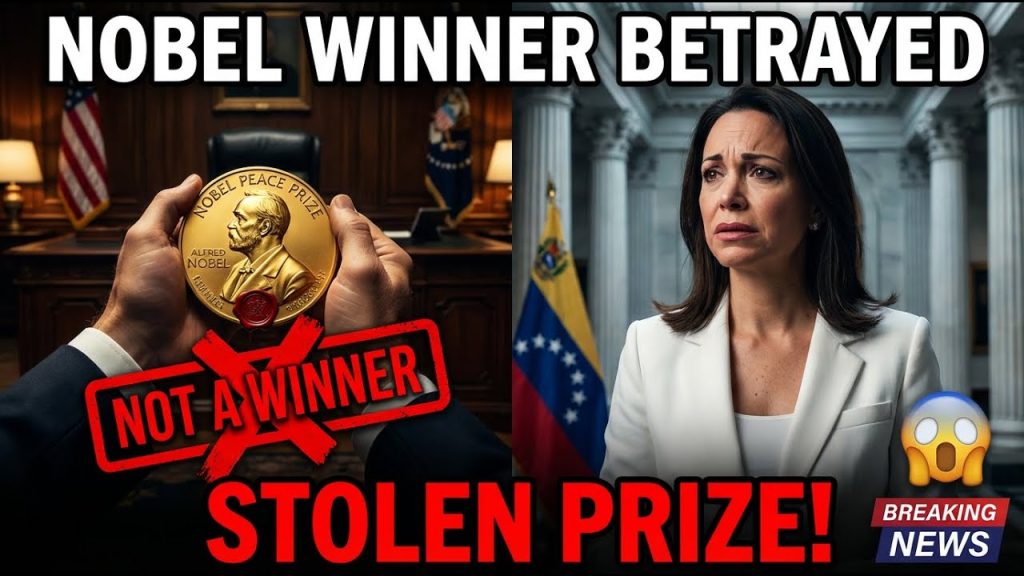
The medal belongs to María Corina Machado, the Venezuelan opposition figure named the 2025 Nobel Peace Prize laureate for her role in mobilizing civilian resistance against authoritarian rule. What might have remained an awkward footnote in diplomatic optics quickly escalated into something more consequential when the Norwegian Nobel Committee issued an unusually direct public clarification.
Once a Nobel Prize is awarded, the committee said, it cannot be transferred, shared, or reassigned. A medal may change hands. The title of laureate does not.
The statement was striking not for its content—longstanding Nobel rules are clear—but for its timing and tone. The committee rarely intervenes after a prize is announced, preferring to let the honor speak for itself. This time, it chose to speak.
At the center of the episode is a meeting that was supposed to symbolize solidarity. Machado, who has lived under persistent threat and was barred from running for Venezuela’s presidency, visited the White House seeking U.S. support for democratic change in her country. Unable to attend the Nobel ceremony in Oslo because of security concerns, she has become a symbol of political endurance in exile. The decision to present her physical medal to Trump was widely interpreted as a gesture of goodwill—perhaps even an appeal.
The optics, however, quickly soured. The medal was displayed in the Oval Office with a plaque praising Trump’s leadership, creating the impression—intended or not—that the honor itself was being recast. Within hours, the Nobel Committee moved to shut down that interpretation.
In its statement, the committee underscored a distinction it has defended for more than a century: the difference between an object and an honor. Medals can be sold, donated, even lost. The recognition they represent cannot be claimed by anyone other than the person named. The committee cited precedent, noting that past laureates have disposed of their medals without affecting their status.
The implication was unmistakable. Trump may possess the gold, but not the legitimacy.
For Machado, the episode has been painful. Her political reality is one of constrained choices, and critics have questioned whether surrendering such a powerful symbol risked diminishing her own standing. Supporters counter that the move reflected the desperation of leaders operating under authoritarian pressure, where symbolism can be one of the few remaining currencies.

What unsettled observers most, however, was not the exchange itself but the contradiction that followed. While the meeting was unfolding inside the White House, the administration reiterated publicly that it did not view Machado as a credible national leader in Venezuela. The juxtaposition—honor accepted in private, political support withheld in public—gave the episode a transactional cast that has drawn criticism across diplomatic circles.
The Nobel Committee did not address U.S. policy toward Venezuela, nor did it comment on Machado’s strategy. Its intervention was narrower, but in some ways more profound. In an era when political authority is increasingly performed through imagery, it reasserted the limits of spectacle.
There is also a broader context. Trump has long expressed fixation with the Nobel Peace Prize, frequently arguing that his predecessors were unfairly recognized while he was overlooked. Displaying the medal of another laureate fits a pattern in which symbols of legitimacy are appropriated to fill perceived slights. The committee’s response suggests it recognized that risk.
For the Nobel institution, the concern is precedent. If possession can be mistaken for credit, the prize’s moral authority erodes. By acting quickly, the committee drew a bright line—one meant to be visible not just in Washington, but globally.
Trump may keep the medal on display. He may frame it as validation. But the Nobel Committee’s message leaves little room for ambiguity. Honor, once awarded, cannot be seized. And the distinction between power and legitimacy, however often tested, still holds.
What remains is a lingering question about the cost of symbolism in modern diplomacy—and who ultimately pays it.