A Seismic Shift in Global Energy: Canada’s Bold Pivot to Asia
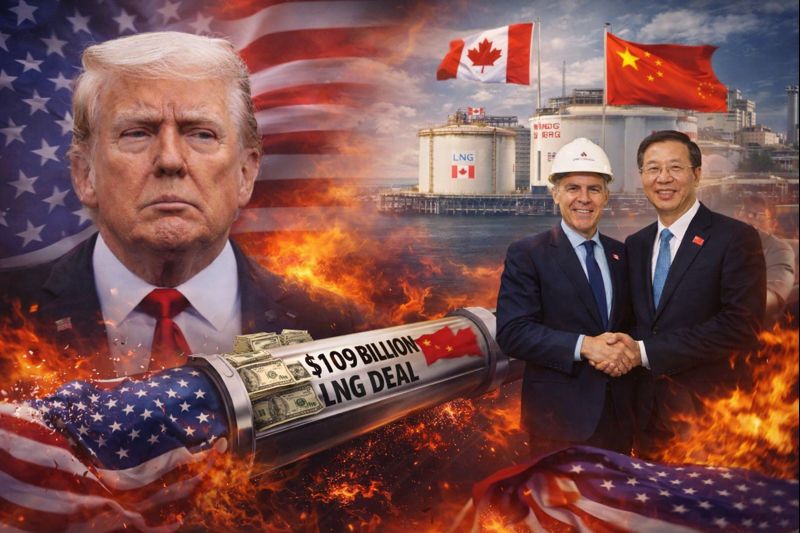
In the frosty dawn of January 2026, as Beijing’s Great Hall of the People hosted handshakes between Canadian Prime Minister Mark Carney and Chinese President Xi Jinping, a profound realignment in North American energy flows quietly took hold. What began as diplomatic niceties during Carney’s landmark visit swiftly crystallized into a memorandum of understanding on energy cooperation, unlocking pathways for massive investments and exports. At its core lies Canada’s ambitious plan to scale liquefied natural gas (LNG) production to 50 million tonnes annually by 2030 — every tonne destined for Asian markets, effectively severing long-standing U.S. reliance on Canadian supplies.
This development arrives amid escalating tensions between Ottawa and Washington. President Donald Trump’s aggressive tariff threats and provocative suggestions of economic coercion — even floating the idea of Canada as a “51st state” — have accelerated Canada’s diversification strategy. For decades, nearly all Canadian natural gas flowed southward through pipelines, cementing American dominance over its northern neighbor’s energy resources. Now, with Pacific-oriented infrastructure rising along British Columbia’s coast, that leverage evaporates overnight.
The $109 Billion Bet: Infrastructure That Redefines Trade Routes
The figure of $109 billion represents the staggering capital investment projected for seven major LNG export projects clustered in British Columbia, from the operational LNG Canada facility in Kitimat to upcoming developments like Cedar LNG, Woodfibre LNG, and Ksi Lisims LNG. These facilities, backed by international consortia including PetroChina, Petronas, Shell, Mitsubishi, and KOGAS, harness British Columbia’s hydroelectric power for one of the world’s lowest carbon-intensity liquefaction processes — a key selling point for China’s air-quality and climate goals.
LNG Canada, already shipping initial cargoes since 2025, exemplifies the model: PetroChina holds a 15 percent stake, ensuring proportional output flows to Chinese buyers. Similar equity arrangements in future projects lock in long-term supply security for Asia, creating path-dependent infrastructure that cannot be rerouted to the United States without massive, impractical reconfiguration. Deep-water Pacific ports enable direct, cost-effective shipments across the ocean, bypassing the Panama Canal routes required for Gulf Coast American LNG.

By 2030, this buildout could capture roughly 18-19 percent of Asia’s projected LNG demand, which is surging as China, Japan, South Korea, and India replace coal with cleaner natural gas. China alone anticipates importing 120 million tonnes annually by decade’s end, driven by urban pollution reduction and industrial needs.
Economic Fallout for the United States: Chaos in the Heartland
The implications for American energy security are immediate and severe. Refineries and industrial users accustomed to steady Canadian feedstock now face potential shortages, volatile prices, and supply disruptions. Pipelines from Alberta and British Columbia, once arteries feeding U.S. markets, stand at risk of underutilization as new export volumes head west. Thousands of jobs tied to cross-border energy flows hang in the balance, while energy companies scramble to adjust strategies in a suddenly hostile continental landscape.
Trump’s response has been predictably volcanic. Administration officials have decried the move as undermining North American unity, warning of regret for Canada’s embrace of Chinese partnerships. Yet the irony is stark: Trump’s own protectionist policies — tariffs on allies, threats of annexation — appear to have catalyzed this exact outcome, pushing Canada toward more predictable, investment-heavy relationships in Asia.
Geopolitical Ripples: A New Era of Pacific Alliances
From Ottawa’s perspective, this represents liberation from American whims. No longer captive to unpredictable trade wars or political tweets, Canada secures stable demand, sovereign partnerships, and economic growth through high-wage jobs in construction and operations. British Columbia’s coastal communities transform into global energy hubs, with supply chains oriented toward the Pacific.
For China, the deal delivers strategic depth: diversified, low-emission supplies from a democratic, rule-of-law nation, reducing dependence on volatile Middle Eastern or Russian sources. Equity ownership ensures influence over production for decades — facilities designed to operate through 2070 and beyond.
The memorandum also opens doors to uranium trade and clean-tech collaboration, signaling a comprehensive energy partnership that spans fossil fuels and renewables. As Carney emphasized, Canada offers reliable, non-coercive trade — a pointed contrast to past experiences with energy weaponization elsewhere.
In this rapidly evolving landscape, the $109 billion pivot stands as a defining moment. What once seemed an unbreakable North American energy bond has fractured under pressure, redirecting vast resources eastward and leaving the United States to confront a diminished role in its own backyard. The full consequences — economic, strategic, and environmental — will unfold over generations, reshaping global power dynamics in ways few anticipated just months ago.