The Phone Call That Changed the Geometry of NATO
For decades, the strategic assumption inside Washington was so deeply embedded that it no longer required explanation. Canada would remain where it had always been: integrated enough to support the United States, restrained enough never to complicate it. The relationship was not viewed as fragile because fragility implies uncertainty. And there was nothing uncertain, American officials believed, about Canada’s place inside the Western alliance system.
That assumption began to change not with a speech or a summit, but with an omission.


Canada had quietly been excluded from a preliminary NATO planning session in Brussels, one of the many procedural gatherings that rarely attract public attention but often determine where future policy eventually lands. Officially, the explanation was administrative. Limited attendance. Scheduling constraints. Internal restructuring.
In Washington, the decision barely registered.
In Ottawa, it landed with unusual force.
The issue was not the meeting itself. Canada has missed alliance discussions before. NATO’s bureaucracy constantly rearranges participation across committees, working groups and strategic consultations. What unsettled officials around Prime Minister Mark Carney was the subject matter under discussion and the message implied by Canada’s absence from it.
The session reportedly focused on evolving interpretations of Article 3 obligations inside NATO — the less discussed but strategically crucial principle requiring members to maintain their own defense capacity before collective defense commitments become credible.
That is where influence begins to crystallize.
Not during televised summits or ceremonial declarations, but during the technical conversations that shape procurement standards, Arctic readiness planning, air-defense interoperability and long-term operational trust among allies.
And Canada was not in the room.


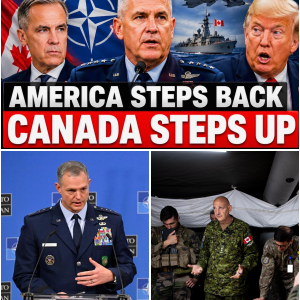
To American officials, the exclusion appears to have been viewed as a manageable signal — a subtle reminder that participation inside the alliance increasingly depended on measurable contributions. Under President Donald Trump, NATO had been framed less as a permanent strategic obligation than as a system of conditional expectations. Burden-sharing became the language of legitimacy.
Canada frequently appeared in those conversations.
Not as an adversary, but as an ally perceived to benefit from security guarantees while failing to meet defense-spending expectations demanded by Washington.
Inside Ottawa, however, the interpretation evolved differently.
The concern was not humiliation. It was structural vulnerability.
If Canada could be excluded from early-stage planning conversations once, then future strategic frameworks could increasingly be designed without Canadian input and later presented as operational realities Canada would simply be expected to implement.
That distinction mattered profoundly.
Because influence inside alliance systems is rarely determined at the end of negotiations. It is determined at the beginning, when assumptions are written into architecture before they become policy.
Publicly, the Canadian government said almost nothing.
Privately, something shifted.
Rather than confronting Washington directly, Carney’s government appears to have concluded that the deeper problem was overdependence on a single channel of strategic influence. If Canada’s access inside NATO could be indirectly constrained through American leverage, then Ottawa needed additional pathways into the Western security system that did not rely entirely on Washington’s approval.
And so, according to diplomats familiar with the discussions, a phone call was placed across the Atlantic.
Not to Washington.
To Berlin.


Under Chancellor Friedrich Merz, Germany has begun behaving differently inside Europe’s strategic order. The cautious post-Cold War model that long defined Berlin’s security posture has steadily given way to something more assertive, more industrial and more independent.
German defense spending has accelerated at levels unseen in generations. Procurement systems are being reorganized around long-term readiness rather than symbolic commitments. More importantly, Berlin has increasingly coordinated with European partners outside the traditional assumption that every major security initiative must originate in Washington.
This does not represent a break from the United States.
It represents diversification.
For Canada, that distinction opened an opportunity.
Officials familiar with the emerging discussions describe the Carney-Merz conversation not as a protest against American influence, but as an exploration of strategic flexibility. The focus reportedly centered on defense-industrial cooperation, aerospace integration and future procurement coordination.
The timing mattered.
Canada’s long-running fighter aircraft discussions had already introduced uncertainty into assumptions surrounding the country’s future defense alignment. While the American-made Lockheed Martin F-35 Lightning II remained central to Canadian planning, Ottawa’s review process had quietly expanded broader conversations about European defense participation.
That alone altered perceptions.
Because in alliance politics, perception frequently moves faster than formal policy.
Once allies begin to suspect that a partner possesses meaningful alternatives, the balance inside negotiations changes immediately, even before those alternatives are fully developed.
Inside Washington, early intelligence assessments reportedly reflected growing attention to the pattern emerging around Canada’s behavior. There was no indication Ottawa intended to weaken ties to the United States. Canada remained fully embedded inside NORAD, the Five Eyes network and NATO itself.
But officials were increasingly observing something harder to categorize.
Canada was not disengaging from American influence.
It was reducing its exclusivity.


That distinction matters because strategic systems built on assumptions of centrality often react most strongly not to confrontation, but to optionality.
Power becomes more complicated the moment it must compete with alternatives.
For decades, Canada’s defense architecture was understood as inseparable from the United States — operationally, technologically and politically. Intelligence sharing, Arctic surveillance, naval coordination and aerospace integration evolved through deeply interconnected systems that blurred the line between partnership and dependence.
The two became almost indistinguishable.
But integration does not eliminate alternatives. It merely increases the cost of creating them.
And Ottawa appears increasingly willing to absorb some of those costs.
What makes the situation particularly difficult for Washington is the absence of any formal rupture. There has been no dramatic declaration, no treaty dispute, no retaliatory diplomatic campaign. Canada has not challenged NATO publicly. It has not threatened withdrawal from any institution.
Instead, it has done something strategically subtler.
It has begun building additional relationships quietly enough to avoid crisis, but clearly enough to alter expectations.
That is significantly harder to counter.
Alliance systems are designed to manage overt disputes. They are less equipped to manage gradual redistribution of influence occurring beneath the surface of official alignment.
The broader European context magnifies the importance of the shift.
Germany, France and several Nordic states have increasingly discussed defense coordination structures capable of operating alongside NATO in areas where European initiative can function without direct American leadership. The goal is not replacement. European leaders understand NATO remains indispensable to continental defense.
But dependence and indispensability are no longer viewed as identical concepts.
For Canada, participation in these evolving networks offers something strategically valuable: access.
Not dominance. Not autonomy in the traditional sense. Access to planning, industrial cooperation and strategic conversations that reduce the risk of exclusion from future architectures shaping the Western alliance.
That is ultimately what the Brussels incident appears to have triggered inside Ottawa’s thinking.
Not anger.
Preparation.
Because countries rarely reconsider their geopolitical assumptions when systems are functioning comfortably. They reconsider them when they sense the possibility — however small — that their relevance could eventually become conditional.
Washington may still possess overwhelming leverage inside the alliance structure. No European partnership can replicate the scale of military integration Canada shares with the United States. Geography alone guarantees a level of permanent interdependence between the two countries.
But strategic relationships are not defined only by geography.
They are defined by options.
And what now concerns many officials on both sides of the Atlantic is not that Canada is leaving the American orbit. It is that Canada has demonstrated its orbit may no longer revolve around a single center of gravity.
That realization changes negotiations before it changes policy.
It changes tone before it changes institutions.
Most importantly, it changes assumptions.
And in international politics, assumptions often matter more than announcements.
Because once allies begin quietly preparing for a world with more than one strategic axis of influence, the architecture of power does not collapse overnight.
It slowly rearranges itself around the possibility that centrality must now be maintained, not presumed.